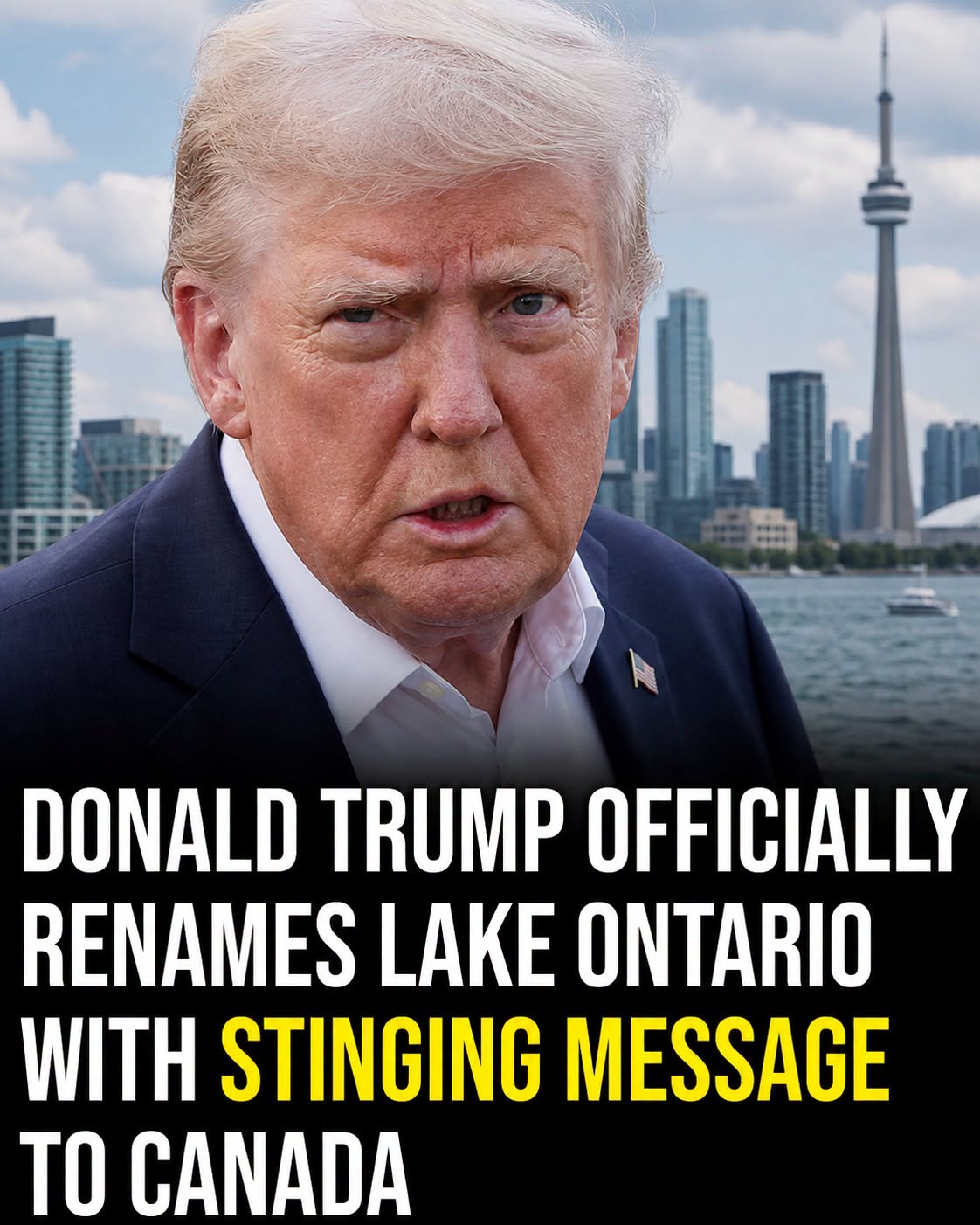
A viral article claims that Donald Trump signed an executive order changing the name of Lake Ontario to “Lake America.” The story describes a dramatic announcement at a podium, an immediate reaction in Canada, objections from Indigenous leaders, and a new source of tension between neighboring countries. The headline is designed to sound definitive, but the claim requires much stronger evidence than the post provides.
Lake Ontario is one of the five Great Lakes and lies between the United States and Canada. Much of its northern shoreline is in the Canadian province of Ontario, while New York borders the lake to the south and east. Its waters, shipping routes, environmental management, and cultural history are shared across an international boundary. That makes the idea of one president unilaterally renaming the entire lake legally and diplomatically complicated.
An American executive order can direct agencies within the executive branch, but it cannot automatically compel Canada, international organizations, mapmakers, or every geographic authority to adopt a new name for a shared body of water. Even inside the United States, official naming decisions involve defined procedures and agencies. The exact text, order number, publication date, and agency guidance would therefore be essential to evaluating the report.
The source excerpt supplies none of those details. It summarizes shock, anger, tariffs, and political reaction without linking to a signed document or quoting a verifiable government notice. That does not prove the story is false, but it means the headline should not be repeated as established fact. A genuine executive order would normally be available through official presidential records and would generate detailed reporting that identifies the document.
The name “Ontario” has deep historical roots. It is generally connected to Indigenous languages of the region and predates the modern political boundaries around the lake. Indigenous nations have longstanding cultural, territorial, and treaty relationships with the Great Lakes. Any serious naming debate would therefore involve more than branding; it would raise questions about heritage, consultation, and whose history is reflected on maps.
Canada would also have an independent position. Geographic names are not merely labels used in speeches. They appear in navigation, emergency planning, environmental agreements, scientific records, legal instruments, and international communication. Two countries can use different names for the same feature, but doing so can create practical confusion and does not erase the name used by the other country.
Readers evaluating the claim should look for several pieces of evidence. First is the executive order itself on an official government website. Second is confirmation from the relevant American naming authority. Third is a response from the Canadian government rather than an unattributed description of outrage. Reporting should also distinguish between a proposal, a symbolic instruction, and a change that has actually entered official use.
The article’s emotional wording is another warning sign. Phrases such as “with the stroke of a pen” and “effective immediately” create urgency while avoiding the procedural questions that determine what changed. The suggestion that tariffs were about to follow adds a second dramatic claim without showing how it relates to a geographic name. Multiple sensational elements can make a story feel important even when its documentation is thin.
Shared landmarks often become symbols during political disputes, which is why a claim like this attracts attention. The Great Lakes are economically and environmentally significant to both countries, and any real policy affecting them deserves careful coverage. That importance is also why readers should demand primary evidence instead of relying on a cropped image or social-media caption.
Until a signed order and official implementation records are produced, the responsible description is that an online source claims Trump ordered the renaming of Lake Ontario. The lake’s established name remains the one used across Canadian, American, scientific, and international contexts. Verification should come before outrage, especially when a headline asserts a major change to a shared geographic feature.