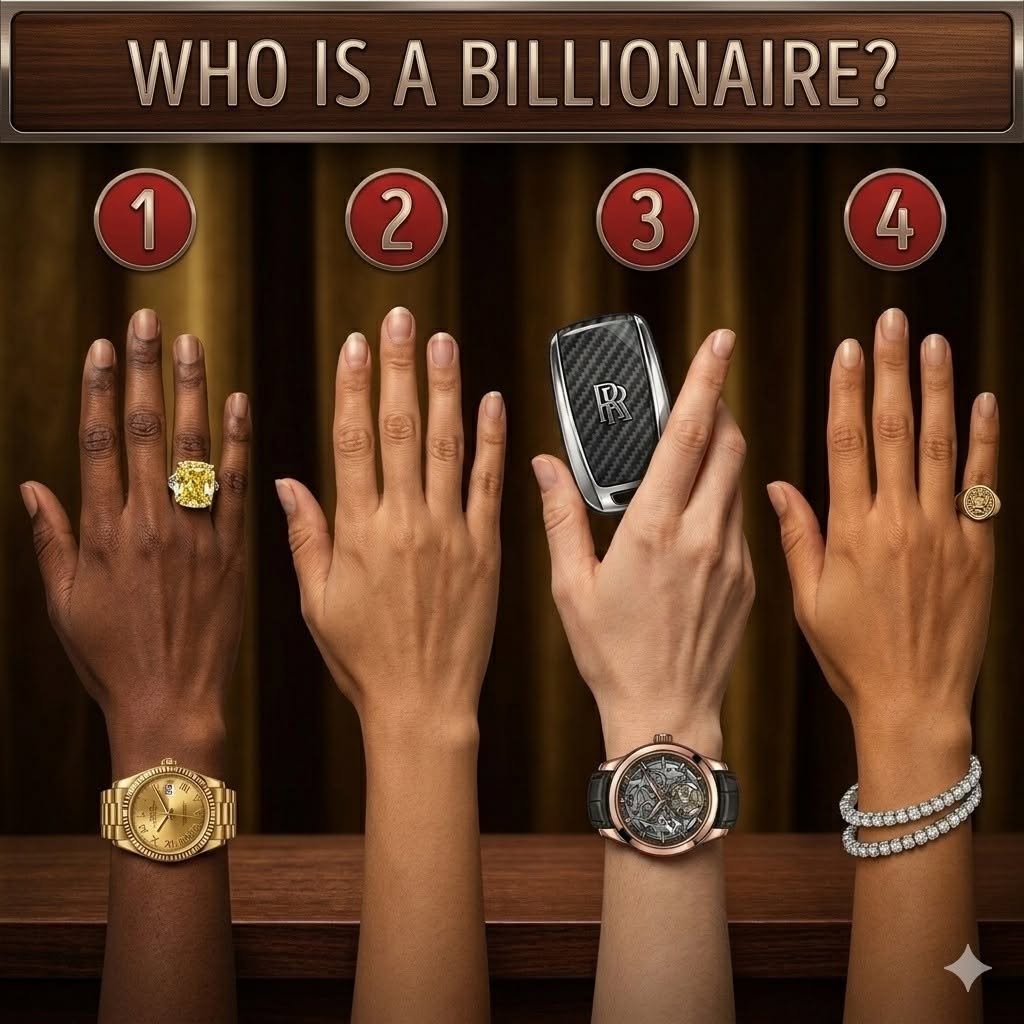
A popular visual puzzle asks viewers to study four hands and decide which one belongs to a real billionaire. The image is designed to make expensive-looking objects compete for attention. One hand carries an oversized diamond ring and a gold watch. Another appears carefully groomed but has no obvious jewelry. A third displays a luxury-car key beside a complicated mechanical watch, while the fourth wears a signet ring and bright bracelets.
The immediate temptation is to choose the person holding the most recognizable status symbol. A Rolls-Royce key, a large gemstone, or a costly watch seems like direct evidence of wealth. That instinct is exactly what makes the puzzle effective. It relies on the assumption that wealthy people advertise their financial position through items that strangers can identify at a glance.
The answer proposed by the linked puzzle is Person Number Two, the hand without flashy accessories. Its explanation uses the idea of “quiet luxury.” According to that interpretation, people with established wealth may value privacy, quality, and restraint more than visible branding. The understated hand is neatly groomed, and its simplicity is presented as a clue that the person does not need jewelry or a car key to prove anything.
That answer is entertaining, but it is not a reliable method of identifying a billionaire. Rich people do not all dress alike. Some enjoy conspicuous diamonds and rare watches, while others wear inexpensive clothes and avoid accessories. A well-groomed hand can belong to almost anyone, and a luxury key can be borrowed, rented, photographed for advertising, or genuinely owned. The image supplies too little information to establish anybody’s net worth.
What the puzzle really tests is not financial knowledge but attention and expectation. Viewers must decide whether to trust the obvious symbols or search for a less conspicuous clue. People who know the familiar “quiet wealth” trope may quickly select the plain hand. Others may focus on the craftsmanship of a watch, the cut of a stone, or the authenticity of the car key. Each approach reveals the assumptions the viewer brings to the picture.
There is also a useful lesson about marketing. Luxury brands often sell more than an object; they sell a story about achievement, exclusivity, and belonging. A recognizable logo allows strangers to read that story instantly. Quiet-luxury marketing works differently. It emphasizes fabric, construction, fit, and insider knowledge. The product may cost just as much, but recognition is limited to people familiar with subtle details.
Online puzzles simplify those two styles into a neat contrast: the person trying to look rich and the person who supposedly is rich. Real life is far messier. Someone may buy one impressive accessory after years of saving. Another person may wear a replica. A wealthy collector may genuinely love bold design, while a person with modest income may prefer clean, understated clothing. Appearance offers clues about taste, not a balance sheet.
The best way to solve the picture is therefore to treat it as a riddle with an intended answer rather than an objective investigation. Compare every hand, list the visible evidence, and notice which detail the creator seems to be hiding in plain sight. If the puzzle emphasizes restraint, Person Two is the expected selection. If it emphasizes material proof, the luxury-car key may appear more convincing.
The exercise can still sharpen observation. Instead of glancing at the largest object, viewers can inspect grooming, wear marks, proportions, and how naturally each item is being held. They can also ask whether any clue could have an alternative explanation. That habit—looking closely and challenging the first interpretation—is useful far beyond a playful social-media image.
So, did the puzzle fool you? The published answer favors the unadorned second hand, but the more honest conclusion is that no photograph of four hands can identify a billionaire with certainty. The fun lies in recognizing how quickly symbols influence judgment and how easily a simple image can turn assumptions about wealth into a debate.