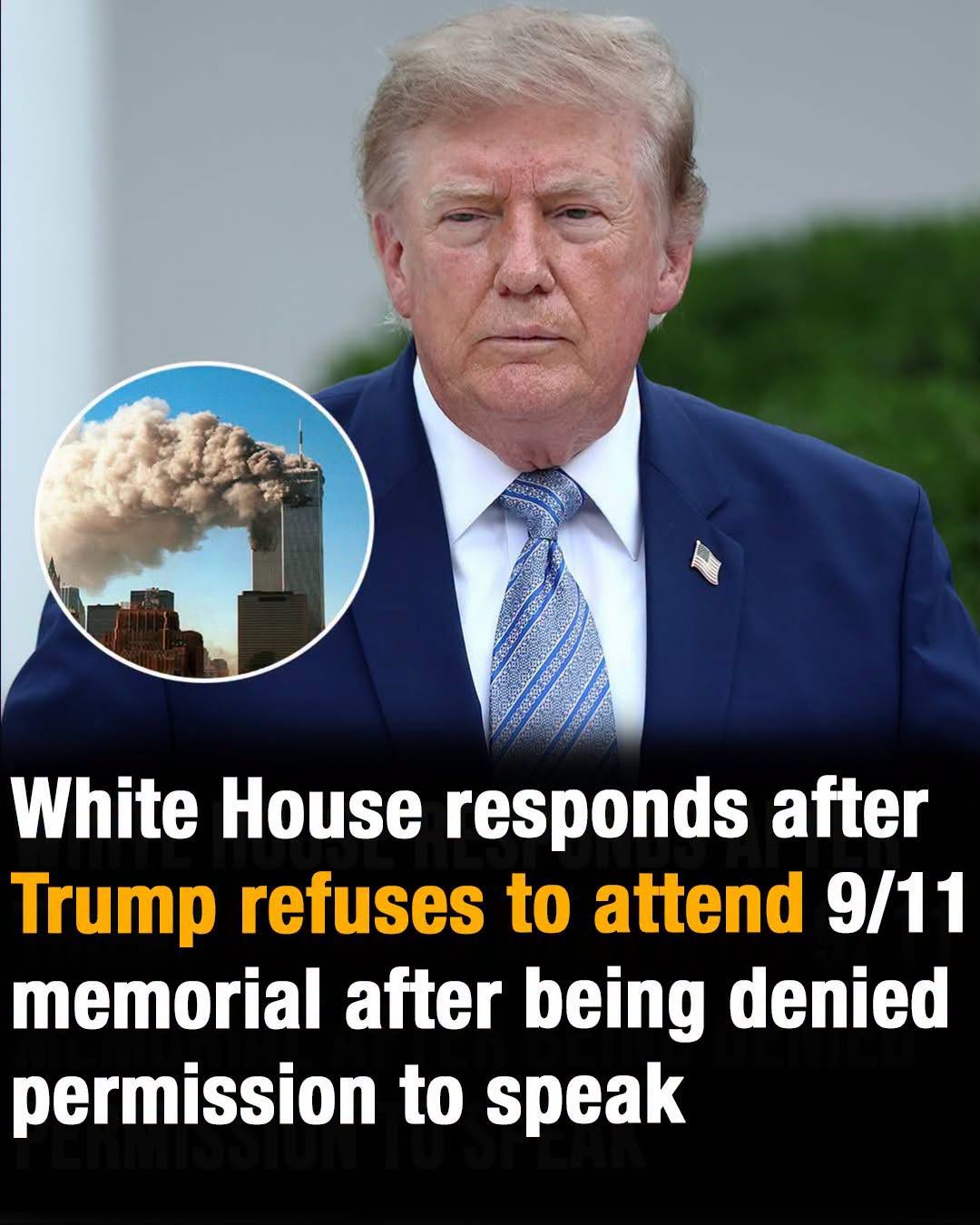
The White House has responded to a report claiming that President Donald Trump will not attend the 25th anniversary commemoration of the September 11 attacks in New York City after being told he would not be permitted to speak.
The report suggested that organizers of the annual ceremony at the National September 11 Memorial and Museum intended to preserve the event’s established format. The remembrance traditionally centers on victims’ relatives reading the names of those who died, with moments of silence marking the times when the hijacked planes struck and when the towers fell. Political figures may attend, but the ceremony has long avoided campaign-style speeches.
Trump strongly denied the claim that he was refusing to appear because he could not address the crowd. He attacked the account and the journalist connected with it, calling the story fabricated. The White House likewise rejected the idea that the president’s schedule reflected a dispute over speaking permission.
Plans reported for the anniversary placed Trump at the Pentagon observance rather than at Ground Zero. Vice President JD Vance was expected to represent the administration in New York, while other senior officials were assigned to the Flight 93 remembrance in Shanksville, Pennsylvania. The arrangement allowed the administration to be present at all three major sites connected with the attacks.
The distinction matters because absence from the New York ceremony does not mean absence from the national commemoration. The September 11 attacks were carried out in New York, at the Pentagon in Virginia and aboard Flight 93, which crashed in Pennsylvania after passengers and crew resisted the hijackers. Each location holds its own memorial events.
The disagreement therefore focused less on whether Trump would mark the anniversary and more on why he would do so at a different site. The initial claim presented the decision as a reaction to the New York event’s no-speech tradition. The president and his team described that interpretation as false.
The anniversary carries particular weight because it marks a quarter-century since nearly 3,000 people were killed. Families of victims have spent decades protecting a commemoration designed around personal remembrance rather than political messaging. At Ground Zero, the reading of names remains the emotional center of the day.
Presidents and other national leaders have attended different September 11 sites over the years, and their schedules can divide attention among New York, the Pentagon and Shanksville. Such decisions often receive close scrutiny because of the symbolic importance of each location.
In this case, the White House’s position was straightforward. Trump was not boycotting the New York memorial because organizers denied him a speaking role. He intended to commemorate the anniversary elsewhere, with members of his administration attending the other ceremonies.
The public dispute added a political argument to a day meant to honor the dead, the survivors, first responders and families whose lives were changed on September 11, 2001. Regardless of where national leaders stood during the observances, the formal commemorations remained focused on the people lost and on the memories preserved at each site.