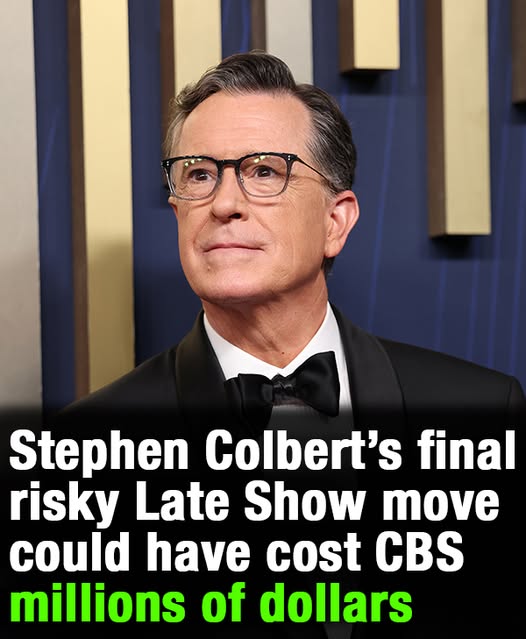
The dramatic final broadcast of The Late Show with Stephen Colbert perfectly illustrated how late-night hosts have evolved from mere network employees into powerful independent brands. When corporate interests and sharp political satire collided, Colbert chose to exit entirely on his own terms.
The Catalyst: The “Big Fat Bribe” Controversy
While CBS officially maintained that the cancellation of The Late Show after its 11-year run was “purely a financial decision against a challenging backdrop in late night,” the timing told a vastly different story.
The network announced the cancellation in July 2025, a mere three days after Colbert used his monologue to aggressively criticize CBS’s parent company, Paramount Global. Paramount had quietly reached a $16 million US settlement to resolve a lawsuit filed by Donald Trump regarding a 60 Minutes interview with Kamala Harris. The settlement raised immense scrutiny, as Paramount was concurrently awaiting federal approval for its highly anticipated corporate sale to Skydance Media.
On-air, Colbert didn’t hold back, calling out his parent network directly:
“I don’t know if anything—anything—will repair my trust in this company. The technical name in legal circles for the deal is a ‘big fat bribe.’“
The remark instantly fractured his relationship with the network executives, making his final broadcast on May 21, 2026, a highly anticipated moment of television history.
The Final Prank: Weaponizing the Peanuts Theme
During his final “Meanwhile” segment, Colbert engineered a brilliant bit of malicious compliance to mock the network’s corporate paranoia. He reported on a real-world headline noting that the owners of the Peanuts animated specials’ catalog had grown incredibly litigious, actively suing entities for using their iconic music without permission.
Right on cue, bandleader Louis Cato and the house band began loudly playing Vince Guaraldi’s famous “Linus and Lucy” theme.
1.The Setup:The News Segment.
Colbert reads a headline detailing how the Peanuts music catalog owners are aggressively suing people for copyright infringement. “Anyone illegally using that music is gonna have to pay through the nose,” he warns.
2.The Trigger:The Band Intervened.
The Late Show band immediately starts playing the forbidden, highly protected Peanuts melody live on air.
3.The Punchline:The Sarcastic Jab.
Colbert looks directly at the camera, breaking the corporate veil of silence with total defiance, and deadpans the defining line of the night: “Oh no, I hope this doesn’t cost CBS any money.”
While internet rumors quickly circulated that this stunt would legally bankrupt the network, industry experts noted that networks utilize sweeping blanket licenses with music rights organizations like ASCAP and BMI. The joke did no actual financial damage to CBS—but the psychological and public relations damage was absolute.
A Star-Studded Declaration of Independence
Colbert’s final hour wasn’t just a corporate roast; it was a deeply affectionate farewell supported by the biggest names in entertainment and late-night comedy. Rather than airing competing broadcasts, fellow late-night hosts like Jimmy Kimmel and Jimmy Fallon intentionally aired reruns or cleared their time slots to ensure all eyes remained on Colbert. On his Wednesday show, Kimmel explicitly told his viewers to watch Colbert’s finale and jokingly added, “Don’t ever watch [CBS] again.”
The final episode featured a massive “wormhole” sketch uniting late-night peers Jon Stewart, John Oliver, Seth Meyers, Jimmy Fallon, and Jimmy Kimmel. The broadcast ultimately concluded with a historic appearance by Sir Paul McCartney, who joined Jon Batiste and Elvis Costello to perform The Beatles’ classic, “Hello, Goodbye.”
Colbert walked off the Ed Sullivan Theater stage having accomplished something rare in modern television: he turned a forced network termination into a masterclass of comedic defiance, leaving with his integrity, his audience, and the definitive last word.
To see a deeper breakdown of the industry shifts, the political tensions, and what this historic exit means for the future of the late-night landscape, you can watch What Stephen Colbert’s exit means for late-night. This analysis explores the fallout between talent and networks following the cancellation.