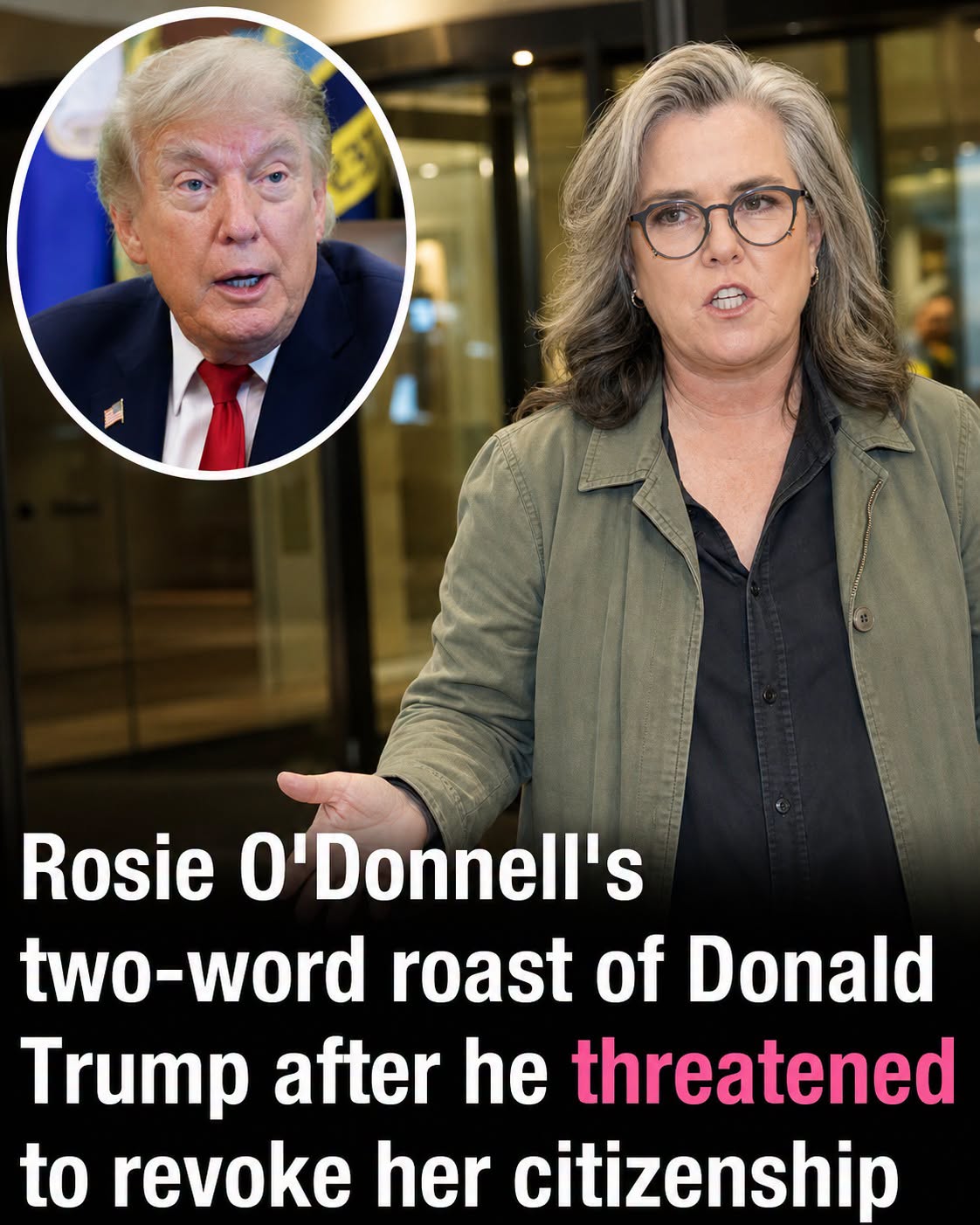
Rosie O’Donnell answered Donald Trump’s threat to consider taking away her United States citizenship with the kind of ridicule that has defined their public feud. Her two-word nickname for him, Mango Mussolini, compressed the response into a joke, but the dispute behind it involved a serious question about presidential power, political criticism, and whether citizenship can be treated as a reward for loyalty.
Trump posted the threat in July 2025, calling O’Donnell a threat to humanity and saying he was giving serious consideration to taking away her citizenship. O’Donnell was born in the United States. Legal experts noted that a president does not have a clear constitutional route to revoke the birthright citizenship of an American merely because she criticizes him. Citizenship is not a license that the executive can cancel over a personal feud.
O’Donnell responded on social media with a photograph of Trump and Jeffrey Epstein and said he appeared rattled. She described herself as a loud, queer mother who tells the truth and argued that she stands against what Trump represents. The language was personal and combative, continuing a clash that began long before Trump entered the White House. The two have traded insults publicly since the mid-2000s.
The comedian had moved to Ireland with one of her children after Trump’s return to power and has discussed seeking Irish citizenship through her grandparents. She presented the move as a decision about safety and values, not a surrender of her identity as an American. Living abroad also did not give the president an additional legal basis to erase citizenship she possessed by birth.
The later television appearance described in the source turned the argument into performance. Wearing a bright pink floral suit while appearing on Jimmy Kimmel Live, O’Donnell joked about leaving after reading Project 2025 and spoke directly toward the camera as though Trump were watching. Mango Mussolini was designed as an insult, joining an orange-colored reference to a comparison with the Italian dictator Benito Mussolini.
The exchange attracted attention because comedy and state power were operating on different levels. A celebrity can answer a political figure with parody, mockery, and sharp opinion. A president’s suggestion that a critic could lose citizenship invokes government authority, even if no lawful process follows. That difference explains why constitutional specialists treated the original statement as more than an ordinary round of name-calling.
American law does provide limited processes involving citizenship, particularly when naturalization was obtained through fraud or when a person voluntarily relinquishes nationality under legally defined conditions. Those situations do not mean a president can personally denaturalize a native-born critic. The Supreme Court has long placed strong protection around citizenship, and political opposition is not a lawful ground for cancellation.
O’Donnell’s answer was not a legal brief. She attacked Trump’s character, called him dangerous, and framed herself as one of millions who oppose him. Supporters saw defiance in the response, while critics viewed it as another inflammatory contribution to a feud that often generates attention for both participants. Either interpretation should remain separate from the legal point: insulting a president does not make a citizen deportable.
The use of Epstein imagery added another layer to the confrontation. Photographs and video have documented past social contact between Trump and Epstein, but an image alone should not be used to claim facts it does not establish. O’Donnell used the association rhetorically to provoke and embarrass him. Her main argument was that Trump’s threat reflected hostility toward dissent rather than a legitimate citizenship case.
The two-word roast became the shareable part of the story because it was vivid and easy to repeat. The more important issue was the premise O’Donnell rejected. American citizenship does not depend on whether the current president considers someone’s speech beneficial to the country. Political leaders can respond to criticism, and citizens can answer them harshly. The Constitution does not turn that argument into a presidential power to decide who remains American.