My daughter vanished at 16 without her phone, her sandals, or any explanation. Eight years later, the first real clue I found was not a message or a police call, but a handmade piece of clothing on a stranger.
My 16-year-old daughter, Nora, disappeared from a crowded beach eight years ago.
She told me she was walking down to the ice cream stand at the far end.
I watched her go.
I remember thinking she’d gotten tall over the winter.
Twenty minutes later, her towel was still on the sand next to mine.
Her sandals were sitting on top of it, and her phone was face-down in her bag.
At first, I was annoyed.
Then worried.
Then terrified.
Lifeguards searched the water.
Police checked the bathrooms, parking lots, hotels, and roads leading away from the beach.
They found the ice cream stand.
Nobody working there remembered seeing her.
They found nothing.
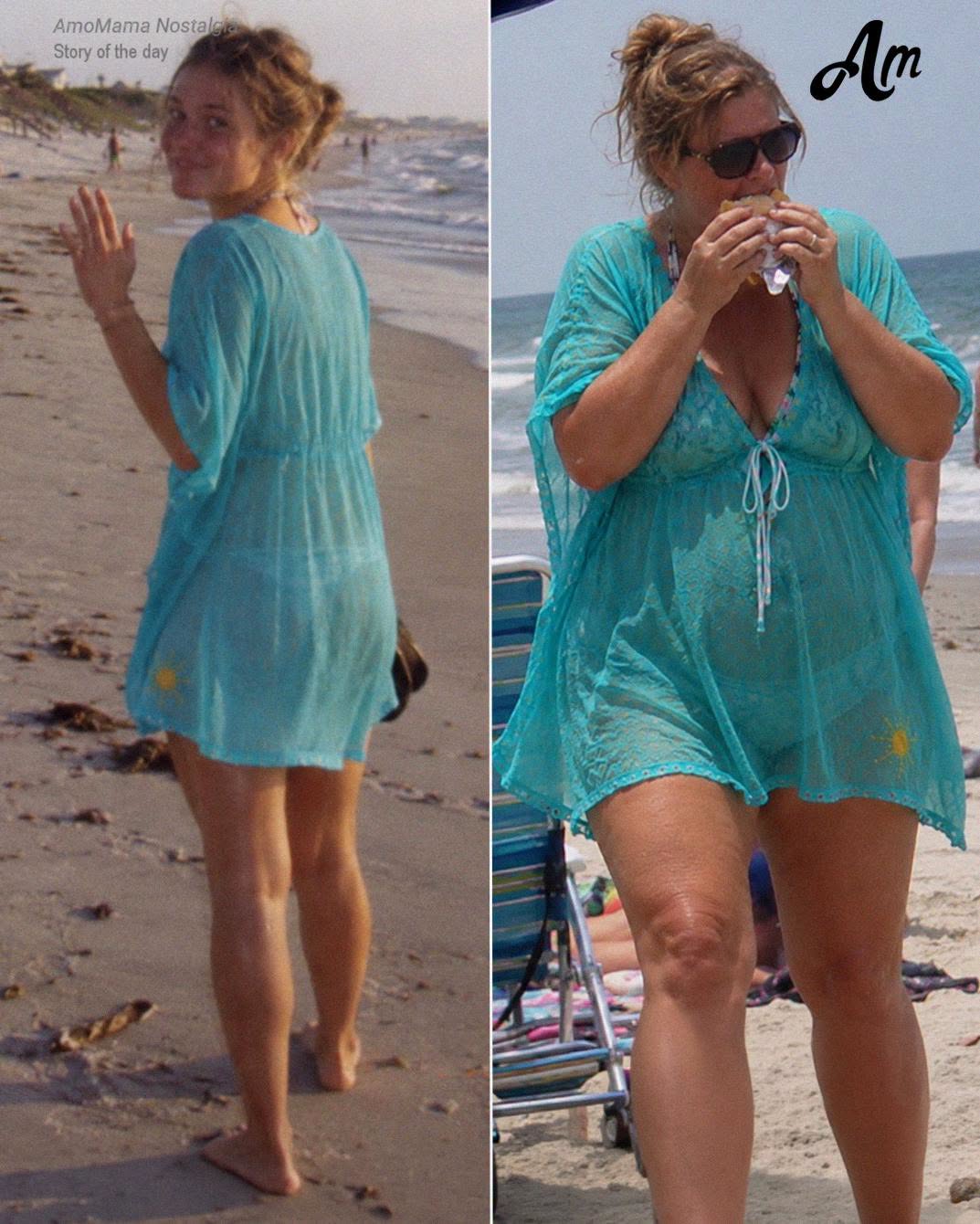
The last thing Nora had been wearing was a turquoise cover-up my mother had sewn for her that spring.
It was light cotton, loose enough to throw over a swimsuit.
My mother had embroidered Nora’s initials, N. V., inside the bottom hem.
On the first day of that trip, Nora caught one corner on a piece of driftwood and tore it.
My mother had been with us.
She patched the tear with a crooked little yellow sun.
Nora laughed when she saw it.
“It looks funny now.”
My mother said, “It looks unique.”
Nora rubbed the stitching between her fingers and smiled.
“I like it better ruined.”
That sentence lived in my head for years.
I had one photo of Nora wearing the cover-up.
I took it about 40 minutes before she disappeared.
She was standing on the sand, squinting into the sun, one hand raised because she was telling me to stop taking pictures.
For eight years, I stared at that photo.
Police enlarged it. News stations used it. Volunteers printed it on flyers.
It all amounted to nothing.
Eventually, the searches stopped.
The calls slowed.
People stopped asking what they could do.
Life kept moving for everyone except us.
My husband, Michael, and I stayed together, although grief changed both of us.
He became quieter.
I became obsessed with details.
Every unidentified young woman in the news.
Every sighting.
Every message from some stranger claiming they had seen Nora in a bus station or grocery store.
Most were nothing.
A few were cruel.
I stopped going to beaches.
I couldn’t hear waves without remembering that afternoon.
So when Michael suggested a weekend in a coastal town almost 600 miles from home, I said no.
Then he asked again.
“It doesn’t have to be about the beach,” he said.
“It is literally a beach town.”
“We can eat. Walk around. Sit somewhere. Leave if you hate it.”
I looked at him.
He looked tired.
We were both in our 40s and had spent eight years arranging our lives around an absence.
So I agreed.
The first day was hard.
I didn’t go near the water.
We walked along the boardwalk instead.
Michael bought coffee.
I pretended not to notice families carrying towels.
Then we passed a cafe with outdoor tables.
A woman stood near the railing talking to one of the servers.
She was maybe 50, maybe older.
She wore a faded turquoise cover-up.
My heart stopped before my brain understood why.
I told myself there must be thousands of turquoise beach cover-ups in the world.
Then the wind lifted one corner.
I saw the yellow sun.
Crooked and hand-stitched.
Exactly where my mother had sewn it.
I crossed the terrace without realizing I had moved.
“Excuse me.”
The woman turned.
“Where did you get that?”
She looked down at herself.
“This?”
“Yes.”
Her expression changed slightly.
“I’ve had it for years.”
“Where did you get it?”
My hands were shaking.
Michael called my name behind me.
I ignored him.
I pulled out my phone.
It took me three tries to open the right photo.
Then I held it up.
Nora at 16, wearing the turquoise cover-up with the yellow sun.
The woman stopped moving.
She stared at the picture.
Then at me.
Then past me.
Her hand closed around my wrist.
“Put that away,” she said quietly. “She can’t know you’re here.”
I felt the world tilt.
“Who?”
The woman’s eyes filled with something I couldn’t read.
Fear, maybe.
Or pity.
Then she whispered, “Nora.”
I turned.
At first, I didn’t see her.
There were too many people.
Then I looked through the cafe window.
A young woman in a black apron was carrying two plates toward a table.
She had dark hair pulled into a low ponytail.
She was thinner than Nora had been.
Older, obviously.
Her face had changed.
But not enough.
I knew my daughter.
My knees nearly gave out.
Michael caught my arm.
“What is it?”
I couldn’t speak.
The woman grabbed my other hand.
“Please don’t go in there.”
“That’s my daughter.”
“I know.”
“She’s alive.”
“Yes.”
Michael followed my gaze.
I felt his whole body go rigid.
“Oh, my God.”
He started toward the cafe.
The woman stepped in front of him. “No.”
Michael looked at her like she was insane. “Move.”
“Please.”
“That is our daughter.”
“I know who she is.”
“Then move.”
I said his name.
He looked at me.
I don’t know why, but something in the woman’s face made me stop.
She wasn’t trying to keep Nora from us forever.
She looked terrified of what would happen if we walked inside.
I asked, “Who are you?”
“My name is Elaine.”
“How do you know Nora?”
She looked toward the window.
Nora was laughing at something a customer had said.
I hadn’t heard her laugh in eight years.
Elaine lowered her voice.
“I used to run a small women’s shelter about 40 minutes from here.”
Michael and I stared at her.
Elaine continued. “Nora came to us four years ago.”
My chest tightened.
“Four years ago?”
“She was 20.”
“Where was she before that?”
Elaine closed her eyes briefly. “Stuck with a man.”
I felt sick. “What man?”
She looked at both of us. “I think we should sit down.”
We went around the side of the cafe to a small patio area where Nora couldn’t easily see us.
I hated every second of it.
I wanted to go inside.
I wanted to touch her face.
I wanted to hear her say “Mom.”
But Elaine kept saying the same thing.
“If you surprise her, she may run.”
That stopped me every time.
She said Nora had arrived at the shelter late one night.
She had no bag, no phone, and barely any money.
She had been frightened, exhausted, and very careful about what she said.
At first, she used another name.
It took weeks before she admitted she had family somewhere else.
Months after arriving, she admitted that she had disappeared as a teenager.
“She told you about us?”
“Eventually.”
“Then why didn’t you call the police?”
Elaine looked at me directly.
“Because she was an adult when she came to me, and because she begged me not to contact anyone.”
Michael’s face hardened.
“You knew she was a missing person.”
“Not immediately.”
“But eventually.”
“Yes.”
“And you did nothing.”
Elaine’s voice stayed calm.
“I encouraged her to contact you. Repeatedly.”
“That’s not the same thing.”
“No. It isn’t.”
I understood his anger.
Part of me shared it.
But another part of me was clinging to the fact that Nora had survived long enough to reach Elaine.
I asked, “What happened to her?”
Elaine glanced toward the cafe again.
“She left the beach with a 19-year-old boy named Caleb.”
The name meant nothing to me.
That somehow made it worse.
Elaine said Nora had been seeing him secretly for a few months.
He lived in another town.
They had met online after Nora lied about her age on a dating app.
Nora knew that Michael and I would never approve of a 19-year-old dating our 16-year-old daughter.
So she hid him.
Caleb had been trying to convince her to spend time alone with him for a while.
On that fateful day, he convinced her to leave the beach with him.
Just for a weekend.
That was what he told her.
They would go away for two days.
A little adventure.
A chance to prove her love for him.
Nora left her phone behind because Caleb said her parents would track it.
She left her sandals because she had been walking barefoot anyway.
She wore the cover-up over her swimsuit and climbed into his car.
I pressed both hands over my mouth.
Michael looked like he might be sick.
“What happened? Why didn’t she come home?”
Elaine was quiet for a moment. “Because he didn’t take her back.”
At first, Nora apparently believed he was just extending the trip.
Then he started controlling where she went.
He held onto her money.
He told her the police were looking for him too now and that if she went home, both of them would be arrested.
Then he started telling her that we hated her.
That we’d never forgive her.
That everyone would think she was stupid.
They moved several times.
Cheap motels, his friends’ apartments, and then another state.
Caleb worked irregular jobs and made Nora work too.
He kept most of what she earned.
When she tried to leave, he threatened her.
Sometimes physically.
Sometimes by telling her he’d make sure she never saw us again.
“He told her he knew where you lived and could harm you if he wanted,” Elaine said.
“Did he?”
“I don’t know.”
Michael stared at the table.
I asked, “How long?”
“Almost four years.”
I couldn’t breathe for a second.
Four years.
My 16-year-old daughter had made one reckless choice.
And then she had spent four years trapped inside it.
“How did she get away?”
Elaine said Caleb was arrested after a fight outside a bar.
Not because of Nora.
Something unrelated.
He had severely injured the other person in the fight.
He was arrested, and Nora took the opportunity to run.
She took the cash he had hidden, left the apartment, and got on a bus.
She ended up near the shelter because another woman at the station told her about it.
“She was afraid he would be released and come after her,” Elaine said.
“Was he?”
“No.”
“Where is he now?”
“I don’t know. Nora hasn’t seen him in years. She hasn’t tried to find out what happened to him.”
Michael said, “Why didn’t she call us then?”
Elaine looked at me.
This was the part I already knew would hurt.
“She was ashamed.”
I started crying before she finished.
Nora believed we would blame her because she had left voluntarily.
She believed we would ask why she stayed.
Why she didn’t escape sooner.
Why she trusted him.
Why she didn’t call.
She believed too much time had passed.
Then another year passed.
Then another.
Elaine helped Nora get her identification replaced.
Helped her find counseling.
Helped her get work.
Eventually, Elaine left the shelter and opened the cafe.
She offered Nora a job.
Nora had been working there ever since.
“What about the cover-up?” I asked.
Elaine looked down at it.
“Nora gave it to me.”
“Why?”
“She was clearing out old things about two years ago. She said she hated looking at it.”
I touched the edge of the yellow sun.
My mother’s stitches.
Elaine’s voice softened.
“She said it was what she wore the day she ruined her life.”
That sentence broke something in me.
“She didn’t ruin her life.”
“She doesn’t believe that.”
“She was 16, and she made a stupid decision.”
“Yes.”
“She didn’t deserve four years of abuse because of it.”
“No.”
I wiped my face.
“Does she know we looked for her?”
Elaine nodded.
“Then why…”
I couldn’t finish.
Elaine did.
“Because knowing you’re loved and believing you deserve to come back are not always the same thing.”
I looked through the cafe window again.
Nora was wiping down a table.
My daughter was 24.
I had missed eight birthdays.
Graduations and milestones she never had.
Jobs, apartments, bad days, good days, and everything.
“I need to see her.”
“You will, but first, let me talk to her.”
Michael leaned forward. “What if she says no?”
Elaine was honest. “Then you need to let her say no today.”
I hated that answer.
But I understood it.
We gave Elaine our hotel information.
Then we left.
Walking away from that cafe while Nora was alive inside it was one of the hardest things I have ever done.
Michael cried in the hotel room.
I had seen him cry before.
Not like that.
“What if she disappears again?”
“She won’t.”
“You don’t know that.”
“No.”
We waited.
At seven that evening, my phone rang.
Elaine said, “She wants to see you.”
Twenty minutes later, we were in a quiet room behind the cafe.
Then the door opened.
Nora walked in.
For several seconds, none of us moved.
She looked at me.
Then Michael.
Her face crumpled. “I’m sorry.”
I crossed the room before I even knew I had moved.
I hugged her.
She went stiff for half a second.
Then she collapsed against me.
She was crying so hard I could barely understand her.
“I’m sorry. I’m sorry. I’m sorry.”
I held her face. “Stop.”
“I left.”
“You were 16.”
“I left with him.”
“You did your best.”
“I should have come home.”
“You are safe now. That’s all that matters.”
She looked at me like she didn’t understand.
Michael wrapped both arms around us.
“We believe you,” he said.
Nora looked at him. “All of it?”
“All of it.”
“You don’t think I was stupid?”
Michael’s voice broke.
“I think you were just 16.”
That was when she really fell apart.
We talked for hours.
Not enough to cover eight years. Not even close. But we started.
We asked her to come home.
She shook her head.
At first, that hurt.
Then she explained.
She had an apartment, a job, friends, a therapist, and savings.
She was planning to take community college classes the following year.
She had spent years learning how to make decisions for herself after Caleb had controlled every part of her life.
Going straight back into her childhood bedroom felt wrong.
“I want you in my life,” she said. “I just don’t know how yet.”
I took her hand. “We don’t know either.”
She looked frightened.
I squeezed harder. “But we’ll figure it out.”
We stayed in town three extra days.
Nora had breakfast with us the next morning. Then dinner.
Then she walked with us along the boardwalk.
She didn’t go onto the sand.
Neither did I.
Before we left, Elaine gave Nora the cover-up back.
Nora stared at it for a long time.
Then she handed it to me. “You keep it.”
“Are you sure?”
She nodded. “I don’t want it for now, but it should stay in the family.”
I folded it carefully.
The yellow sun was faded.
Still crooked. Still there.
It’s been six months now.
Nora calls twice a week.
Sometimes more.
Michael visits once a month.
I probably text too often, but she hasn’t complained yet.
She enrolled in two classes.
She still works at the cafe.
She still sees Elaine.
And she still has difficult days.
So do we.
There is no version of this where eight years disappear because we hugged in a back room and cried.
We missed too much.
She survived too much.
But last week, Nora called me after class.
She was laughing.
She said, “Mom, I think I completely failed this quiz.”
I laughed too.
“Then welcome back to normal life.”
She went quiet.
Then she said, “I like normal.”
So do I.
For years, I thought finding Nora would mean bringing her home.
I understand now that I was wrong.
She already has a home.
What we are building is something different.
A way back to each other.
And for the first time in eight years, I don’t have to wonder whether my daughter is alive.
I know where she is.
I know she is safe.
And she finally knows that one terrible decision she made at 16 never meant she deserved everything that came after.
Parents often say, “You can always come home.” But how do you prove that when your child has spent years convinced they no longer deserve to?
Still in the mood for a good story? Check out this one: The crooked little flower I’d sewn on Olivia’s jacket was the last piece of her I expected to see walking through a grocery store. But yesterday, it passed me on an older woman’s coat and disappeared into the woods. I followed, only to hear my own name spoken aloud by the person who opened the door.