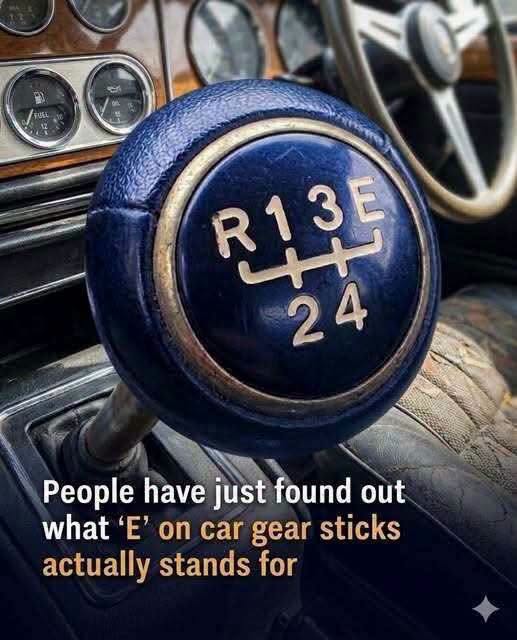
Modern car interiors are dominated by screens, buttons, and electronic controls. But older drivers remember when the gear shifter itself told a story. Alongside familiar letters like “P” for Park and “D” for Drive, some older automatic transmissions featured an unusual “E.” So what did it mean?
In many vehicles from the 1980s and 1990s, “E” stood for Economy. It was designed during an era when fuel prices and efficiency were major concerns. Selecting “E” changed how the transmission behaved, encouraging the car to shift into higher gears sooner and keep engine speeds lower.
The result was smoother, quieter driving and, under suitable conditions, reduced fuel consumption. Economy mode also discouraged aggressive acceleration and frequent kick-down shifts. Instead of responding instantly to a heavy foot, some systems delivered power more gradually, encouraging drivers to adopt a calmer, more efficient style.
Unlike modern cars, many vehicles of that era gave drivers a much more direct mechanical connection to the machine. Moving the shifter into “E” was a physical decision to prioritize efficiency. There were no sophisticated menus or constantly adapting algorithms—just a simple position on the transmission and a noticeable change in driving behavior.
Today, the dedicated “E” position has largely disappeared. Modern engines, transmissions, fuel injection systems, aerodynamics, and low-rolling-resistance tires are engineered for efficiency from the beginning. Computer-controlled transmissions can constantly adjust shift points without requiring the driver to select a special economy gear.
The idea, however, never disappeared. Modern vehicles often include an Eco driving mode that electronically manages throttle response, transmission behavior, air conditioning, and other systems. What once required a physical movement of the gear lever can now happen automatically in the background.
Interestingly, the letter “E” has gained new meaning in the electric-car era. It can refer to electric propulsion, electronic controls, or features such as e-Pedal driving and regenerative braking. The symbol has evolved from saving gasoline to representing an entirely different approach to transportation.
That old “E” therefore represents more than a forgotten gear position. It marks a transition from mechanical control to computerized efficiency. The physical lever may have disappeared, but its purpose remains: helping vehicles travel farther while using less energy. The technology changed, but the goal stayed remarkably consistent.
The older Economy setting also illustrates how a small control can communicate a larger engineering choice. A driver moving the lever to E was selecting a calmer pattern of acceleration and earlier shifts. The response could be noticed through lower engine speed and a less eager kick-down, making the connection between a control and the vehicle’s behavior relatively easy to understand.
The transition to electronic Eco modes changes how that choice is presented. Instead of a dedicated position on a lever, a modern system may coordinate several functions through a selected mode. The account links that development with the broader move toward computerized efficiency. The underlying aim remains familiar even when the control itself looks different.
Remembering the older letter is therefore a way of tracing continuity in car design. Drivers have long been offered ways to favor economical operation over a more aggressive response. The old E position expressed that preference through a simple mechanical interface. Its successors express a similar goal through electronic management and increasingly integrated vehicle systems.