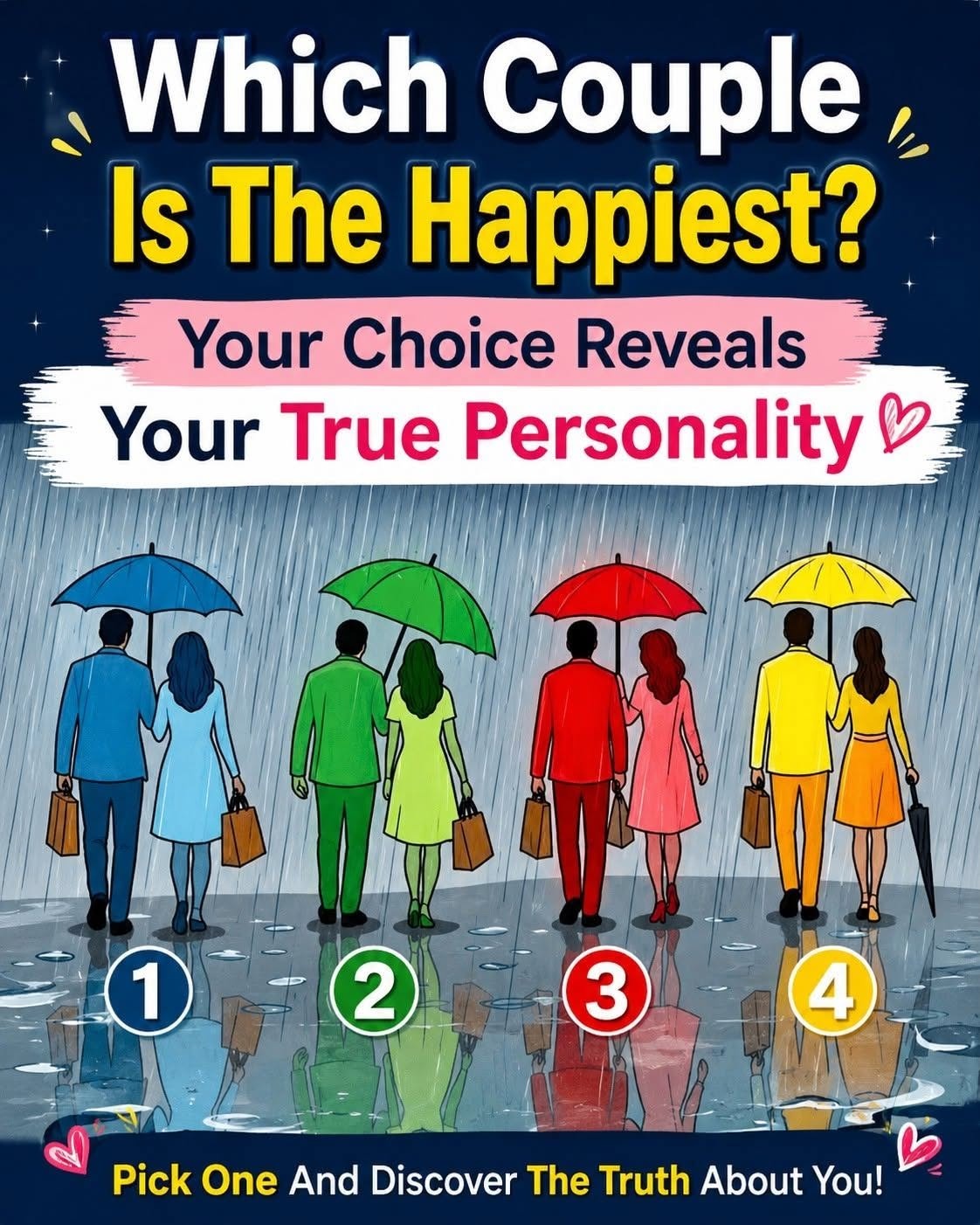
A colorful image asks viewers to choose which of four couples appears happiest while walking in the rain. The exercise is presented as a personality test, with each color connected to a different relationship style. It can be an enjoyable prompt for reflection, but it is not a scientific psychological assessment and cannot determine the actual quality of any relationship.
Couple number one is shown in blue. People drawn to this pair are described as valuing calm, loyalty, emotional safety, and dependable partnership. The couple walks closely beneath an umbrella without dramatic gestures, suggesting a relationship built through consistency rather than spectacle. The umbrella becomes a symbol of protecting one another during difficult periods.
Choosing blue may mean that peace and trust feel more important to you than constant excitement. You may prefer quiet evenings, patient conversations, and commitments demonstrated through repeated action. The interpretation also suggests a possible weakness: loyal people sometimes remain too long in unhealthy situations because leaving feels like failure.
Couple number two wears green, a color associated in the test with growth, healing, renewal, and adaptability. Their relaxed appearance attracts viewers who believe healthy partners should encourage one another’s development. Happiness is not imagined as remaining unchanged but as learning together through different seasons.
A green choice may reflect compassion and optimism. You might naturally support another person’s goals and look for the best in people. The caution is that helpers can neglect their own needs or forgive behavior without requiring meaningful change. Growth works best when both partners contribute rather than one person carrying the emotional labor.
The third couple appears in red, the strongest visual color. This selection is linked with passion, romance, intensity, and open affection. People whose eyes go immediately to red may want love to feel powerful and unmistakable. They are often described as devoted and protective, with little interest in emotionally distant partnerships.
Intensity can create memorable closeness, but it can also make conflict feel overwhelming. The red interpretation warns against expecting another person to express emotion at exactly the same volume. A quiet partner is not necessarily less committed, just as dramatic chemistry does not automatically create stability.
Couple number four is yellow, associated with optimism, confidence, creativity, and independence. This pair seems to create brightness inside a gray, rainy scene. People choosing them may admire relationships in which both individuals retain a strong identity while still offering companionship.
The yellow interpretation emphasizes humor, resilience, and freedom from control. Its suggested weakness is the tendency to hide pain behind cheerfulness or postpone serious conversations because negativity feels draining. Optimism supports a relationship when it makes difficult work possible, not when it is used to avoid that work.
A person who cannot choose may simply be analytical or skeptical of judging happiness from appearances. That response can be emotionally mature. Body language, clothing, color, and one frozen moment cannot reveal trust, respect, safety, or private conflict. The couple who looks closest in an illustration is not automatically the healthiest.
Current mood also shapes a choice. Someone recovering from conflict may notice the calm blue pair; a lonely viewer may focus on romantic red; a person beginning a new chapter may prefer green; and someone feeling controlled may be drawn to independent yellow. The result may describe what you need today more than a permanent personality trait.
The value of this image is therefore conversational rather than diagnostic. It can help someone name the qualities they associate with love—stability, growth, passion, or freedom—and compare those ideals with real behavior. Happiness cannot be proven by an umbrella or a color. It is built through honesty, safety, shared responsibility, affection, boundaries, and the freedom for both people to be fully themselves.