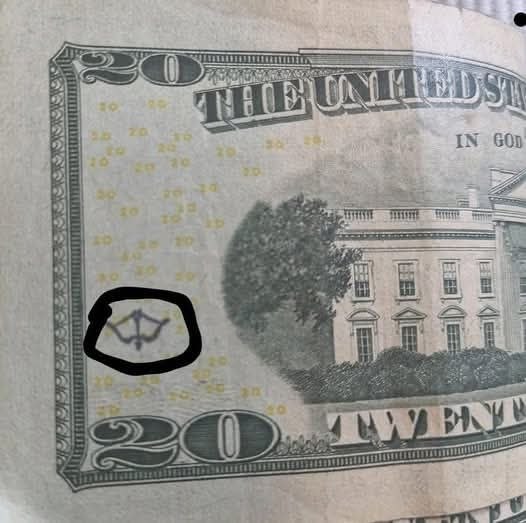
If you have ever taken a moment to closely look at a crisp United States dollar bill under a bright lamp, you might have spotted a tiny, unfamiliar icon, a weird ink stamp, or an abstract pattern that clearly doesn’t fit the official government look. Many people across the nation have come across these odd marks, which often look like a miniature bow and arrow, a small star, or a complex foreign symbol quietly inked into the edge of the paper money. At first glance, finding one of these unofficial markings can feel very mysterious, or even creepy, as if that specific bill is carrying a coded note or hiding a deep, underground plot.
The interesting truth behind these cryptic signs is far from random damage or a secret government scheme. Instead, these ink shapes are known in global financial circles as chop marks. They are tiny, purposeful signatures put directly on paper money by professional money changers, big-time sellers, global banks, and independent cash handlers working in faraway foreign markets. When a U.S. dollar leaves American soil and enters world circulation, it often lands in areas where fake money is a very high-tech and common threat. In these fast-moving global shops, seeing and feeling proof of value is vital for survival.
When a skilled foreign money changer gets a hundred-dollar bill or a twenty-dollar bill, they put the paper through a tough check, testing the feel, the watermarks, and the security strips. Once they are totally sure the bill is 100% real, they press their own unique ink stamp, like a bow and arrow or a geometric crest, onto the face of the note. This stamp acts as a silent, permanent thumbs-up. It sends a clear message to the next seller or bank worker who handles the cash, confirming that the bill has already been carefully checked and judged fully real by a trusted pro. This simple setup saves a ton of time and greatly cuts financial risk in busy global markets where high-stakes deals happen every single second.
The cool tradition of using chop marks actually goes back several hundred years, long before modern paper money was made. The habit started on ancient trade paths, mainly across China and East Asia, where sellers regularly dealt in silver coins, bars, and foreign trade dollars. To make sure a silver coin hadn’t been secretly hollowed out, shaved at the edges, or mixed with cheap metals, a merchant would punch a unique physical mark or symbol right into the metal’s surface after checking its weight and purity. The word “chop” itself comes from this old trade lingo, meaning an official seal, stamp, or mark of truth. As global trade grew fast and paper notes slowly replaced heavy metal coins as the main way to pay, this deep habit of physical checking moved right over to paper cash.
Because the U.S. dollar has long worked as the unofficial global reserve cash, taken and actively used in almost every single corner of the planet, it naturally became the most stamped and marked money in human history. A single dollar bill can spend years moving through various shadow economies, fancy exchange booths, and country markets across South America, Asia, Africa, and the Middle East before finally heading back to a bank in the States. Each individual chop mark pressed into the paper represents a unique stop in that bill’s grand trip. It reflects a specific moment in time when that exact piece of paper cash passed through another foreign economy, changed hands in a different culture, and successfully moved through a complex system of human trust built on personal experience rather than modern scanning tools.
This global trend often sparks questions about the legality of using these heavily stamped bills back home in America. While federal law strictly forbids damaging U.S. money to the point that it becomes badly warped, torn, or totally unusable, the presence of standard chop marks doesn’t cross that legal line. Because these tiny ink stamps don’t change the bill’s official value, hide the vital serial numbers, or ruin the main security features, they don’t make the cash invalid as legal tender. The bill is still fully backed by the U.S. government and keeps its exact face value.
However, carrying a heavily stamped bill can sometimes cause a few small, daily hassles for regular buyers. Automatic vending machines, self-checkout spots at grocery stores, and electronic parking meters are very sensitive to unexpected ink patterns and might keep spitting out a chopped bill simply because the sensors see the odd mark as a printing mistake or a fake money red flag. Also, some very careful bank workers or local shop clerks who know nothing about the global history of chop marks might check the bill with extra focus or ask for a different way to pay just to be safe.
Despite these occasional bumps, these unusual marks don’t lower the real value of the money. Instead, they add an invisible, incredibly rich layer of world history to a plain piece of daily paper. Finding a bow and arrow stamp turns a normal, boring dollar bill into a seasoned, quiet traveler that has successfully crossed world borders, survived risky foreign markets, and linked different cultures and money systems. It carries physical, undeniable proof of exactly where it has been and how it earned the trust of strangers half a world away, turning a simple tool of trade into a cool historical object that you can hold right in your hand.