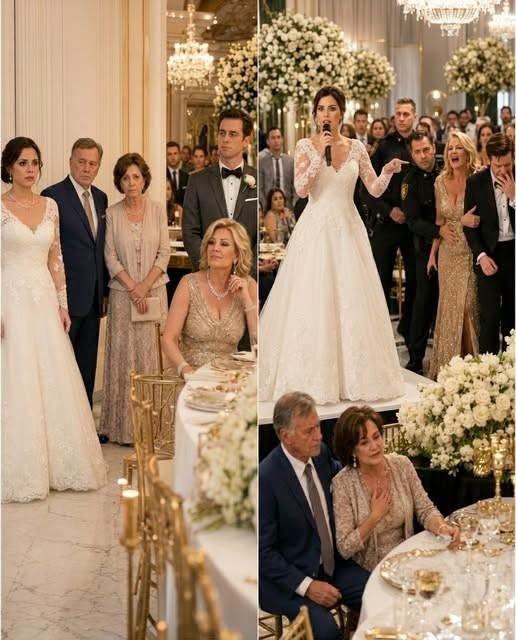
Elena entered her wedding ballroom expecting to see her parents at the main family table she had arranged for them. Instead, they stood against a wall while all nine seats were occupied by her fiancé Victor’s relatives. Her mother clutched an old pearl purse, and her father wore the brown suit he had saved for months to buy. Their place cards had been removed.
Victor’s mother, Celeste, admitted changing the seating plan. Dressed in champagne silk, she announced that the main table needed to look respectable in photographs and said Elena’s parents looked poor. Several guests laughed. Elena waited for Victor to defend the people he had once called Mom and Dad. He told her not to make a scene and agreed that optics mattered.
Celeste added that Elena was lucky to have married into their social circle. For six months, the family had treated her like a grateful outsider who was being elevated by Victor’s status. They mistook her quietness for shame about her background and never showed enough interest to learn who had actually organized and paid for the celebration.
They missed several clues. The venue manager called her Ms. Moreau. Every contract—from flowers to catering—carried Elena’s signature alone. Victor’s family also never asked why staff deferred to her when decisions were required. The ballroom, estate, and event were controlled by Moreau Enterprises, a company Elena owned.
After seeing her father lower his eyes, Elena stopped protecting Victor’s image. She asked the planner for a wireless microphone and walked to the center of the dance floor. Cameras were already pointed toward her, the sound system was live, and the room quieted as guests expected a conventional welcome from the bride.
Elena began by agreeing with Celeste that appearances mattered. She explained that her parents deserved to be honored in a space reflecting their value. Then she informed the guests that Victor’s family had not purchased the venue or paid for the wedding. Elena had bought the estate three years earlier and was hosting everyone through her own company.
The revelation stripped away the status story Victor and Celeste had constructed. Elena was not marrying upward, and her parents were not charity cases standing inside someone else’s world. Victor’s tailored tuxedo and his mother’s expensive dress gave them no authority over the building, staff, or woman they had chosen to humiliate.
Elena then announced that the wedding would not proceed. Guests could remain for the meal because it was already paid for, but Victor, Celeste, and their immediate family were no longer invited. As the owner of the property, she formally revoked their access and signaled security to escort them out.
The decision was larger than revenge over a table. Victor had demonstrated, before the marriage legally began, that he would join his mother in degrading Elena’s family whenever social approval was at stake. He did not merely fail to intervene; he agreed with the insult and asked Elena to smile so photographs would remain convenient.
By ending the ceremony, Elena refused to build a marriage on contempt. Her parents’ modest clothing represented years of work and sacrifice, not a lack of worth. The public announcement cost Victor the wedding, the status he expected to gain, and the illusion that wealth belonged to him. Elena’s last word restored the only optics that mattered: her parents standing beside a daughter who would no longer permit anyone to treat them as invisible.
The guests’ dinner continuing without the groom emphasized Elena’s control of the situation. She did not destroy the celebration or waste the staff’s work. She removed the people whose behavior made the marriage impossible and allowed everyone else to witness the truth. The same microphone Victor wanted used for appearances became the instrument that ended his deception.
Most importantly, Elena acted before vows made the conflict harder to escape. Public humiliation revealed a private value system: Victor valued approval from his mother and wealthy guests above basic loyalty. Walking away at the ballroom was painful, but it prevented years of being told to tolerate cruelty for the sake of family image.