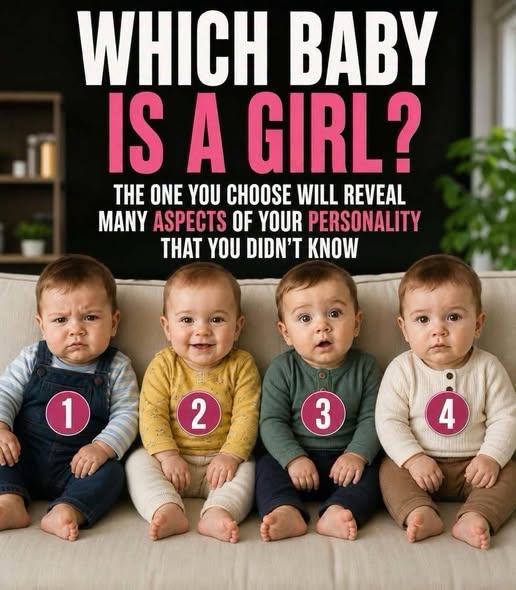
Four baby photographs and one question have circulated online: which baby is a girl? The puzzle invites people to study faces, clothing, expressions, and posture as if one image contains a reliable answer. In reality, it does not.
Babies do not have facial features that allow a stranger to determine their sex or gender from a photograph. Hair length, cheeks, eye shape, and expressions overlap completely. Clothing may reflect a parent’s choice, a cultural convention, or nothing more than what was clean that morning.
The game works because people bring assumptions to the pictures. A calm baby may be labeled a girl, while an active expression may be labeled a boy. Pastel colors, blankets, bows, or neutral outfits trigger learned associations even when they provide no biological information. The answer often reveals more about the observer’s expectations than about any child shown.
Those expectations begin early. Adults may describe the same behavior differently depending on whether they believe a baby is male or female. A strong grip becomes “tough” in one child and “determined” in another. Crying may be treated as sensitivity or fussiness. The baby has not changed; the interpretation has.
Confirmation bias strengthens the effect. Once someone chooses one photograph, the mind starts collecting details that support the decision and ignoring details that do not. A tiny expression begins to look obviously feminine or masculine only because the viewer has already committed to an answer.
The puzzle also resembles personality tests that use broad descriptions. If an explanation says a choice shows compassion, independence, or attention to detail, many readers will recognize themselves in it. This is related to the Barnum effect, in which general statements feel personally accurate because they are flattering or flexible enough to fit many people.
That does not make the puzzle harmful by definition. It can be a light visual game, especially when everyone understands that the result is not scientific. It may even be useful as a demonstration of how quickly the brain forms a confident judgment from limited evidence.
Problems arise when such guesses are presented as psychological facts. A photograph cannot diagnose personality, measure empathy, or reveal hidden character. Nor can a viewer’s choice establish anything reliable about the babies. Claims that one answer proves intelligence or another exposes a flaw are entertainment, not assessment.
There is also a respectful way to discuss the images. The children should not be turned into examples of rigid stereotypes. Gender identity is more complex than appearance, and infants cannot communicate how they will understand themselves later. Assigning meaning to a face because it seems soft, bold, serious, or playful says little about the individual.
If the original poster has supplied an answer based on information outside the picture, that answer may identify which child was known to be a girl. It still does not mean viewers could logically derive it from appearance. A correct guess remains a guess.
The most honest response is therefore simple: the photographs alone do not contain enough information. People can choose for fun, compare their reasons, and notice which visual cues influenced them. The interesting result is not a hidden truth about four babies. It is the speed with which ordinary cultural assumptions can feel like evidence.
Parents often see how unstable those assumptions are when strangers address a baby differently after noticing a pink blanket or blue hat. The same face suddenly receives different adjectives and expectations. Using the puzzle as a mirror can make the game more worthwhile: rather than defending a guess, ask which clue felt persuasive, where that association came from, and whether it would still seem meaningful if the clothing colors were exchanged.