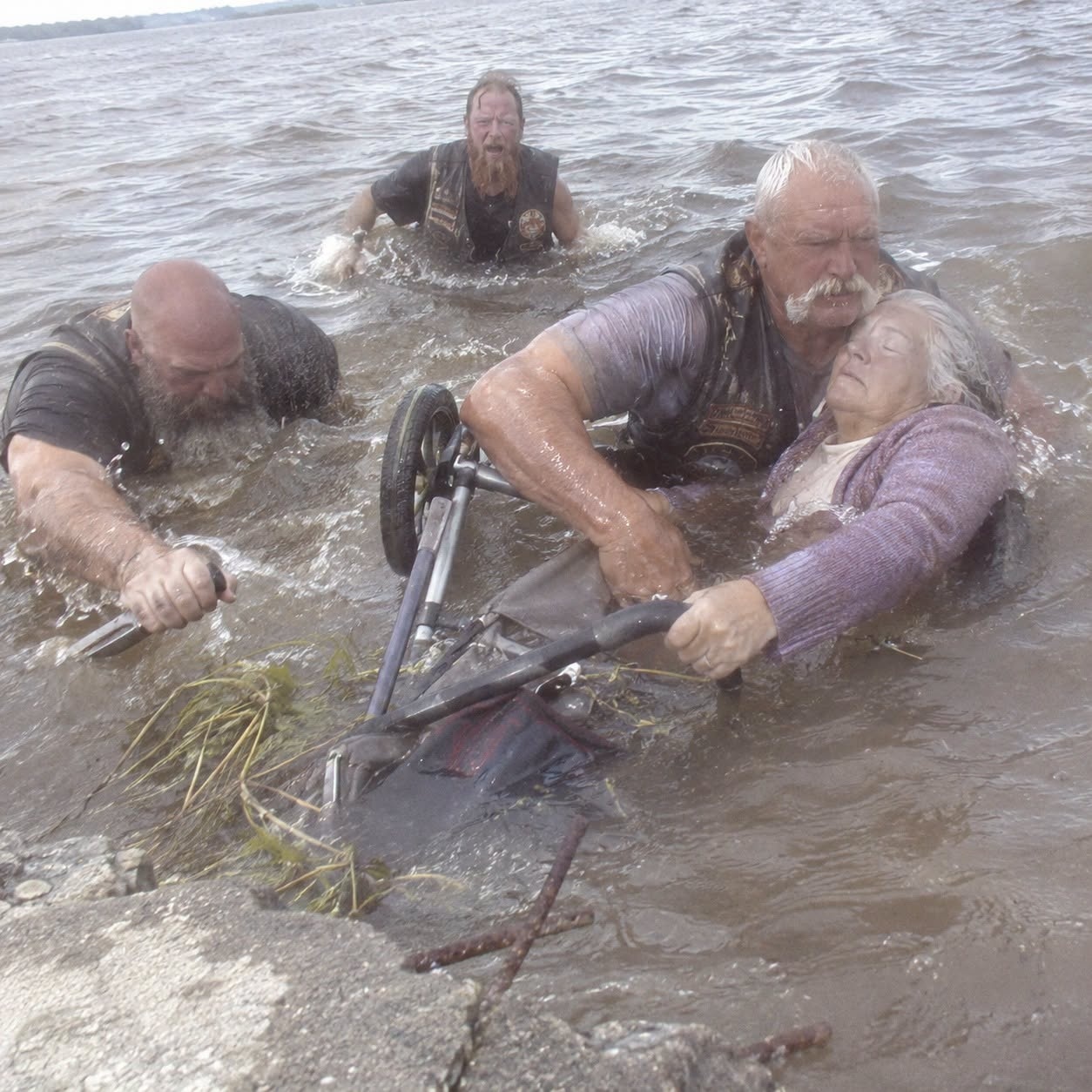
We were rolling past the boat ramp at Pomme de Terre Lake when I saw a stroller wheel spinning above the water.
Just the wheel. Still turning slow, like somebody had just let go of it.
Then I saw the gray hair floating next to it.
I’m 64 years old. I’ve got a bad knee and a worse back. But I dumped my Road King in the gravel and hit that water running.
The ramp drops off fast. Six feet out, I couldn’t touch bottom.
The grandmother was face down, both hands locked on the stroller handle. She was out cold, and she still wasn’t letting go.
And the stroller was upside down. With a two-year-old still buckled inside it.
I grabbed the frame and pulled. Nothing. The harness strap had wrapped around a piece of rebar sticking out of the old concrete, and every time I yanked, the whole thing sank deeper.
“Tank! Knife!” I yelled.
Tank is 300 pounds and swims like a rock. He came in anyway. Dutch and Rooster came right behind him, boots and all.
Tank went under with his buck knife. I held the grandmother’s head up. Rooster was screaming at a woman on the shore to call 911.
It took maybe forty seconds. Felt like forty years.
When the strap finally snapped loose, Dutch flipped that stroller and I saw her face. A tiny little girl in a pink jacket. Her lips were blue.
We dragged them both up on the ramp. Dutch started CPR on the baby. He was a medic in the Army. Two fingers on that little chest, counting out loud.
The grandmother coughed up half the lake and opened her eyes. I thought she’d reach for the baby.
She didn’t. She grabbed my vest with both hands and stared past me, back at the water. Then she screamed something that turned my blood cold.
“Where’s Caleb? He was holding the stroller with me. My grandson was right here!”
I looked at the water. Flat. Brown. Nothing on it but a little blue ball cap turning in slow circles about twenty feet out.
There had been another kid the whole time, and none of us had seen him.
“How old?” I said, and I had to shake her a little to get her eyes on me. “Ma’am. How old is he?”
“Six. He’s six. He can’t swim, he can’t swim, oh God, he went in after her, he went in after the stroller…”
I was already moving. Behind me I heard Shorty, the fifth man in our group, still up on the road with the bikes, yelling to the woman on her phone that there was a second child in the water. I heard Dutch’s voice not stopping for anything. Twenty-eight, twenty-nine, thirty. Two breaths. Come on, baby girl. Come on.
I went back in to my chest and then past it, and the cold of that lake in late October grabbed my lungs and squeezed. Rooster came in on my left. Tank was still standing knee deep, gasping and holding his side, because a man that size doesn’t go underwater twice in a minute without paying for it.
“Spread out!” I yelled. “Feel with your feet!”
That’s what you do when you can’t see. You walk the bottom and you pray you kick something soft.
I went under with my eyes open and saw nothing but brown. Came up. Went under again. My knee was screaming. My boots felt like they were full of concrete, because they were full of lake.
Rooster came up blowing and shaking his head. Nothing.
That’s when I noticed the dock.
The marina had one of those floating courtesy docks running alongside the ramp, the kind that sits on big plastic barrels with maybe a foot and a half of dark space between the water and the boards. The ball cap had drifted right up against it.
And I swear on my brother’s grave, I heard something under there. Not a scream. A tiny wet hiccup, the sound a kid makes when he’s been crying so hard he’s run out of air to cry with.
“Under the dock!” I hollered.
I pulled myself along the edge of it hand over hand until I got to the spot. Then I took the biggest breath of my life and ducked under.
I want you to understand how dark it is under one of those things. The boards block the sky. The barrels make walls on either side. You come up into a pocket of air that smells like rot and gasoline, and you can’t see your own hand.
But I could hear him breathing. Fast and shallow, right in front of me.
“Caleb,” I said. My voice bounced around in there like we were inside a drum. “Caleb, buddy. I’m here to get you.”
The breathing stopped. He was holding it. Hiding from me.
My eyes started to adjust, and a little gray light was coming through the cracks between the boards. I could make out a small white face maybe three feet away. He had both arms wrapped around one of the metal cross braces, hugging it the way you’d hug a tree in a tornado. His chin was just barely above the waterline.
He was looking at me like I was the monster that lived under the dock.
And I guess I can’t blame him. Picture what he saw. A big wet stranger with a gray beard down to his chest and a leather vest with a skull patch on it, rising up out of the black water in a place where nobody should be.
“I’m not supposed to talk to you,” he whispered.
That about broke me.
“I know, son,” I said. “Your grandma told you not to talk to strangers, right? She’s smart. She’s right. But your grandma’s the one who sent me. She’s up on the ramp right now and she’s yelling your name. You hear her?”
We both went quiet, and through the boards over our heads you could hear her. Caleb! Caleb! Over and over, in a voice that was almost gone.
His face crumpled.
“Lily went in the water,” he said. “I tried to grab her. I grabbed her but she was too heavy and then I was in the water too and I couldn’t find the bottom.”
“I know. You did good. You did real good. You hung on.”
“Is Lily dead?”
I didn’t know. Up on that ramp, a man I’d ridden with for nineteen years was pushing on her chest, and I didn’t know if she was coming back.
So I told him the only true thing I had.
“There’s a man up there right now who’s an Army medic, and he’s taking care of her. He’s the best there is. But she’s gonna want her big brother when she wakes up. And I can’t get you out of here unless you let go of that pipe and hang onto me instead.”
He shook his head hard. His teeth were chattering so bad I could hear them clicking.
“I’ll go under,” he said. “I can’t go under.”
He was right that we’d have to. The only way out was down and sideways, about four feet underwater, past the edge of the barrels. For a six-year-old who’d just nearly drowned, that might as well have been four miles.
I’ve thought a lot since then about what made him finally trust me. I think it was the next thing I said, which I hadn’t planned to say, and which I hadn’t said out loud to anybody in a long, long time.
“Caleb, when I was a little bit older than you, my baby brother fell in a pond. And I was scared, just like you’re scared now. And I didn’t go in after him because I couldn’t swim.” I had to stop for a second. “So after that I learned how. I learned real good. I learned so I’d never have to be scared of the water again. You understand? I’m the best swimmer you’re ever gonna meet. You hold my neck and close your eyes and count to three, and when you open them, we’ll be out.”
He looked at me for a long time.
Then one of his little hands let go of the pipe and grabbed a fistful of my beard.
“One,” I said. “Two…”
I didn’t wait for three.
We came up out of that hole into the daylight, and the first thing I heard was the most beautiful sound God ever made.
A baby screaming her head off.
Lily was alive. She was on her side on the concrete with Dutch kneeling over her, and she was coughing up lake water and wailing with everything in her little body. Dutch had his hand on her back, and his shoulders were shaking, and I realized he was crying too. Dutch, who did two tours. Dutch, who I’ve never seen so much as wince.
Rooster took Caleb out of my arms and carried him up the ramp. I couldn’t have done it. Somewhere under that dock, my knee had quit on me completely, and I crawled the last few feet on my hands like an old dog.
The grandmother saw Caleb and made a sound I won’t try to describe. She tried to stand up and fell back down, and Rooster just put the boy right into her lap. She wrapped both arms around him and rocked and rocked, and she kept saying, “I’m sorry, I’m sorry, I’m so sorry,” and I couldn’t tell if she was saying it to him, or to God, or to the lake.
Shorty came down from the road carrying every jacket we owned. He wrapped the baby in his flannel and the grandmother in his leather, and he gave Caleb his vest, which hung down to the kid’s ankles like a dress. Caleb looked down at the big skull patch on the back of it and then up at me.
He didn’t look scared anymore.
The ambulance took twenty-two minutes. That’s how it is out there. The lake’s a long way from anywhere.
We used those twenty-two minutes the best we could. Tank and Rooster built a wall around the grandmother and the kids with their bodies to block the wind. Dutch never took his hand off that baby. Shorty walked up and down the road, flagging so the ambulance wouldn’t miss the turn.
And I sat on the concrete next to the grandmother with my leg stuck straight out in front of me, and somewhere in there, she started talking.
Her name was Margaret. She was seventy-three. Her daughter had dropped the kids off with her for the weekend so she and her husband could go to a wedding in St. Louis. First time Margaret had ever had both of them overnight by herself.
“We came down to look at the boats,” she said. “Caleb loves the boats. And his hat blew off, and he ran after it right to the edge, and I just let go of the stroller to grab him. Just for one second. I thought the brake was on.”
“The ramp’s slick,” I said. “All that algae. Brake doesn’t mean much on a slope like that.”
“It rolled so fast. Caleb saw it and he grabbed the handle and it pulled him right in. And then I grabbed it and it pulled me in too.” She looked down at the boy in her lap. “He was trying to save his sister. He’s six years old and he went in after her.”
“He’s a good brother,” I said.
“I couldn’t get her out. Her strap was caught on something. I kept pulling and I couldn’t get her out and I couldn’t get back up and I couldn’t see Caleb anywhere.” She closed her eyes. “I remember thinking I’d killed them both. That was the last thing I remember. I thought, my daughter trusted me, and I’ve killed them both.”
“You didn’t let go of that stroller,” I told her. “You were out cold, and you still had both hands on it. You kept it from floating out past the drop-off. That’s why we found her so fast.”
She looked at me then, really looked at me, for the first time.
And her face did something I didn’t understand right away. Something like shame.
“I saw you,” she said quietly. “This morning. At the gas station in Hermitage.”
I remembered. We’d stopped for coffee and a fill-up. A woman with two kids had been coming out of the store as we were going in.
“I pulled Caleb behind me,” she said. “I told him to stay away from you. I said men like that are trouble. I said it loud enough for you to hear.”
I hadn’t heard it. Or if I had, I’d heard it so many times in forty-some years of riding that it just ran off me like rain.
“Ma’am,” I said, “you’re not the first, and you won’t be the last. Don’t spend a second of your life worrying on it.”
She shook her head. “Four hours later, you jumped in a lake for us.”
“Well,” I said, “you were in it.”
That got a little laugh out of her, the wet broken kind, and Caleb laughed too, without really knowing why. Then the ambulance came over the hill with its lights going, and everything turned into noise and hands and questions.
They took Margaret and both kids to the hospital in Bolivar. A deputy took our names. A paramedic took one look at my knee and told me I was going too, whether I liked it or not.
I didn’t like it. I went anyway.
So I was sitting in a hallway with an ice pack on my leg around eight o’clock that night, still in damp jeans, when a young woman came running around the corner with her husband right behind her. She still had her wedding clothes on. Her mascara was all the way down her face.
She stopped when she saw me, because Caleb had already told her what I looked like.
She didn’t say a word. She just walked over and put her arms around my neck and held on. She shook so hard I could feel it in my teeth.
Her husband stood behind her with his hand over his mouth. Then he reached out and shook my hand, and he didn’t let go of it for a long time either.
“The doctor said another minute,” the young woman said into my shoulder. “One more minute and Lily wouldn’t…”
“Thank Dutch,” I said. “He’s the one who brought her back. He’s down in the cafeteria trying to get somebody to make him a real cup of coffee.”
She did thank Dutch. She found every one of us that night. Tank, who’d cracked a rib going under. Rooster, who’d lost his wallet and his phone in the lake. Shorty, who never did get his flannel back and never asked for it. She hugged every one of them like they were family.
Lily stayed two nights for observation. The doctors said she was going to be fine. No lasting damage. She was pulling the monitor wires off her toes by the second morning.
Caleb asked to see me before I left the hospital.
His mother brought him down to the room where they had me. He walked in still wearing Shorty’s leather vest. The nurses had tried to take it, and he’d raised such a fuss they let him keep it on over his hospital gown.
He climbed up on the edge of my bed and looked at me real serious, the way little kids do when they’ve been chewing on a question all day.
“Did your brother get out of the pond?” he asked.
His mother started to shush him. I put my hand up.
“No, son,” I told him. “He didn’t. His name was Danny. He was four.”
Caleb thought about that for a long time.
“That’s why you learned to swim.”
“That’s why.”
“So you could get the next kid out.”
I hadn’t ever thought about it that way. Not once, in fifty-five years. I’d always thought of learning to swim as a punishment. Something I did because I’d failed. Every lap I swam in that cold YMCA pool when I was ten years old, I was swimming away from that pond.
But this little boy, with his wet hair sticking up and a dead man’s skull patch on his back, had just told me something different.
I’d been swimming toward this.
“Yeah, buddy,” I said, and my voice didn’t work right. “I guess I was.”
That was in October of last year.
In December, a Christmas card came to the address Margaret had gotten from the deputy. Inside was a picture of Lily, chubby and pink-cheeked, in a little Santa hat. And folded up behind it was a drawing in crayon.
Five motorcycles in a row, and five men with big beards, and a blue lake. And under the dock, a tiny stick figure with a big smile, holding onto a bigger one.
Across the top, in six-year-old letters, it said: THE BEST SWIMMER YOUR EVER GONNA MEET.
There was a note from Margaret too. It was short. She wrote that she’d told the story to her church group and her bridge club and anybody else who’d sit still long enough. She wrote that she’d been wrong about a lot of things in her life, but she’d never been as wrong as she was at that gas station in Hermitage.
And at the bottom, she wrote, I’d be honored if you’d let us buy you boys coffee next time you’re through.
We took her up on it in June. Met them at the same gas station. Margaret brought both kids and a box of homemade cinnamon rolls, and she stood out in that parking lot hugging five greasy old bikers while people pumping gas stared like they’d seen a dog walking on its hind legs.
Caleb’s seven now. He’s taking swimming lessons. His mother tells me he’s the fastest in his class.
I’ve got that crayon drawing tacked up on the wall of my garage, right next to the only picture I have of my brother Danny. He’s sitting on our daddy’s tractor in that one, grinning with no front teeth.
Some nights I still see that stroller wheel when I close my eyes. Spinning slow above the brown water, like somebody had just let go.
But I don’t see the pond anymore.
For fifty-five years, every time I looked at the water, I saw the kid I couldn’t reach.
Now I see the one I did.