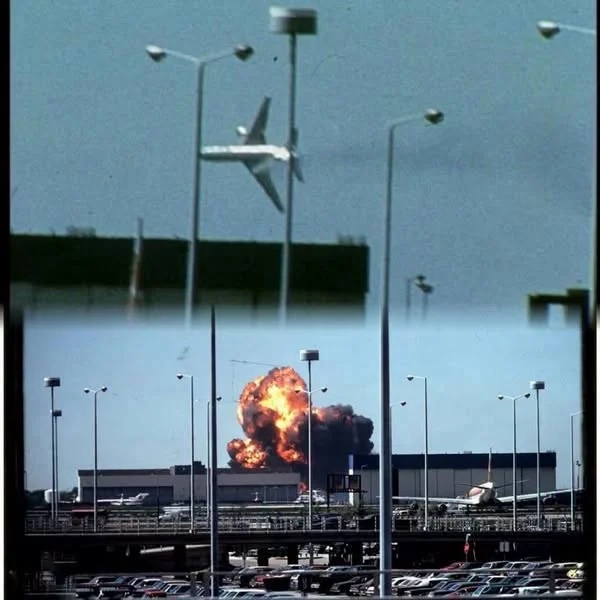
In the history of aviation accidents, some tragedies acquire strange stories that linger long after investigators determine what went wrong. One of the most unsettling accounts linked to a major air disaster involves American Airlines Flight 191, the catastrophic crash near Chicago’s O’Hare International Airport on 25 May 1979 that killed 273 people.
Flight 191 was a scheduled American Airlines service from Chicago to Los Angeles. On May 25, 1979, its DC-10 began its takeoff from runway 32R at O’Hare. The weather was clear. There were 258 passengers and 13 crew members aboard, and the accident also killed two people on the ground. Those numbers explain the total of 273 in the original account.
The emergency began during takeoff rotation. The left engine and the structure attaching it to the wing separated from the aircraft. The assembly passed over the wing before falling to the runway, damaging important hydraulic and electrical connections as it went. This was more complex than an engine simply stopping while remaining attached to the aircraft.
Damage to the hydraulic system allowed leading-edge slats on the left wing to retract. The resulting difference between the wings’ aerodynamic configurations meant they no longer behaved alike at the same speed. The aircraft initially climbed, then rolled sharply left and descended into the ground. Its crew faced a situation that the usual engine-failure procedure did not adequately describe.
The National Transportation Safety Board’s investigation identified an asymmetric stall and the ensuing roll as the immediate loss-of-control sequence. It traced the separation to maintenance-related damage affecting the engine-pylon structure. The findings also addressed design vulnerabilities, oversight and communication between the airline industry and regulators. The accident therefore became an important case in the relationship between maintenance practices and flight safety.
The distinction matters because a dramatic image of an engine separation can make the accident seem to have one obvious explanation. Investigators instead reconstructed a chain: structural damage, the engine and pylon coming away, damage to aircraft systems, slat retraction, unequal lift and loss of control. Understanding the sequence requires following those connected events rather than stopping at the first visible failure.
Accounts of the disaster sometimes mix the documented investigation with unsettling stories repeated afterward. The opening paragraph alludes to that broader folklore but does not identify or substantiate a particular supernatural claim. The confirmed history is already grave enough: a departing passenger flight was lost, families were bereaved, and investigators had to establish why an apparently routine takeoff became unrecoverable.
This is a historical account of the May 1979 accident. It should not be read as an announcement of a new crash at O’Hare. Keeping the date, flight number and aircraft type together preserves the identity of the event when the story is shared again. The official investigation and the FAA’s lessons-learned account provide the technical record behind that history.
FAA accident history and investigation findings
The investigation also demonstrates why safety lessons extend beyond the flight deck. An earlier maintenance decision can create a vulnerability that becomes visible only later, under the stresses of departure. The aircraft, its maintenance history and its systems must therefore be considered together.