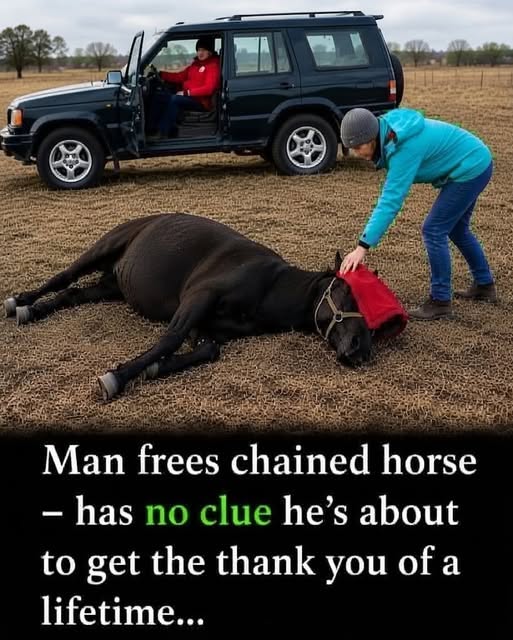
In Romania, veterinarian Ovidiu Roșu encountered a wild horse whose front legs had been bound with chains. The restraint prevented the animal from moving normally and placed it at risk of injury. Roșu approached carefully, sedated the horse, and used tools to remove the metal. The rescue was already powerful, but the moment that followed made it unforgettable: another free-roaming horse came close and appeared to acknowledge the mare that had been released.
Human viewers naturally interpret the approach as gratitude, comfort, or a kiss. No one can know exactly what the second horse intended, but social contact between horses is meaningful. They communicate through posture, movement, touch, and proximity. After a frightening restraint and intervention, the return of another horse may have helped the freed animal rejoin the security of the group.
The scene also drew attention to Romania’s free-roaming horses, especially those associated with the Danube Delta and Letea Forest. Horses have lived in the region for centuries. Their numbers expanded after political and economic changes in 1989, when some domestic animals were released or no longer managed as before. Over time, the growing population became part of a complicated debate involving animal welfare, local livelihoods, habitat protection, and public responsibility.
By 2011, plans to remove or slaughter horses caused international concern. Conservationists warned that unmanaged grazing could damage sensitive forest habitat, while animal-welfare organizations opposed cruel capture and transport. The conflict showed why simple labels do not solve the problem. Calling the horses wild does not remove human responsibility for the conditions that allowed their numbers to grow, and protecting animals cannot mean ignoring ecological pressure.
FOUR PAWS and local partners developed a nonlethal program involving veterinary treatment, monitoring, and immunocontraception. Fertility control can reduce population growth gradually without mass killing. It requires trained teams, repeat observation, and cooperation with authorities and communities. Injured horses may also need direct care, as the chained mare did.
The chain itself reflects another welfare issue. In some places, owners restrain grazing horses by tying or hobbling their legs. The practice can cause wounds, infection, restricted circulation, falls, and severe distress. Removing a restraint safely is not as simple as walking up with cutters. A frightened horse is large and powerful. Sedation, veterinary judgment, and control of the surrounding area can protect both the animal and the rescuers.
By 2025, responsibility for the long-term program was being transferred back toward national and local authorities. That transition matters because emergency rescues cannot replace durable management. The horses need ongoing monitoring, humane population planning, habitat protection, and enforceable standards against cruelty. Communities also need workable solutions rather than rules imposed without resources.
The emotional image of one horse approaching another is the part most people remember. Its deeper value is that it leads viewers toward the larger story. One veterinarian freed one animal from immediate pain, but the welfare of the herd depends on years of patient work. Compassion in this setting is not only the dramatic moment when a chain falls away. It is the less visible commitment to prevent the next restraint, manage the population humanely, and protect both the horses and the landscape they inhabit.
Visitors can support that work by keeping a safe distance, avoiding feeding, and following local guidance. Approaching a free-roaming horse for a photograph can stress the animal and put people at risk. Donations and public attention are most useful when directed toward credible veterinary and conservation programs. The rescue became famous because it was emotionally immediate; the next step is turning that attention into long-term humane management rather than treating the mare’s release as the end of the story.