The memorial service for legendary civil rights leader Rev. Jesse Jackson brought together some of the most prominent figures in American politics. But in the days following the ceremony, attention shifted away from the tributes and toward criticism about how the event was used by some speakers.
Jackson passed away on February 17 at the age of 84 after a long battle with serious health conditions. In 2017 he publicly revealed he had been diagnosed with Parkinson’s disease, and later the Rainbow PUSH Coalition confirmed he was also living with progressive supranuclear palsy, a degenerative neurological disorder that affects movement, balance, and speech.
Throughout his life, Jackson was one of the most recognizable leaders of the civil rights movement. He marched alongside Martin Luther King Jr., founded major advocacy organizations, and twice ran for the Democratic presidential nomination, in 1984 and 1988.
A Major Memorial Gathering
On March 6, thousands of people gathered at the House of Hope in Chicago for a public memorial celebrating Jackson’s life and influence.
Among those attending were former U.S. Presidents Barack Obama, Joe Biden, and Bill Clinton, along with former Vice President Kamala Harris and many other political and community leaders.
Speakers reflected on Jackson’s impact on American politics, social justice, and the broader civil rights movement. Many described him as a figure who reshaped the country’s political landscape and gave a voice to communities that had long been marginalized.
Political Remarks During the Service
However, parts of the speeches delivered during the memorial touched on the current political climate in the United States.
During his remarks, Obama spoke about what he described as growing challenges facing democratic institutions. According to reports, he warned about repeated pressures on democratic norms and the rule of law.
Although he did not mention Donald Trump directly, the comments were widely interpreted as criticism of the current political environment.
Biden also addressed the state of the country, suggesting that the United States was facing difficult political circumstances and expressing concern about the direction of national leadership.
Many people in attendance applauded the remarks, viewing them as consistent with the moral and political themes that defined Jackson’s career.
Jesse Jackson Jr. Responds
Not everyone agreed that the memorial was the appropriate setting for such commentary.
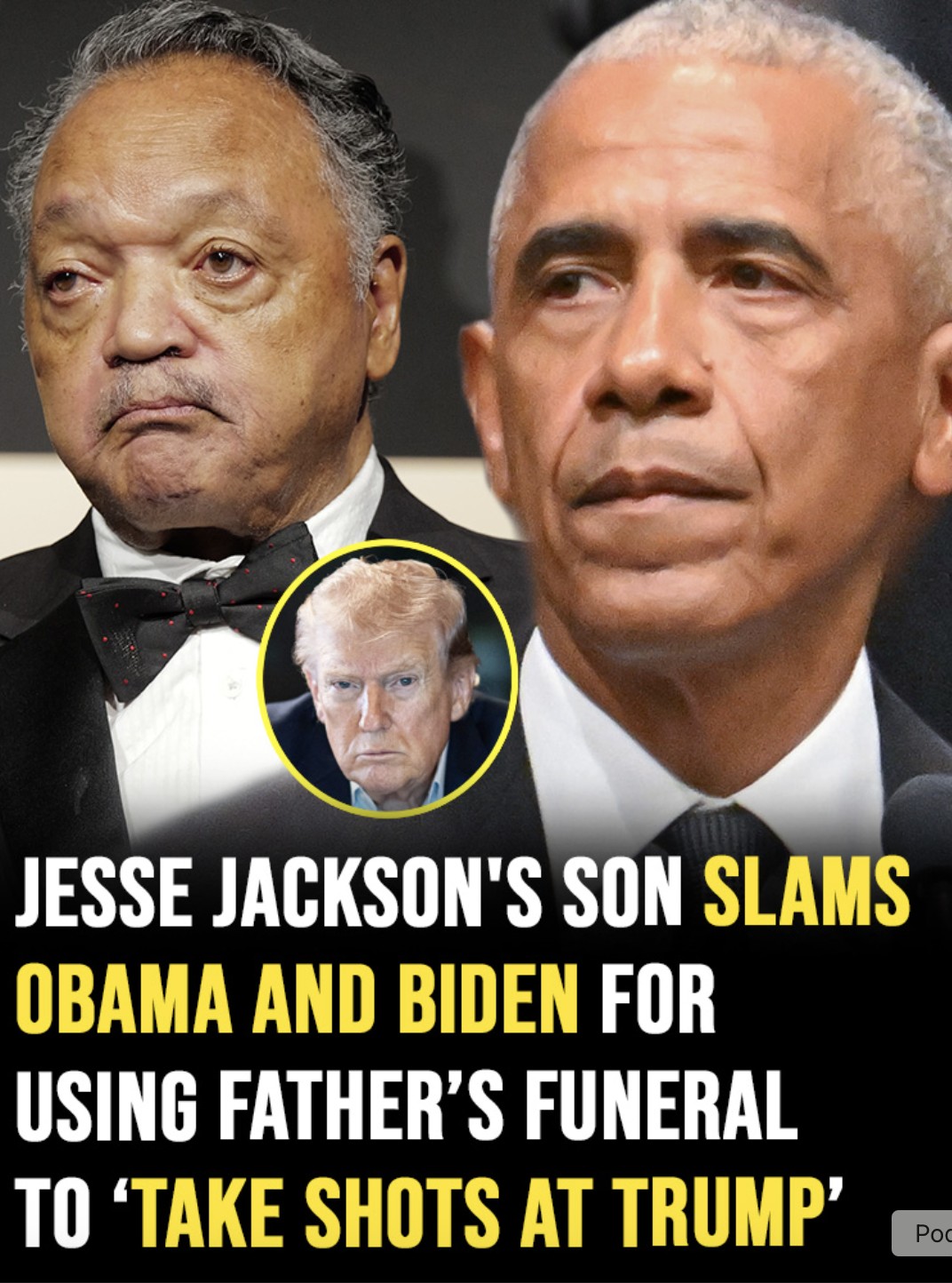
The strongest criticism came from Jesse Jackson Jr., the civil rights leader’s son.
Speaking the following day at a smaller gathering held at Rainbow PUSH Coalition headquarters in Chicago, Jackson Jr. expressed disappointment with the tone of the earlier speeches.
He said he had listened to several hours of remarks from former presidents and argued that the political commentary did not fully reflect his father’s broader legacy.
According to Jackson Jr., his father’s life was not defined by loyalty to any single political party. Instead, he said Rev. Jackson’s mission centered on defending and uplifting those who were marginalized or overlooked in society.
Earlier Calls to Keep Politics Out
Jackson Jr.’s reaction also followed earlier requests he had made after his father’s death.
At that time, he encouraged those attending the memorial services to avoid turning the event into a partisan platform. His hope was that people of different political beliefs could come together to honor his father in a spirit of respect.
He emphasized that Rev. Jackson’s life and work spoke to a wide range of Americans, not just those aligned with a particular political movement.
No Response From Obama or Biden
So far, neither Obama nor Biden has publicly responded to Jackson Jr.’s criticism.
The memorial also occurred during another political controversy. Shortly after Jackson’s death was announced, Donald Trump posted a message on Truth Social praising the civil rights leader while also claiming that Jackson had been critical of Obama.
Several media outlets disputed that claim, saying there was no clear evidence supporting it.
A Legacy That Still Sparks Debate
The disagreement surrounding the memorial highlights how influential Jesse Jackson remained even at the end of his life.
For decades, he challenged America to confront issues of inequality, injustice, and political accountability.
Even after his passing, his legacy continues to generate discussion—about politics, leadership, and the role of activism in American society.
For some, the speeches reflected the same urgency Jackson carried throughout his career. For others, including his son, they distracted from the purpose of the gathering: honoring the life of a man whose influence stretched far beyond partisan politics.
What remains clear is that Jesse Jackson’s legacy is still shaping conversations about justice and political responsibility long after his death.