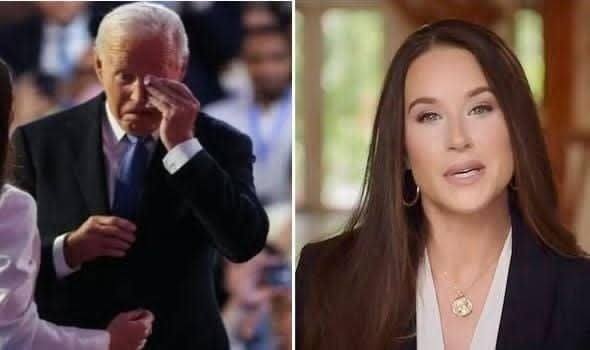
Ilhan Omar made a statement that cut through the usual political noise with rare bluntness. She said she believes Tara Reade’s allegation, and yet she still planned to vote for Joe Biden. In one sentence, she forced a collision between moral conviction and political survival, exposing a contradiction many voters feel but few are willing to articulate publicly.
For years, “believe women” functioned as a moral absolute in progressive politics. It was not meant to be conditional or strategic. It was a corrective to decades of silence, dismissal, and institutional protection of powerful men. Omar’s admission didn’t reject that principle, but it revealed how fragile it becomes when tested against the machinery of electoral politics and the fear of what losing might mean.
Her words landed heavily because they refused to provide comfort. There was no neat reconciliation, no moral loophole, no rhetorical escape hatch. Instead, she acknowledged something deeply unsettling: that even when harm is believed to be real, political actors may still decide that stopping a perceived greater threat outweighs full accountability.
Omar did not say Reade was lying. She did not minimize the allegation. She did not pretend the accusation evaporates in the face of party loyalty. She said she believes it — and then she said she would vote for Biden anyway. That distinction matters. It removes the illusion that supporting a candidate automatically absolves them of wrongdoing.
What Omar articulated was not hypocrisy so much as triage. In her framing, voting becomes less about moral endorsement and more about risk management. The ballot is not a declaration of purity; it is a tool used under pressure, in a system that rarely offers clean choices. Every option carries harm. The question becomes which harm feels more survivable.
That framing exposes a brutal reality of modern democracy. Elections are not moral tribunals. They are power contests, conducted under time constraints, fear, and imperfect information. Voters are often asked to choose not between good and evil, but between different kinds of damage. Omar simply said the quiet part out loud.
The reaction to her comments revealed how uncomfortable that honesty makes people. Critics accused her of betraying feminist principles. Supporters argued she was being realistic in the face of a potential second Trump presidency. Both sides, in different ways, wanted her to simplify the choice. She refused.
Her statement forced progressives to confront an unresolved tension: if “believe women” is absolute, what happens when believing a woman collides with the urgency of defeating someone like Donald Trump? Is belief supposed to automatically determine political outcomes, or does it coexist with other fears — authoritarianism, judicial appointments, climate policy, democratic erosion?
Omar did not claim to have solved that conflict. She admitted she was living inside it. That admission stripped away the moral theater that often surrounds elections, where voters pretend their choice is virtuous rather than strategic. She acknowledged that supporting Biden comes with unresolved pain attached to it — pain that does not disappear just because the alternative feels worse.
This is what made her words so destabilizing. Politics thrives on certainty, slogans, and clear villains. Omar introduced ambiguity, and ambiguity is dangerous in a system built on mobilizing outrage and loyalty. She reminded people that political wins can be built on compromise with injustice, and that pretending otherwise is a lie we tell ourselves to sleep at night.
Her stance also exposed the limits of symbolic politics. Movements can set moral standards, but institutions operate differently. Justice, accountability, and electoral success do not always move in the same direction. When they diverge, voters are left holding the weight of that contradiction, often alone.
Omar’s comments resonated because many people privately navigate the same calculus. They believe survivors. They also fear political outcomes that could strip rights, normalize cruelty, or entrench power in dangerous ways. They vote with clenched teeth, knowing their choice solves nothing completely. Omar gave language to that experience.
The discomfort she created may be the most honest part of the conversation. Democracy, as practiced, is not a space of moral clarity. It is a system built on trade-offs, imperfect actors, and decisions made under duress. Acknowledging that does not make the system better, but it makes participation more truthful.
There is also a cost to this honesty. It risks alienating survivors who hear belief followed by political abandonment. It risks reinforcing the idea that powerful men are ultimately protected when they are useful. Omar did not deny that cost. She exposed it.
Her statement did not ask for forgiveness or approval. It did not demand agreement. It simply laid bare the reality that many political actors navigate quietly: that sometimes the choice is not between right and wrong, but between outcomes that all carry moral injury.
In that sense, Omar’s words were less a defense of Biden than an indictment of the system itself. A system that repeatedly forces voters into corners where ethical consistency becomes impossible. A system where survival instincts override ideals. A system where unresolved harm is often the price of political stability.
What made the moment powerful was not its resolution, but its refusal to resolve. Omar did not offer closure. She offered clarity — and clarity, in this case, was uncomfortable. It showed that democracy often demands choices that leave no one fully satisfied, only more aware of what they are sacrificing.
Her statement did not weaken the conversation around belief or accountability. It complicated it. And that complication may be the most honest contribution she could have made.
Leave a Reply