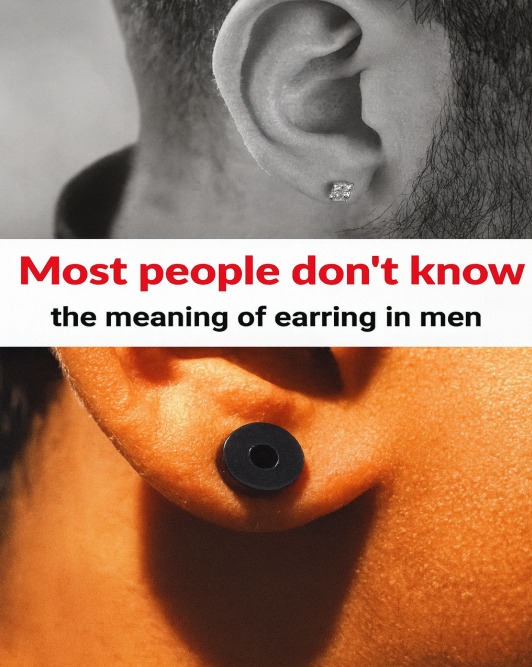
In the ever-evolving landscape of masculine aesthetics, few accessories carry as much historical weight or semiotic complexity as the earring. What often appears to the casual observer as a simple flash of gold or a subtle glimmer of a diamond is, in reality, a powerful medium of communication that has been utilized by men for millennia. The act of a man piercing his ear—whether he chooses a minimalist stud, an avant-garde cuff, or a classic hoop—is rarely a gesture of mere vanity. Instead, it is an intersection of personal narrative, cultural heritage, and a defiant assertion of individuality. To understand what a man’s earrings reveal today, one must look past the contemporary fashion trends of 2026 and delve into a rich, global history where jewelry served as a social passport, a spiritual talisman, and a badge of courage.
The roots of male ear adornment are buried deep in the soil of the ancient world. In the gilded courts of Pharaonic Egypt, earrings were not the exclusive province of women; they were worn by men of high status to signify wealth, power, and divine favor. To the ancient Persians and the warriors of the Assyrian Empire, a heavy earring was a symbol of strength and military rank, often depicted in stone reliefs to denote the wearer’s proximity to the throne. Even in the maritime traditions of the Mediterranean, the earring took on a pragmatic, if somber, significance. For a sailor, a gold hoop was often worn as a form of “burial insurance.” Should he perish at sea and his body wash ashore, the gold served as payment for a proper Christian burial, ensuring his soul found peace even in a foreign land. This blend of status and survivalism laid the groundwork for the earring’s enduring role as a marker of identity.
Beyond the halls of power and the decks of ships, earrings have long served a ceremonial function in indigenous cultures across Africa, the Americas, and South Asia. In many of these traditions, the piercing of a young man’s ear was a pivotal rite of passage—a physical manifestation of his transition from childhood to the responsibilities of adulthood. In specific Nilotic tribes in East Africa, the size and material of an earring can still communicate a man’s family lineage or his success as a provider. For Native American communities, such as the Pawnee or the Haida, jewelry was often a repository of history, with specific designs honoring tribal ancestors or spiritual animal guides. These practices remind us that for much of human history, an earring was never “just” an earring; it was a visible fragment of a man’s soul and a map of his heritage.
Spiritual and metaphysical layers add further depth to this history. In certain Eastern traditions, the ear is viewed as a microcosm of the entire human body, and the act of piercing is believed to stimulate specific pressure points that enhance mental clarity or physical wellness. In some Buddhist iconographies, the elongated earlobes of the Buddha—originally caused by the weight of heavy, royal earrings—symbolize the rejection of material wealth in favor of spiritual enlightenment. For many modern men, choosing to wear an earring is a way of tapping into these ancestral energies, viewing the accessory as a talisman of protection or a reminder of their personal growth and spiritual journey.
As the 20th century dawned, the meaning of men’s earrings shifted into the realm of counterculture and rebellion. In the post-war era, the “single earring” became a coded language within various subcultures, signaling membership in the burgeoning rock-and-roll scene, the punk movement, or the LGBTQ+ community. During these decades, wearing an earring was an act of bravery—a visual challenge to the rigid gender norms of the time. It was a tool used to reclaim one’s body from the expectations of a conservative society. This era of “earring as rebellion” paved the way for the radical inclusivity we see today, where the accessory has been liberated from its strictly coded past to become a universal canvas for self-expression.
In the contemporary world of 2026, the stigma once associated with men’s jewelry has largely evaporated, replaced by a sophisticated appreciation for artistic individuality. Public figures, from star athletes and high-fashion models to tech innovators and world leaders, have embraced the earring as a staple of the modern wardrobe. Today, a man’s choice of earring might reveal his affinity for sustainable luxury through the use of lab-grown diamonds, or his appreciation for artisanal craftsmanship through hand-forged silver. It might signal his connection to his roots or his desire to disrupt traditional corporate aesthetics. In the professional spheres of 2026, a well-chosen stud is seen as a sign of confidence—a mark of a man who is comfortable enough in his identity to curate his own appearance without adhering to outdated blueprints of masculinity.
The psychology behind the choice is equally fascinating. For some, the earring is a “memento mori,” a small, tangible reminder of a loved one or a significant life event. For others, it is a creative outlet, a way to add a touch of “wry humor” or “artistic flair” to an otherwise standard suit. The diversity of styles available—from the industrial look of titanium bolts to the organic curves of wood and bone—allows for a level of personalization that few other accessories can provide. What a man’s earring reveals most fundamentally in the modern age is his autonomy. It is a declaration that he is the sole architect of his image.
Looking ahead, the history of men’s earrings continues to be written in real-time. As we move deeper into an era that values authenticity above all else, the earring remains a steadfast tool for storytelling. It bridges the gap between the ancient warrior and the modern creative, the spiritual seeker and the fashion-forward professional. It is a small detail that makes a massive impact, reminding us that the human desire for adornment is one of our oldest and most consistent traits. Whether it is worn to honor the past, celebrate the present, or signal a bold new future, the earring remains a potent symbol of what it means to be a man in a complex, beautiful, and ever-changing world.
The next time you see a man with a single, deliberate spark at his ear, remember that you are not just looking at a fashion choice. You are looking at a lineage of power, a tradition of ritual, and a modern testament to the courage it takes to stand out. In the quiet language of style, the earring speaks volumes about where a man has been and, more importantly, where he is going.
Leave a Reply