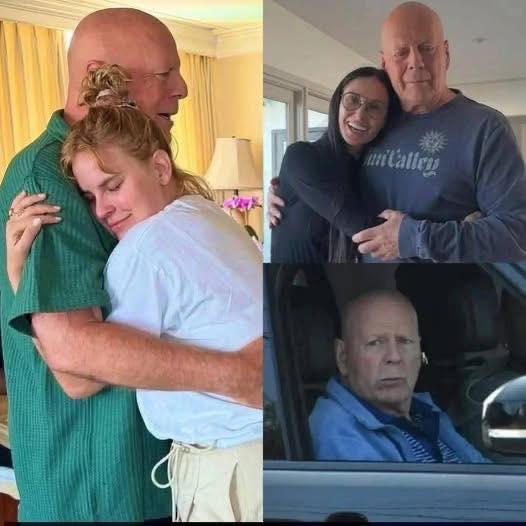
For decades, Bruce Willis was a global symbol of grit and charisma—a presence that defined action cinema through sharp humor and a signature, relatable confidence. Whether playing the vulnerable hero or the stoic lead, he commanded the screen in a way that audiences recognized instantly.
However, in recent years, the narrative surrounding him has shifted from his legendary performances to a deeply personal and difficult reality.
A Diagnosis That Changed Everything
After Bruce stepped away from acting, his absence from the public eye initially sparked curiosity. That uncertainty was addressed in 2022 when his family revealed he had been diagnosed with aphasia, a condition that impairs the ability to communicate, affecting speech, writing, and language comprehension.
What the public once interpreted as a simple retirement was revealed to be a profound health challenge. As time progressed, the family provided a more specific and sobering update: Bruce is living with frontotemporal dementia (FTD).
Understanding Frontotemporal Dementia
Unlike more common forms of dementia that typically begin with memory loss, FTD primarily attacks the frontal and temporal lobes of the brain. This results in:
- Communication barriers: Significant difficulty with expression and understanding.
- Personality shifts: Changes in behavior and emotional processing.
- Motor function impact: In some cases, physical coordination is also affected.
For an artist whose entire career was built on voice, timing, and physical presence, the impact of FTD is particularly poignant.
A Unified Front
From the start, the Willis family—including his wife Emma Heming Willis, his daughters, and his former partner Demi Moore—has chosen radical transparency over secrecy. By speaking openly, they have transformed a private struggle into a platform for global awareness.
Daughter Rumer Willis expressed the family’s perspective early on:
“Our family wanted to start by expressing our deepest gratitude for the incredible outpouring of love, support, and wonderful stories we have all received.”
This openness serves several vital purposes:
- Reducing Stigma: By showing Bruce’s reality, they help de-stigmatize a misunderstood condition.
- Educating the Public: They provide a real-world look at the nuances of FTD, which is often misdiagnosed as Alzheimer’s or psychiatric issues.
- Building Community: Their updates offer comfort to other families navigating similar diagnoses.
Resilience Beyond the Screen
The story of Bruce Willis today isn’t found in Hollywood headlines or box office returns. It unfolds in a quieter space defined by daily life, small adjustments, and a different kind of strength—one that requires patience and unwavering presence.
The family’s messaging has consistently focused on what remains rather than just what has been lost. They emphasize:- Connection: Finding new ways to bond when verbal language fails.
- Support: Maintaining a tight-knit, blended family unit.
- Honesty: Facing the progression of the disease with dignity and realism.
A Universal Resonance
This journey resonates because it mirrors a universal human experience: the way life can change direction without warning. It highlights the shift from independence to dependence and the grace required to navigate that transition.
As of April 2026, Bruce continues to be surrounded by this dedicated support system. While he is no longer the “action hero” of the silver screen, he has become a symbol of a different sort of bravery. His legacy is no longer just the characters he played, but the resilience of the family standing by him.
The outpouring of love from fans serves as a final tribute to his impact—proving that while language may fade, the connection he built with the world remains as strong as ever.