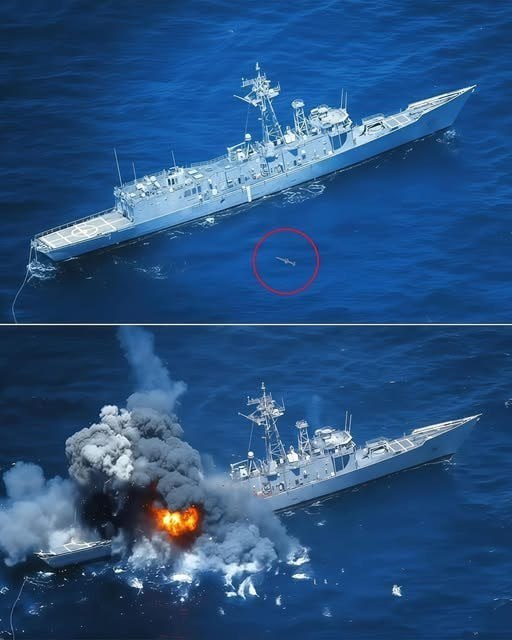
The story of the USS Rodney M. Davis (FFG-60) is one that captures the full arc of a naval vessel’s life—from its inception as a guardian of the seas during the height of the Cold War to its final, sacrificial role as a target for cutting-edge weapons testing. When the former guided-missile frigate was finally sent to the ocean floor during a controlled Sinking Exercise, known in naval parlance as a SINKEX, it marked the end of an era. The vessel was struck by an AGM-84 Harpoon anti-ship missile, a weapon it was once designed to deploy against others, in a choreographed event that was far from a tragic combat loss. Instead, it was a calculated final mission, allowing the ship to serve the United States Navy one last time by providing invaluable data on ship survivability and modern weapon effectiveness.
To understand the weight of this final mission, one must first look back at the origins of the vessel. Commissioned in 1982, the USS Rodney M. Davis was an Oliver Hazard Perry-class frigate, a class of ships that became the workhorses of the American fleet in the late 20th century. These frigates were designed with a specific philosophy: they were meant to be cost-effective, multi-role platforms capable of providing a robust defense for carrier battle groups and merchant convoys. During the Cold War, their primary responsibility was anti-submarine warfare (ASW), acting as a shield against the submerged threats that patrolled the deep waters of the Atlantic and Pacific.
The ship’s namesake added a layer of profound honor to its hull. Rodney Maxwell Davis was a United States Marine Corps sergeant who was posthumously awarded the Medal of Honor for his conspicuous gallantry during the Vietnam War. In 1967, during an intense firefight in the Quang Nam Province, Davis threw himself onto a North Vietnamese grenade to save his fellow Marines. The frigate that bore his name carried that spirit of sacrifice into every deployment, from maritime security operations to joint international exercises. For over thirty years, the “Rodney M.” was a symbol of American presence across the globe, maintaining a steady watch in the Indian Ocean, participating in counter-drug operations in the Eastern Pacific, and building diplomatic bridges during port visits in the Western Pacific.
As naval technology advanced, the Oliver Hazard Perry-class began to reach the end of its projected service life. By the mid-2010s, the Navy was shifting its focus toward more modular and technologically advanced platforms like the Littoral Combat Ships and the upcoming Constellation-class frigates. The USS Rodney M. Davis was officially decommissioned in early 2015 at Naval Station Everett, Washington. For many ships, decommissioning leads to the “mothball fleet” or the scrap yard, but for the Rodney M. Davis, a more purposeful end awaited.
The decision to utilize a decommissioned vessel for a SINKEX is never made lightly. It is a rigorous process governed by strict environmental and safety regulations. Before the ship could be towed to the designated sinking site, it underwent a comprehensive cleaning process known as “environmentally sound preparation.” Every ounce of hazardous material was meticulously removed. Polychlorinated biphenyls (PCBs), asbestos, mercury, and residual fuels were stripped from the ship to ensure that once it rested on the seabed, it would serve as an artificial reef rather than a source of pollution. Furthermore, all sensitive military technology and classified equipment were salvaged, leaving behind a hollowed-out but structurally sound target.
The exercise itself was a masterpiece of naval coordination. As the Harpoon missile was launched, it streaked across the sky, locked onto the frigate’s radar cross-section. The impact was precise. Analysts monitored the event using a vast array of high-speed cameras, acoustic sensors, and structural monitors. The goal of a SINKEX isn’t merely to sink a ship; it is to understand exactly how a modern hull reacts to the kinetic energy and thermal explosion of a missile strike. In a real-world conflict, this data is the difference between a ship remaining afloat after a hit or being lost to the depths. By studying the way the Rodney M. Davis succumbed to the Harpoon, engineers can design more resilient bulkheads, better firefighting systems, and more effective damage control protocols for the sailors of tomorrow.
For the former crew members who once called the ship home, news of the sinking was met with a complex tapestry of emotions. For many “plank owners”—those who were part of the original commissioning crew—and those who served on her final voyages, the ship was more than a collection of steel and wires. It was a home where they had formed lifelong bonds, weathered literal and metaphorical storms, and sacrificed time away from their families. Seeing images of the ship listing and then disappearing beneath the waves can feel like losing a piece of one’s own history. However, there is a prevailing sense of pride in the fact that the ship did not rot away in a salvage yard. By serving as a target, the Rodney M. Davis went out “with her boots on,” contributing to the defense of the nation until her very last second on the surface.
The location of the sinking, often in deep water thousands of feet below the surface, ensures that the vessel will rest undisturbed for centuries. In its new life as an artificial reef, the frigate will provide a complex habitat for marine life, supporting biodiversity in the deep ocean. It is a poetic conclusion: a ship built for the violence of war eventually becomes a sanctuary for the natural world.
The sinking of the USS Rodney M. Davis serves as a reminder of the constant cycle of renewal within the United States Navy. As old hulls are retired and new ones are launched, the lessons learned from the past are integrated into the future. The data gathered during that final Harpoon strike is currently being used by naval architects to refine the survivability of the next generation of surface combatants. The vessel’s service did not end at the decommissioning pier in 2015; it ended in the deep blue, providing the knowledge necessary to keep future American sailors safe.
In the grand tradition of the sea, the Rodney M. Davis has joined the ranks of the ghost fleet, but her legacy remains vivid in the hearts of those who served aboard her and in the technical manuals of the Navy she helped to strengthen. She was a ship named for a hero, and in her final moments, she performed a final act of service that mirrored the selflessness of her namesake. As the waves closed over her mast for the last time, the USS Rodney M. Davis fulfilled her mission, leaving the world’s oceans a little safer through the knowledge she left behind.
Leave a Reply