A Las Vegas anatomy museum has issued a firm response to renewed and deeply disturbing allegations from a Texas mother who believes one of its plastinated human displays is actually the body of her deceased son. The claim, which has circulated online for years and recently resurfaced across social media and alternative news platforms, has reopened an emotional and unresolved chapter surrounding a death she has never been able to accept.
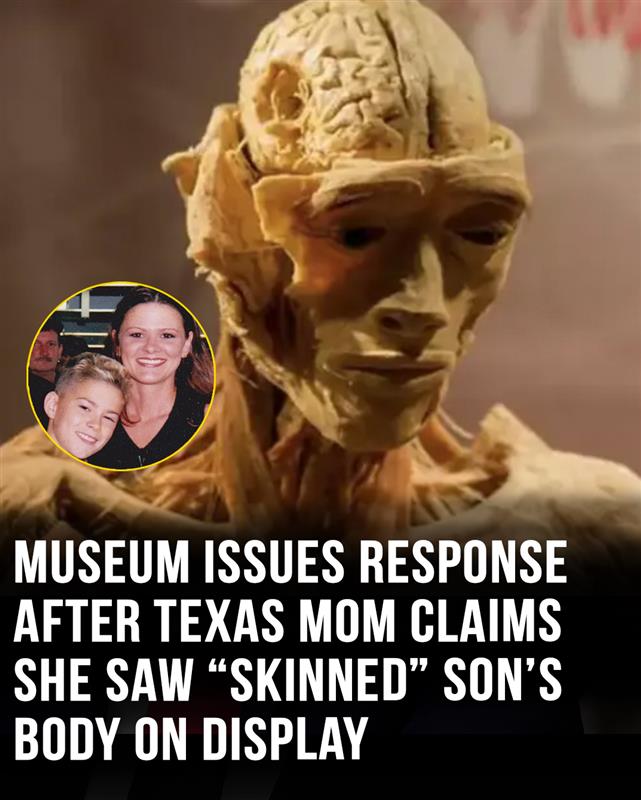
Kim Erick maintains that her son, Chris Todd Erick, who died in 2012 at the age of 23, was not cremated as she was told and that his remains were instead used without consent in the Real Bodies anatomy exhibition. Her belief centers on a plastinated cadaver known as “The Thinker,” a seated, skinless human figure that was displayed for years in Las Vegas and other cities as part of the popular educational exhibit.
Chris was found dead in his bed at his grandmother’s home in Midlothian, Texas, approximately 30 miles south of Dallas. Authorities informed Kim that her son had died in his sleep after suffering two heart attacks, allegedly caused by an undiagnosed congenital heart condition. In the days following his death, while Kim says she was still in shock and struggling to process what had happened, Chris’s father and grandmother arranged for his cremation. She was later given a necklace containing ashes she was told belonged to her son.
Almost immediately, Kim began to question the official narrative. Her doubts intensified when she eventually obtained police photographs from the scene. According to her, the images showed injuries she says were never explained to her by investigators: bruising, marks across his chest and abdomen, and what she interpreted as signs of restraint or prolonged suffering.
In an emotional post shared on social media, Kim wrote that “something very bad happened in that room,” claiming she believed her son had been harmed in the days leading up to his death. She alleged that Chris may have been “tortured for two days” before he died. Despite her assertions, a homicide investigation conducted in 2014 concluded there was no evidence of foul play. The medical examiner’s findings and police reports upheld the original ruling, leaving Kim devastated and unconvinced.
Unable to reconcile the official explanations with what she believed she had seen, Kim began years of independent research. In 2018, she visited the Real Bodies exhibition, a well-known traveling anatomy display that features plastinated human cadavers preserved using a scientific process designed for medical education. It was there, she says, that her suspicions crystallized.
One particular specimen stopped her cold. The figure known as “The Thinker” bore what Kim believed to be a distinctive skull fracture on the right temple—an injury she says matched medical documentation related to Chris. She also claimed that an area of skin where her son had a tattoo appeared to have been cleanly removed, something she interpreted as intentional concealment of identifying marks.
Standing in front of the display, Kim later described the experience as overwhelming and traumatic, saying she felt as though she was looking directly at her son’s dissected body. The moment reignited her grief and propelled her into a public campaign for answers, accountability, and forensic verification.
Kim demanded that the exhibition allow independent DNA testing of the specimen. The request was denied. Organizers of Real Bodies stated unequivocally that the cadaver had no connection to Chris Erick and that such testing was neither warranted nor feasible. The exhibition’s owner, Imagine Exhibitions, Inc., released a detailed statement through fact-checking outlet Lead Stories, expressing sympathy for Kim’s loss but categorically rejecting her claims.
According to the company, all specimens used in the Real Bodies exhibition were legally acquired overseas, primarily in China, through documented and regulated processes that complied with international standards at the time. The company stated that “The Thinker” had been part of the collection for more than two decades and had been publicly displayed in Las Vegas since at least 2004—eight years before Chris’s death.
Archived photographs of the specimen from years prior to 2012 were published to support the timeline, and experts noted that plastination is an extensive scientific procedure that can take many months to complete, making Kim’s theory incompatible with established records. Imagine Exhibitions also emphasized that plastinated specimens are biologically anonymized, with no identifying DNA available for comparison.
Despite these explanations, Kim’s distrust deepened when “The Thinker” was quietly removed from the Las Vegas exhibit not long after her allegations gained traction online. She later learned the specimen had reportedly been transferred to Union City, Tennessee, but said she was eventually unable to track its location. To her, the removal felt suspicious rather than routine.
For Kim, the issue goes far beyond a single exhibit. She has repeatedly stated that her fight is about dignity, transparency, and a mother’s right to know what truly happened to her child. “Chris was never abandoned in life,” she has said, “and I won’t allow him to be abandoned in death.”
In July 2023, the discovery of more than 300 piles of unidentified cremated human remains in the Nevada desert reignited her fears. Although authorities did not link the remains to any museum or exhibition, Kim publicly called for advanced forensic analysis, including testing for chemicals associated with plastination, to rule out any broader mishandling of human remains.
Experts and investigators continue to stand by the documented evidence, insisting there is no factual basis for Kim’s claims. Museum officials stress that misinformation surrounding anatomy exhibitions has fueled unnecessary fear and confusion, while acknowledging the profound grief driving Kim’s actions.
The story has become a viral and polarizing case study at the intersection of grief, forensic science, ethical sourcing of human remains, and public trust in institutions. Online searches related to “Real Bodies exhibit controversy,” “plastinated human cadavers,” “museum ethics,” and “unidentified human remains investigation” have surged as the debate continues.
Yet for Kim Erick, statistics, timelines, and official statements have never been enough. Her search for answers persists, sustained by loss, conviction, and a refusal to let her son’s story end without what she believes is the full truth. Whether her claims are ultimately remembered as tragic misunderstanding or unresolved mystery, they underscore the enduring power of grief—and the lengths to which a parent will go when closure feels just out of reach.