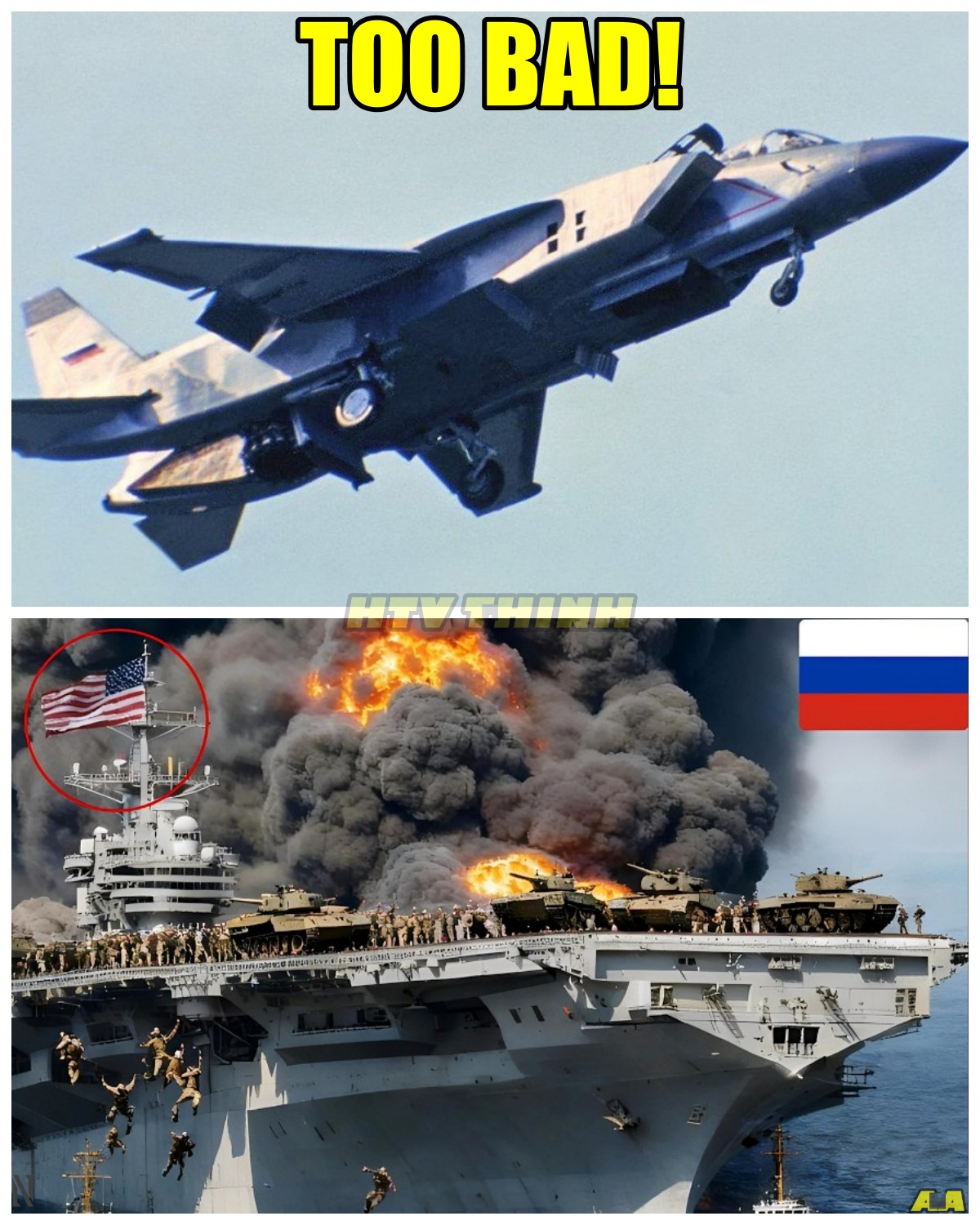
In the fast-moving world of digital media, where information spreads instantly, a dramatic report has recently circulated across social platforms claiming that a major military attack occurred in international waters. According to the viral narrative, nine Russian fighter jets allegedly carried out a coordinated strike that sank a United States aircraft carrier. The story goes even further, claiming that the carrier was transporting 500 brand-new tanks at the time, suggesting a massive strategic loss.
The description of the alleged attack reads almost like a scene from a military thriller. The report claims that the aircraft involved were Russian Yak-141 fighter jets, which supposedly launched a sudden assault powerful enough to overwhelm the carrier’s defense systems. In the story’s version of events, the attack caused catastrophic explosions that sent one of the most powerful warships in the world to the bottom of the ocean. If true, such an event would represent one of the most significant naval incidents in modern history.
However, when examined carefully, the claim quickly raises serious questions.
An event of this scale—especially the sinking of a U.S. aircraft carrier—would immediately dominate global news coverage. It would trigger official statements from institutions such as the United States Department of Defense, the Russian Ministry of Defense, and international bodies like the United Nations. Yet no such confirmations have appeared from credible sources. Major global news agencies, satellite monitoring services, and military analysts have not reported any incident matching these claims.
Another detail that casts doubt on the story involves the aircraft itself. The Yak-141 was a Soviet prototype developed during the late Cold War. Although it featured advanced vertical takeoff technology, the program was cancelled in the early 1990s and the aircraft never entered full operational service. The idea that a squadron of these rare prototypes would suddenly appear in active combat decades later is considered extremely unlikely by military experts.
The logistical claims in the story also appear questionable. Aircraft carriers are designed primarily as floating airbases that support fighter jets and helicopters. Their decks and hangars are built to operate aircraft rather than transport heavy armored vehicles. Transporting hundreds of tanks would typically require specialized cargo vessels or roll-on/roll-off transport ships rather than a carrier.
Because of these inconsistencies, analysts often point to another possibility: misinformation. In recent years, highly realistic footage from military simulation games or digital flight simulators has sometimes been edited and reposted online without context, making fictional scenarios appear like real combat events. Once shared widely, these clips can quickly evolve into dramatic but inaccurate “breaking news” stories.
This highlights an important lesson about media literacy. In moments of geopolitical tension, sensational stories about military attacks can spread rapidly and create genuine anxiety among the public. However, credible journalism relies on verification through multiple sources, official statements, and reliable evidence. When a story describes a world-changing event but appears only on unverified websites or social media posts, skepticism is usually warranted.
The broader issue is that misinformation often thrives on dramatic details designed to provoke emotional reactions. Claims of massive losses, secret attacks, or sudden escalations in global conflict tend to attract attention and clicks—even when the underlying information lacks factual support.
For now, there is no credible evidence that any U.S. aircraft carrier has been attacked or sunk by Russian forces. The viral report appears to be an unverified claim rather than a confirmed military event.
In a digital environment where information moves faster than ever, the best defense against confusion and panic is careful verification. Turning to established news organizations and official sources remains the most reliable way to understand what is actually happening in the world.