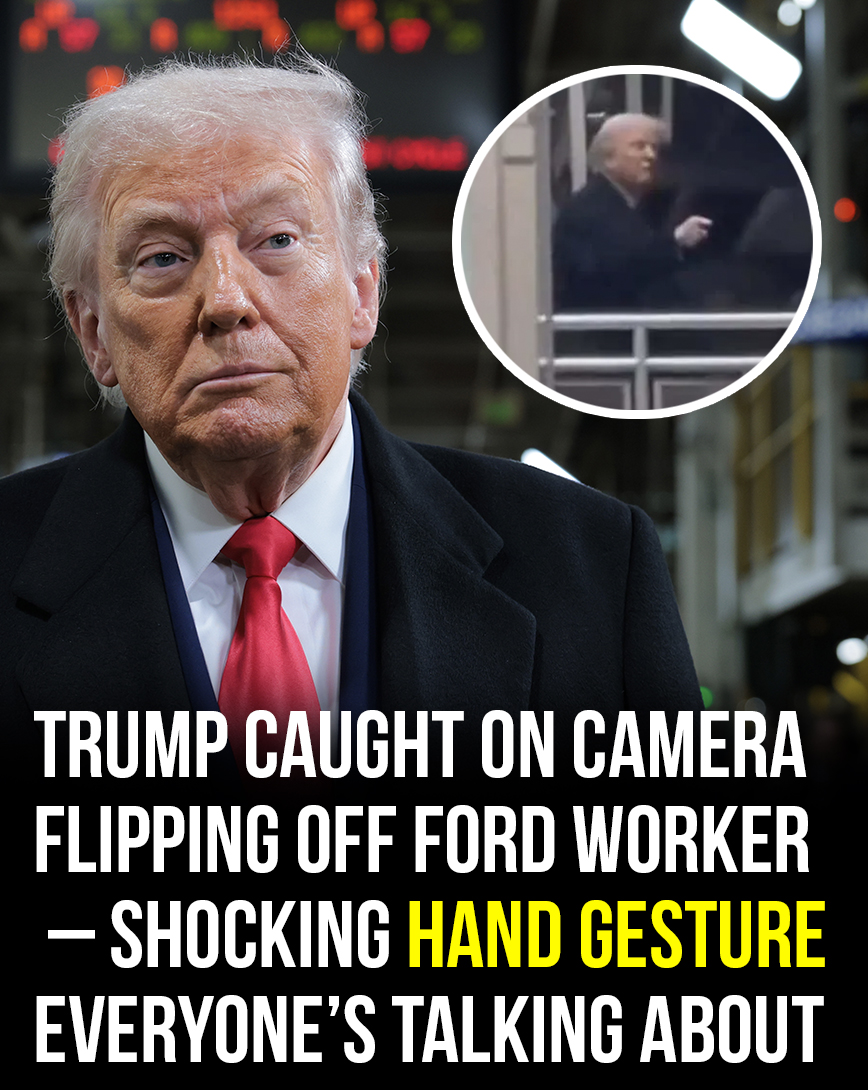
Not everyone in the crowd welcomed Donald Trump when he stepped into Ford’s River Rouge complex in Dearborn, Michigan. What was supposed to be a routine presidential visit to highlight American manufacturing quickly spiraled into a tense and highly public confrontation—one that was caught on camera and spread rapidly online.
The incident unfolded on Tuesday as Donald Trump addressed workers from a raised walkway overlooking the factory floor. The setting was carefully staged: hard hats, machinery humming below, and employees gathered to listen. But the atmosphere shifted almost instantly when a voice from the crowd cut through the noise.
A worker shouted an accusation at the president, calling him a “pedophile protector.” The remark appeared to reference Trump’s long-documented social ties to financier Jeffrey Epstein and ongoing criticism over the administration’s handling of Justice Department files connected to Epstein’s crimes. The accusation was loud, direct, and unmistakable.
Trump’s reaction was immediate.
Video footage shows him stopping mid-stride, visibly agitated. He points sharply toward the crowd, locks eyes in the direction of the heckler, and mouths the words “fuck you.” His expression is tight, jaw clenched, and the gesture is deliberate. As he continues walking, he appears to mouth “you’re fired,” a phrase closely associated with his television persona, before turning back once more and raising his middle finger.
The exchange lasted only seconds, but it was enough to overshadow the entire visit.
Within hours, clips of the moment were circulating widely, igniting fierce debate about presidential conduct, free speech, and the unresolved controversy surrounding the so-called Epstein files. Supporters framed Trump’s response as justified pushback against an offensive accusation. Critics called it an extraordinary breach of decorum, especially given the setting and audience.
The White House moved quickly to defend the president.
Spokesperson Steven Cheung issued a statement characterizing the heckler as unstable and aggressive. “A lunatic was wildly screaming expletives in a complete fit of rage,” Cheung said, adding that the president’s response was “appropriate and unambiguous.” The statement framed Trump’s actions as a clear refusal to tolerate what the administration described as abusive behavior.
Ford Motor Company took a more measured tone.
In a response to media inquiries, representatives for Ford Motor Company emphasized that the company was proud of its employees’ professionalism during the visit. At the same time, Ford made it clear that it does not condone inappropriate behavior inside its facilities—by anyone.
“When that happens, we have a process to deal with it,” a spokesperson said, declining to discuss any specific personnel matters. The company’s statement carefully avoided taking sides while reinforcing its internal standards of conduct.
The confrontation did not occur in a vacuum.
It comes amid intensifying scrutiny of the Trump administration’s handling of records related to Epstein, the disgraced financier who died in federal custody in 2019 while awaiting trial on sex trafficking charges. Federal law required the release of certain Epstein-related documents by mid-December, but as of early January, less than one percent had been made public.
The limited release has fueled bipartisan frustration.
California Democrat Ro Khanna and Kentucky Republican Thomas Massie jointly petitioned a federal judge, urging the full release of the files. Their unusual alliance underscores the breadth of concern surrounding the issue, which has united critics across party lines.
Attorney General Pam Bondi, who oversees the release process, has defended the slow pace, citing the need to protect victims’ identities. According to the Justice Department, many of the documents contain sensitive personal information that could retraumatize survivors if released without extensive redaction.
That explanation has done little to quiet criticism.
Democrats argue that the heavy redactions in the small number of documents released so far obscure key details and shield powerful individuals from scrutiny. Some Republicans, meanwhile, accuse the administration of selective transparency, saying the delay undermines public trust.
Trump himself has repeatedly dismissed the Epstein files as a “hoax,” a position that has only intensified suspicion among critics. His past relationship with Epstein is well documented: the two were photographed together on multiple occasions in the late 1990s and early 2000s, including at Trump’s Mar-a-Lago resort. Trump has insisted that the relationship ended years before Epstein’s arrest and has denied any involvement in Epstein’s crimes.
Still, the optics remain politically volatile.
For many observers, the outburst at the Ford plant crystallized a broader pattern: a president who responds to provocation with personal attacks rather than restraint, even in professional or symbolic settings. Others argue that the heckler crossed a line first and that Trump’s reaction, while crude, was honest and unfiltered—a quality his supporters often praise.
What made the moment particularly striking was the setting itself.
Presidential visits to factories are typically choreographed to project strength, unity, and economic optimism. They are meant to showcase leadership in tangible, working-class environments. Instead, the focus shifted from manufacturing jobs and industrial pride to a raw, unscripted clash that exposed deep political and cultural divisions.
Workers who attended the event described a mix of shock and discomfort. Some said they barely registered what was said until they saw the video later. Others said the tension was palpable in real time, with the factory floor falling quiet as the exchange unfolded.
By the end of the day, the visit was no longer about Ford, jobs, or policy. It was about a president caught on camera flipping off a critic and the unresolved questions that continue to surround his past associations and present decisions.
As pressure mounts for greater transparency around the Epstein documents, moments like this are likely to carry even more weight. They reinforce narratives on both sides: to supporters, Trump is a man who refuses to back down; to detractors, he is a leader whose conduct reflects avoidance rather than accountability.
The footage from Dearborn now stands as another flashpoint in an already volatile political landscape—one that shows how quickly a single shouted accusation can trigger a response that reverberates far beyond the factory walls.