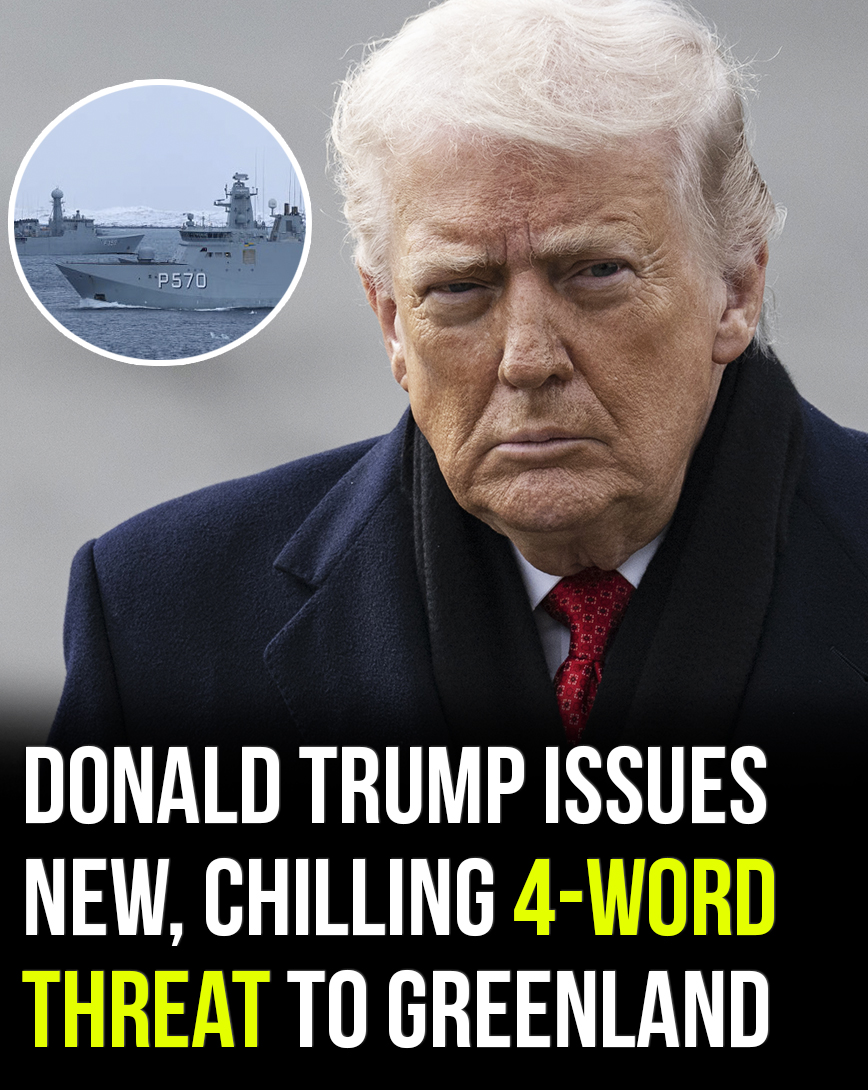
Tensions surrounding Greenland have surged back into international focus, and this time the rhetoric coming from Washington is more direct, more confrontational, and harder to dismiss as posturing. What had once been floated as a controversial idea has now evolved into a pointed warning, one that has unsettled European allies and reignited concerns about sovereignty, alliance stability, and the future of transatlantic cooperation.
At the center of the escalation is Donald Trump, who has again turned his attention to Greenland, the vast Arctic island that remains an autonomous territory within the Kingdom of Denmark. Despite a poll conducted last year showing that roughly 85 percent of Greenland’s population opposes becoming part of the United States, Trump has signaled that public opinion on the island is not deterring his ambitions.
On Monday morning, Trump issued a sharply worded message on Truth Social, accusing Denmark of failing to counter what he described as a growing Russian security threat in Greenland. His post was blunt and unambiguous, suggesting that Denmark’s long-standing stewardship of the territory has fallen short and that the United States may be prepared to step in directly. The language left little room for interpretation, ending with a declaration that “now it is time, and it will be done.”
Trump further claimed that NATO has pressured Denmark for decades to strengthen security in Greenland and implied that allied patience has run out. By framing the issue as both a security failure and an urgent geopolitical necessity, he positioned the United States as the actor willing to take decisive action where others allegedly have not.
The warning did not arrive in isolation. It came just one day after Trump announced a sweeping set of economic measures aimed squarely at Europe. A 10 percent tariff on goods from Denmark, Norway, Sweden, France, Germany, the United Kingdom, the Netherlands, and Finland is set to take effect on February 1. According to Trump, the tariffs will remain in place “until Greenland becomes American,” tying economic pressure directly to territorial demands in a way that immediately alarmed European capitals.
The response across Europe was swift and forceful. Emergency discussions among EU ambassadors took place over the weekend, reflecting the seriousness with which the threat was taken. Leaders within the European Union warned that the tariffs could undermine existing trade agreements and damage decades of diplomatic cooperation. European Council President Antonio Costa described the move as coercive and warned that the EU was prepared to defend itself economically and politically if necessary.
A special EU leaders’ summit has been scheduled to address the crisis, underscoring how quickly Trump’s remarks transformed a long-standing geopolitical curiosity into a full-blown diplomatic confrontation. For many European officials, the issue is no longer just about Greenland, but about the precedent such pressure sets within alliances built on mutual respect and consent.
On the ground in Greenland, the reaction has been equally emphatic. In the capital city of Nuuk, around 1,000 residents recently marched through the city center to the U.S. consulate, protesting Trump’s remarks and reaffirming their opposition to any transfer of sovereignty. Demonstrators emphasized that Greenland’s future is a matter for Greenlanders themselves, not a bargaining chip in global power politics.
Greenland’s leaders have repeatedly stressed that while they are open to cooperation and investment, any discussion of ownership is a nonstarter. The island’s autonomous status within Denmark grants it significant self-governance, and public sentiment strongly favors maintaining that arrangement rather than becoming part of another nation.
Denmark and several allied nations have attempted to de-escalate the situation by emphasizing transparency and dialogue. In a joint statement, they reiterated that troops deployed to Greenland under Operation Arctic Endurance pose no threat and are intended purely for defensive and cooperative purposes. Danish Foreign Minister Lars Løkke Rasmussen acknowledged the seriousness of the situation but maintained that diplomatic channels remain open. He stressed that Denmark intends to stay the course and continue discussions, unless the United States chooses to abandon dialogue altogether.
Other European leaders were less restrained in their criticism. Norwegian Foreign Minister Espen Barth Eide described Trump’s threats as unacceptable between close allies, warning that the use of economic pressure within long-standing partnerships risks eroding trust that has taken generations to build.
The controversy has also sparked unease within the United States itself. Some lawmakers have warned that the rhetoric could spiral into consequences far more severe than trade disputes or diplomatic strain. Republican Congressman Michael McCaul, a former chair of the House Foreign Affairs Committee, cautioned publicly that any military action directed at Greenland would put the United States on a collision course with its own allies.
Speaking on national television, McCaul pointed out that the U.S. already enjoys extensive military access to Greenland through existing agreements. He acknowledged that discussions about purchasing territory, while controversial, are fundamentally different from coercion or force. A military move, he warned, would effectively invert NATO’s collective defense principle and could place the United States in direct conflict with the alliance it helped create. Such a scenario, he argued, would undermine NATO itself.
As the situation continues to unfold, Greenland has become a symbol of larger anxieties about power, sovereignty, and the durability of alliances in an increasingly unstable world. What might once have sounded like an outlandish proposal has now evolved into a test of how far economic and political pressure can be pushed before alliances fracture.
Whether this confrontation cools through negotiation or hardens into a deeper standoff remains uncertain. What is clear is that the issue has moved beyond rhetoric and into a phase with real diplomatic, economic, and strategic consequences. How it is resolved may shape not only the future of Greenland, but the balance of trust among longtime allies navigating an era of rising global tension.
Leave a Reply