The image is indelible: a rumpled, tan raincoat, a half-ash cigar, and the deceptive shuffle of a man who always seemed to be looking for his car keys. For decades, Lieutenant Columbo was the ultimate underdog of the television landscape, a scruffy, soft-spoken investigator who specialized in the dismantling of the “perfect crime.” Week after week, audiences tuned in not to see who committed the murder—the show famously revealed the killer in the opening minutes—but to watch the brilliant, unassuming mind of Columbo quietly trap the wealthy and the arrogant in their own lies. At the heart of this global phenomenon was Peter Falk, an actor whose life was as marked by resilience and grit as his most famous character. Yet, in a cruel irony that mirrors the tragedies of the theater, the man who brought such a razor-sharp mind to the screen spent his final years in a world where even his most iconic achievements had faded into the fog of memory.
The genius of Columbo lay in the subversion of the traditional detective archetype. While his contemporaries were often portrayed as polished, high-octane action heroes, Falk’s Columbo looked like a man who had slept in his car. He was the ultimate “invisible” man, a detective who used his perceived incompetence as a tactical weapon. By appearing distracted, absent-minded, and overly impressed by the wealth of his suspects, he lulled brilliant criminals into a false sense of security. It was only at the very end of an episode, usually as he was walking out the door, that he would pause, turn back, and utter the immortal phrase, “Just one more thing…” This signature line became a cultural shorthand for the moment a façade is stripped away, exposing the hidden truth. For Falk, this role was a masterclass in character acting that earned him four Emmy Awards and made him one of the highest-paid stars of his generation, reportedly earning $250,000 per episode at the peak of the show’s success.
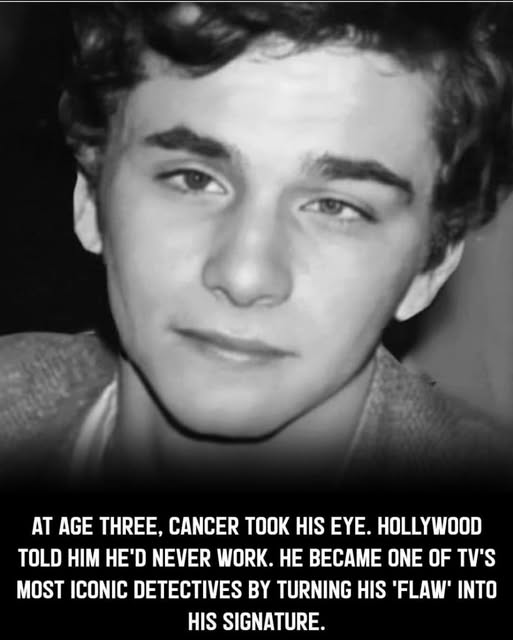
However, Falk’s journey to the top of the Hollywood hierarchy began long before the raincoat. His life was shaped by a profound medical challenge at the age of three, when he was diagnosed with retinoblastoma, a rare form of eye cancer. To save his life, doctors had to remove his right eye, leaving him with a prosthetic for the remainder of his life. Rather than allowing this to become a limitation, Falk integrated it into his unique persona. His distinctive squint and intense, slightly asymmetrical gaze became part of his magnetic on-screen presence. Falk famously possessed a wicked sense of humor regarding his prosthetic; as a teenager, after a heated disagreement with a baseball umpire over a call at third base, he reportedly plucked the eye from its socket, handed it to the official, and told him to “Try this.” This irreverent spirit and refusal to be defined by disability became the fuel for a career built on character and substance.
Before he was a household name on television, Falk was a formidable force in American cinema. He first captured the industry’s attention in 1960 with his terrifyingly authentic portrayal of the real-life mob enforcer Abe Reles in the film Murder, Inc. The performance was so chilling that it earned him an Academy Award nomination for Best Supporting Actor. He followed this success just a year later with another Oscar nomination for his role in Frank Capra’s Pocketful of Miracles, starring alongside Bette Davis. These early accolades established Falk as a “serious” actor who could disappear into roles that ranged from the menacing to the comedic, long before he stepped into the shoes of the LAPD’s most famous lieutenant.
While his professional life was a series of triumphs, Falk’s personal life was characterized by the complexities common to those in the high-pressure world of stardom. In 1960, he married Alyce Mayo, his sweetheart from Syracuse University. The couple shared sixteen years and two adopted daughters, Catherine and Jackie. However, the marriage eventually buckled under the weight of Falk’s demanding career and the personal strains that often accompany global fame. His subsequent marriage to actress Shera Danese brought further personal complications, particularly regarding his relationship with his daughter Catherine. In later years, the family’s internal divisions became public, with Catherine claiming she was increasingly estranged from her father and barred from visiting him as his health began to fail.
The final act of Peter Falk’s life was a poignant departure from the brilliance of his career. In the late 2000s, he began a rapid decline into the shadows of Alzheimer’s disease and dementia. His condition was significantly exacerbated following hip surgery in 2008, a common catalyst for the acceleration of cognitive decline in the elderly. The tragedy was compounded by the fact that the man who had built a legacy on the power of observation and the retention of minute details could no longer remember the character that had defined him. According to his physicians and family, Falk eventually lost all recollection of Lieutenant Columbo. The half-lit cigar and the rumpled coat were gone from his mind, replaced by the profound, quiet stillness of late-stage Alzheimer’s.
Peter Falk passed away in June 2011 at the age of 83 in his home in Beverly Hills. His death was met with a global outpouring of grief, but also a profound celebration of his artistry. Even the legendary Steven Spielberg, who directed one of the early episodes of Columbo, reflected on Falk as one of his greatest teachers, noting that he learned more about the craft of acting from Falk than from anyone else in those formative years. Falk’s legacy, however, remains remarkably vibrant. In an era of high-speed edits and flashy visual effects, the slow, methodical brilliance of Columbo continues to find new audiences. The character’s appeal remains rooted in the universal desire to see the powerful held accountable by the humble.
Though Peter Falk may have forgotten the man in the raincoat, the rest of the world has not. He remains a testament to the idea that an obstacle—whether it be a childhood illness or a rumpled exterior—can be transformed into a superpower. He taught us that the most dangerous person in the room is often the one who is the most overlooked, and that truth usually reveals itself in the “one more thing” we almost forgot to ask. Falk’s performance ensures that as long as there is a screen and a story, the scruffy lieutenant will always be there, just about to walk out the door, before turning around to solve the mystery one last time.
Leave a Reply