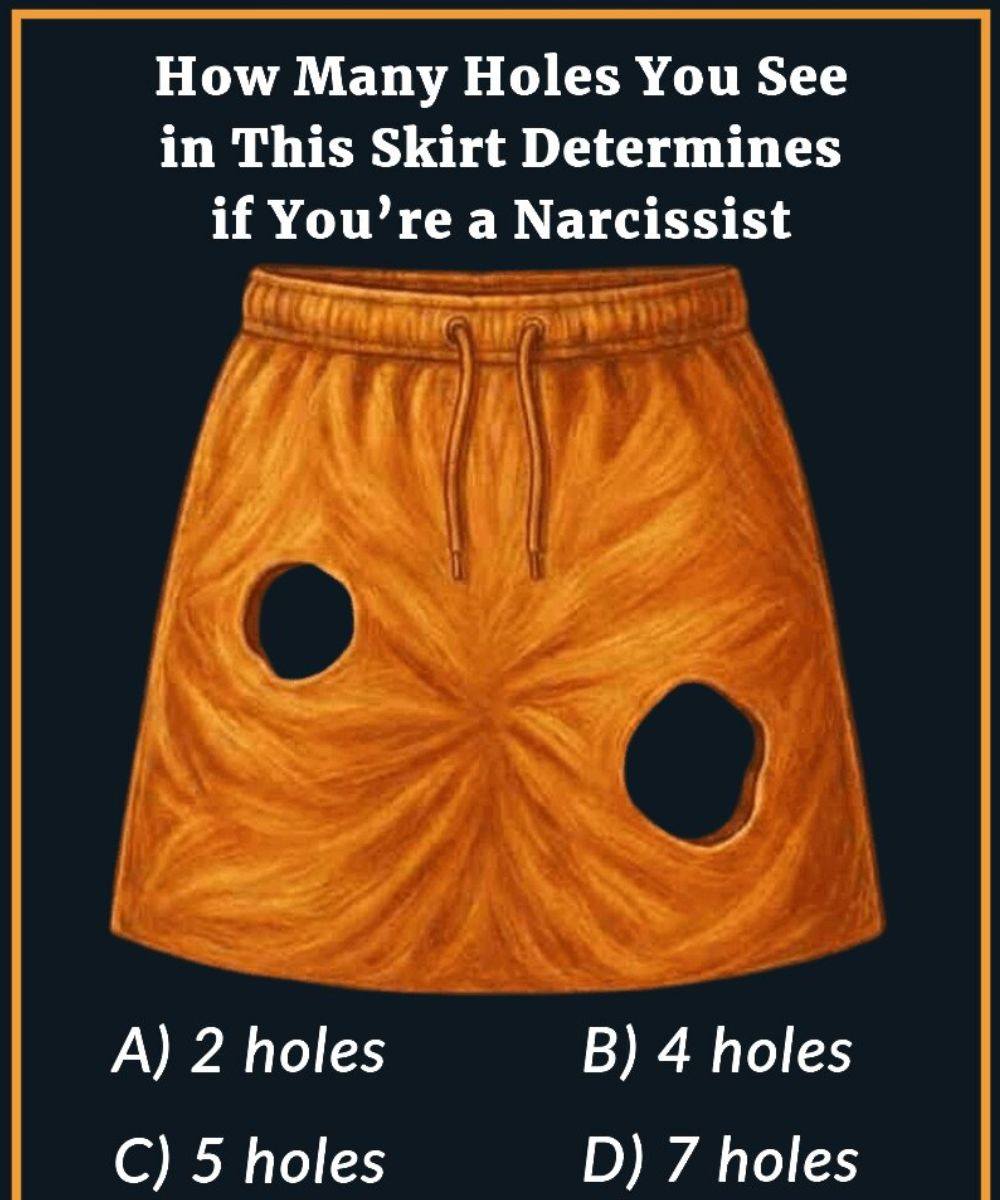
At first glance, it’s just a skirt with a few tears—a simple image that looks like a child’s counting game. But this viral puzzle is a psychological trap, designed to undermine your certainty the moment you think you’ve solved it.
What starts as a quick question—“How many holes are in the skirt?”—quickly spirals into a debate about logic, physics, and semantics.
The Stages of the “Trap”
Most people move through the puzzle in a specific sequence, with the “correct” answer shifting every time they change their perspective.
- The Surface Level (2 Holes): You see two clear tears on the front of the fabric. It’s the most intuitive answer.
- The 3D Perspective (4 Holes): You realize that for the background to be visible through the skirt, the tears must go through both the front and back layers of the fabric.
- The Structural Layer (6 Holes): You remember that a skirt is, by definition, a tube. It must have a hole at the top for the waist and a hole at the bottom for the legs.
- The Technical Layer (8+ Holes): You notice tiny openings for drawstrings, belt loops, or decorative stitching.
Why the Puzzle Works
The effectiveness of the riddle doesn’t lie in the image itself, but in the definition of a “hole.” The debate persists because people use different criteria for their count:
- Damage vs. Design: Some only count “accidental” holes (the tears). Others count “functional” holes (the waist).
- Visual vs. Logical: Some count what they can see. Others count what must be there based on the laws of physics.
Perspecitve Reasoning
Intuitive “I see two tears, so the answer is two.”
Physical “A hole through two layers of fabric is technically two holes.”
Architectural “An opening is an opening, whether it’s a tear or the waistband.” The “Personality” Myth Many versions of this puzzle claim that your answer reveals secret traits about your personality (e.g., “If you saw 6, you’re a genius!”). In reality, this is just a marketing tactic to drive engagement.
Your answer doesn’t reveal who you are; it reveals how you categorize information.- Are you a literalist who focuses on immediate evidence?
- Are you a systems-thinker who considers the construction of the object?
- Are you a skeptic who looks for hidden details?
In the end, there is no single “correct” answer—only a lesson in how many different ways the mind can interpret the “obvious.” The next time you see a simple puzzle online, remember: the trap isn’t the image, it’s the assumption that everyone sees the world exactly like you do.