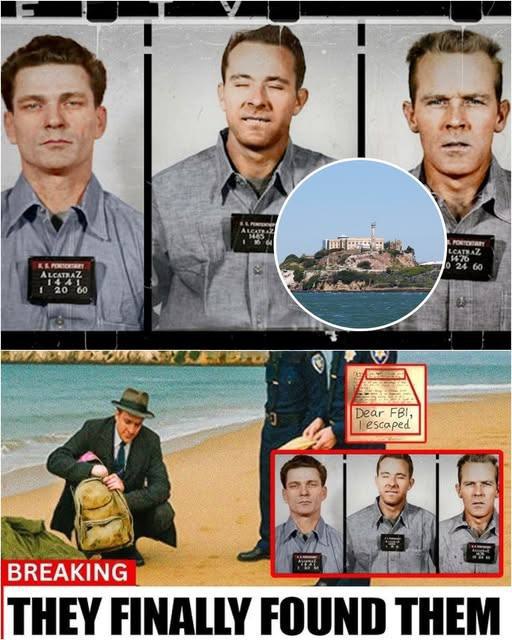
Alcatraz Island, rising starkly from the frigid, churning waters of the San Francisco Bay, was designed to be the final stop for the most incorrigible criminals in the American penal system. It was marketed as “escape-proof,” a fortress of concrete and iron where the tides served as a more effective deterrent than the armed guards in the watchtowers. Yet, in June 1962, three men—Frank Morris and brothers John and Clarence Anglin—orchestrated a disappearance so meticulous and daring that it would become the most enduring enigma in the history of American criminology. Their departure from the “The Rock” was not merely a prison break; it was a masterclass in ingenuity and the relentless nature of the human spirit when confined.
The preparation for the escape was a feat of low-tech brilliance that spanned months of clandestine labor. Operating under the very noses of their captors, the trio used sharpened spoons and a makeshift drill powered by a vacuum cleaner motor to slowly widen the ventilation ducts at the back of their cells. To conceal their progress, they crafted elaborate false walls out of painted cardboard and magazine scraps. Perhaps their most macabre stroke of genius was the creation of “dummy heads.” Using a mixture of soap, toilet paper, and actual hair salvaged from the prison barber shop, they sculpted lifelike decoys. These were placed in their beds on the night of June 11, 1962, successfully deceiving the guards during multiple rounds of night checks while the real inmates were already navigating the shadows of the prison’s utility corridors.
Once they had squeezed through the ventilation shafts, the men scaled a series of pipes to reach the roof. From there, they descended a fifty-foot kitchen vent to the ground and moved toward the water’s edge. Their primary vessel for the crossing was a masterpiece of improvisational engineering: a six-by-fourteen-foot inflatable raft and accompanying life vests meticulously constructed from more than fifty stolen rubberized raincoats, heat-sealed together with the warmth of steam pipes. At approximately 10:00 PM, they launched into the San Francisco Bay, a treacherous expanse defined by bone-chilling temperatures and currents that could sweep even the strongest swimmers out to the Pacific.
When the ruse was finally discovered the next morning, the resulting chaos was unprecedented. The FBI and the Coast Guard launched one of the largest manhunts in history, scouring the coastline and every inch of the bay. They found fragments of the raft and a single paddle, but no bodies were ever recovered. Authorities eventually officially concluded that the men had succumbed to hypothermia and drowned, citing the impossibility of surviving the crossing in such primitive gear. The case was closed by the FBI in 1979, but for the U.S. Marshals Service, the warrant remains open to this day.
The legend of the Alcatraz three refused to be buried at sea. Over the ensuing decades, a steady trickle of evidence emerged to challenge the official narrative of death. In 2013, the debate reached a fever pitch when a letter, purportedly written by John Anglin, was delivered to the San Francisco Police Department. The author claimed that all three men had successfully reached the shore and had lived under assumed identities for decades. He stated that Clarence had passed away in 2011 and Frank Morris in 2008, and that he, John, was now suffering from cancer and was willing to surrender in exchange for medical treatment. While handwriting experts found the results to be inconclusive, the letter added a haunting layer of possibility to the mystery.
Technological advancements in the 21st century have only added fuel to the fire. In 2003, the popular television program MythBusters demonstrated that a raft built to the exact specifications used by the inmates could, under the right tidal conditions, successfully navigate the bay to the Marin Headlands. This proved that survival was not a biological impossibility, but a matter of timing and luck. However, the most compelling evidence surfaced in 2018. Researchers applied modern artificial intelligence and sophisticated facial recognition software to a 1975 photograph allegedly taken in Brazil. The photo depicted two men standing on a rural road who bore a striking resemblance to the Anglin brothers. The AI analysis returned a high probability match, suggesting that the brothers had not only survived the crossing but had successfully disappeared into South America to lead lives of quiet anonymity.
This new evidence aligns with long-standing rumors from the Anglin family, who claimed to have received postcards and signed Christmas cards from the brothers for years after the escape. Relatives have consistently maintained that the men did not drown, but rather relocated to a place where the reach of American law was thin. If they were indeed in Brazil in the 1970s, it would mean they had achieved what the government had declared impossible: they had conquered “The Rock” and outlived the very system designed to break them.
The Alcatraz escape endures in the public imagination because it represents the ultimate victory of the underdog. Frank Morris, known for his high IQ, and the Anglin brothers, who had grown up swimming in the turbulent waters of Lake Michigan, combined intellectual strategy with physical resilience. They didn’t just break out of a cell; they outthought an entire institution. Their story is a reminder that even the most formidable fortresses are vulnerable to those who have nothing to lose and everything to gain. Whether they are currently resting in unmarked graves at the bottom of the San Francisco Bay or they lived out their final years in the sun-drenched landscapes of Brazil, their legacy remains a powerful testament to the desire for freedom.
The truth of what happened that night in June 1962 may never be fully confirmed by a DNA test or a public confession, but the legend has a life of its own. It is a story that proves the most “escape-proof” barriers are often more psychological than physical. As long as the mystery remains unsolved, the ghosts of Morris and the Anglin brothers will continue to haunt the corridors of Alcatraz, serving as a silent, mocking reminder that the human will can never be truly contained. The Rock stands today as a museum, a relic of a bygone era of incarceration, but its most famous residents are no longer there to see it—and perhaps they haven’t been for a very long time.