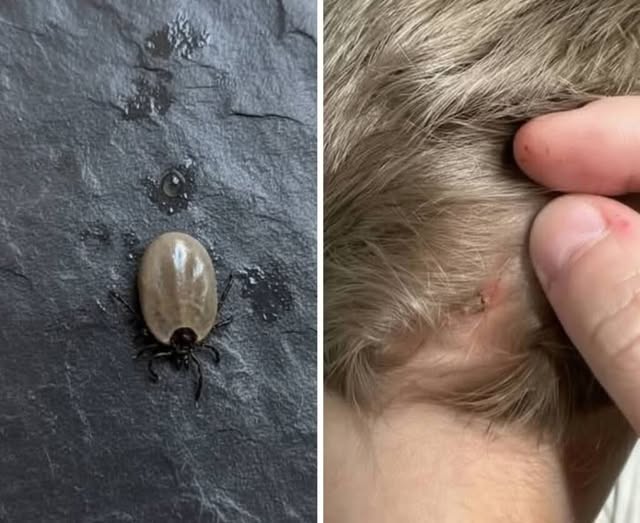
Discovering an unfamiliar insect tangled in the soft strands of a child’s hair can trigger an immediate wave of alarm for any parent. It usually happens in the most ordinary moments — while brushing hair after a bath, tying braids before school, or relaxing on the couch during a quiet afternoon.
Then suddenly, something moves.
A tiny dark speck shifts where it shouldn’t be.
In that instant, many parents feel a surge of panic. Questions start racing through the mind: Is it lice? Could it be a tick? Did something get into the house?
While the instinct might be to rush for strong chemical treatments or immediately head to a clinic, the most important first step is much simpler: stay calm and observe carefully.
The scalp may feel like a very personal and protected place, so finding a bug there can seem unsettling. But in most situations, the problem is manageable with patience and the right approach. Most discoveries like this are not emergencies — they are simply another small challenge that comes with raising children.
Identifying the Visitor: Three Common Possibilities
Before taking action, it helps to understand what kind of insect you are dealing with. In most cases, a bug found in a child’s hair falls into one of three categories.
Suspect #1: Head Lice
Head lice are the most common scalp invaders, especially among school-age children. These insects are small — about the size of a sesame seed — and are usually tan or pale gray.
Unlike fleas, lice cannot jump or fly. Instead, they crawl quickly from hair strand to hair strand. They depend entirely on a human scalp for survival and typically die within about 48 hours if separated from their host.
Often, the clearest sign of lice is not the insect itself but the presence of nits — tiny oval eggs that stick firmly to hair shafts. These eggs are glued in place with a strong natural substance and cannot simply be brushed away like dandruff.
Parents usually find them in common “hot spots” such as:
- Behind the ears
- Around the crown of the head
- Along the back of the neck
Suspect #2: A Tick
Ticks behave very differently from lice. Instead of roaming through hair, a tick’s goal is to attach directly to the skin and feed.
Ticks are usually oval-shaped with eight legs. If they have already started feeding, they may appear swollen or gray.
If the insect appears firmly attached to the skin and doesn’t move when touched, it may be a tick.
The primary concern with ticks is the potential transmission of illnesses such as Lyme disease. While infection is uncommon in most cases, removing the tick correctly is important to reduce risk.
Suspect #3: A Random Visitor
Not every insect found in a child’s hair is a parasite.
Kids spend time outdoors, roll in grass, climb trees, and explore. Sometimes an ant, beetle, or tiny spider simply ends up tangled in hair by accident.
If there is only one insect and no signs of eggs or scalp irritation, it is often just a temporary visitor that can easily be rinsed away.
The Myth of the Itchy Head
Many parents assume that lice always cause intense itching.
In reality, itching doesn’t come from the insects moving through the hair. It occurs because of an allergic reaction to the saliva lice release when feeding.
This reaction can take several weeks to develop. That means a child may carry a mild lice infestation without scratching at all.
For this reason, occasional scalp checks are often more effective than waiting for symptoms to appear.
What Parents Should Do Immediately
If you notice an insect in your child’s hair, the most important thing is to keep the situation calm.
Children quickly mirror their parents’ emotions. If you react with panic, they may feel frightened as well.
Instead, treat the situation like a small problem to solve — almost like a science experiment.
If the Insect Is Crawling Freely
Use tweezers or a tissue to gently remove it. Place it in a small sealed bag or container with rubbing alcohol. This can help a pediatrician or school nurse identify it if necessary.
If It Is a Tick
Use fine-tipped tweezers to grasp the tick as close to the skin as possible. Pull upward with steady pressure.
Avoid twisting or jerking the tick, as this may leave parts embedded in the skin. After removal, clean the area with soap and water or rubbing alcohol.
Modern Approaches to Treating Lice
In recent years, experts have noticed that some lice populations have become resistant to common chemical treatments. Because of this, many specialists now recommend a more physical approach to removal.
The Wet Combing Method
This method is widely considered one of the safest and most effective treatments.
First, apply a generous amount of thick hair conditioner to damp hair. The conditioner slows down the lice and makes them easier to remove.
Then use a metal nit comb to carefully comb through the hair in small sections, starting at the scalp and moving to the ends.
After each pass, wipe the comb onto a white paper towel to check for lice or eggs.
This process should be repeated every three to four days for about two weeks, which allows time to remove newly hatched lice before they can reproduce.
Staying Calm and Moving Forward
Finding a bug in your child’s hair can feel unsettling, but it is actually a very common parenting experience.
It does not mean your home is dirty, and it does not reflect poor hygiene. Children naturally interact closely with others and explore the outdoors, making these situations almost inevitable.
By learning how to identify the problem and handle it calmly, parents can turn a moment of panic into a simple, manageable task.
In the end, you’re not just removing a tiny intruder from your child’s hair — you’re showing them how to face small surprises in life with patience, confidence, and calm.