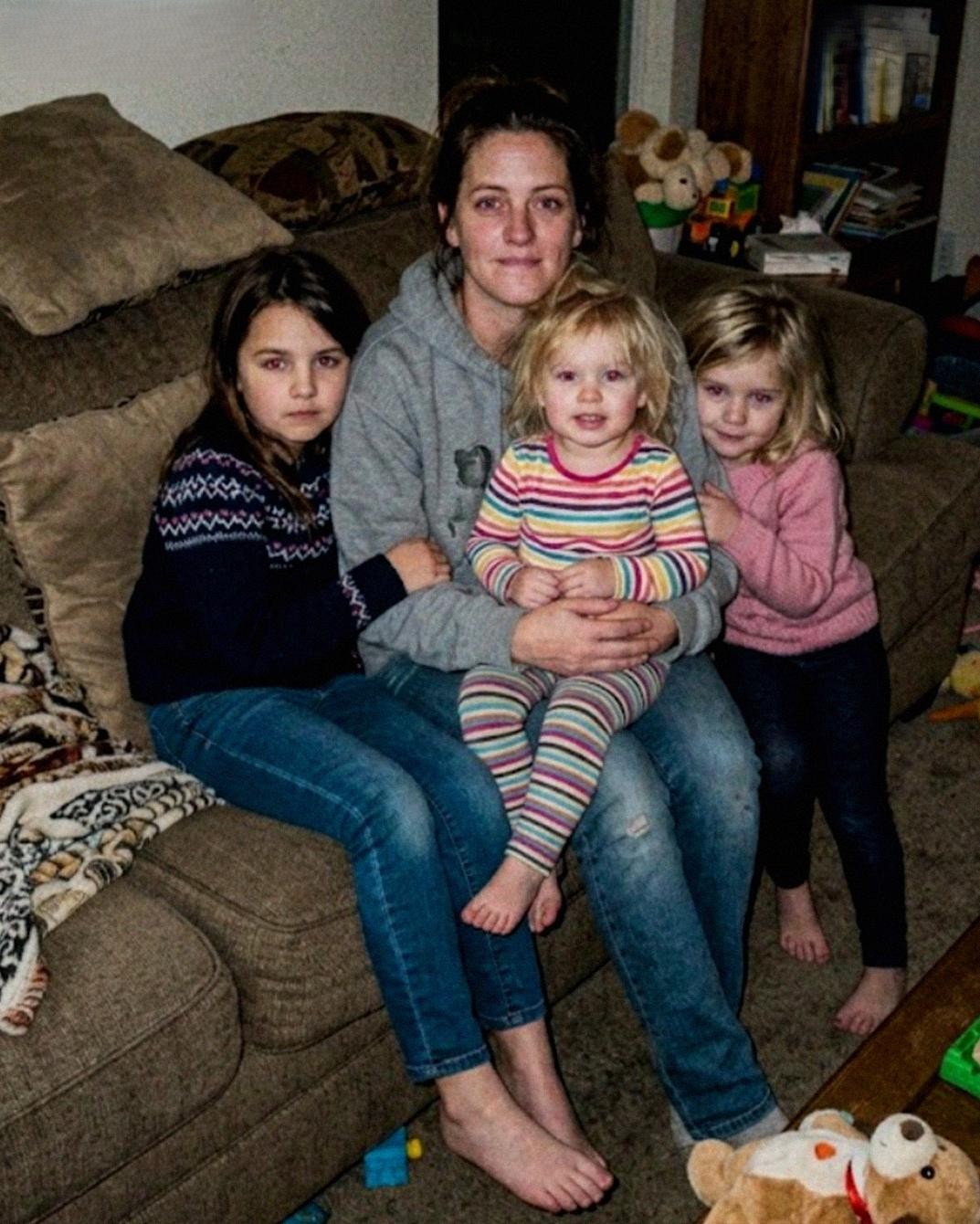
I became a mother in the heavy, echoing silence that follows a disaster. It wasn’t a decision made during a calm conversation or a carefully planned moment on a calendar. It happened after a funeral, beneath the dull grey sky of a cemetery where the earth was still freshly turned on my sister-in-law Laura’s grave. My brother, Edwin, stood there looking like the shadow of the man I once knew. And then, before the funeral flowers had even begun to fade, he disappeared. No goodbye. No frantic phone call. No message left behind. Just an absence so complete that it changed the course of four lives overnight.
The shift happened brutally fast. Less than two days later, a social worker appeared at my door with three confused little girls and a single overstuffed suitcase. That worn piece of luggage looked painfully small, as if it were trying to carry the entire world of an eight-year-old, a five-year-old, and a three-year-old. Jenny, Lyra, and tiny Dora stood quietly on my porch, their eyes filled with confusion. They hadn’t only lost their mother—they had suddenly been abandoned by their father as well.
The first year felt like a long emotional endurance test. My home, once peaceful and quiet, became a place filled with grief. Dora, the youngest, tugged on my sleeve every evening asking when her mommy would come back. Lyra refused to unpack her clothes for months, living out of that old suitcase because she didn’t want to “get too comfortable,” as if settling in meant betraying the life they had lost. Jenny, the oldest, reacted differently. She stopped crying altogether. Not because she felt better—but because she had already reached a painful conclusion: tears didn’t change anything in a world that could take so much away.
For years, I lived with the constant expectation that Edwin would return. I convinced myself there had to be a logical explanation—maybe a breakdown, maybe work, maybe some problem he needed to solve before facing his daughters again. I told the girls stories about how much he loved them, trying to keep that image alive even while fearing it was collapsing. But weeks turned into months, and months slowly hardened into years. His silence became almost physical, like another presence in the house sitting at the dinner table and lingering in every room.
As time passed, the difference between “aunt” and “mother” slowly disappeared. I signed school permission slips, held their hair back during stomach flu, and sat in the front row of every school play so they would never have to search the audience for a missing parent. I helped them through teenage heartbreak and the overwhelming stress of college applications. Eventually they stopped feeling like my brother’s children and became mine in the only way that truly matters—through the everyday act of being there.
Then, last week, the ghost came back.
A sharp knock interrupted an ordinary Tuesday afternoon. When I opened the door, my breath caught in my chest. Edwin stood there looking older, as if life had worn him down and scraped away the man I once recognized. In the kitchen behind me, the girls—now young women—were laughing about something, unaware that the man on the porch shared their blood. Edwin looked at me nervously, as if expecting anger or rejection.
“Hi, Sarah,” he said quietly.
Fifteen years of absence—missed birthdays, empty chairs, unanswered questions—and all he offered was a simple greeting.
I didn’t invite him inside. Instead, he handed me a thick sealed envelope.
“Not in front of them,” he said, his voice unsteady.
I stepped outside and closed the door behind me. My hands shook as I opened it, years of buried anger rising to the surface.
Inside was a letter dated fifteen years earlier, written in rushed, uneven handwriting. It revealed a truth I had never imagined. After Laura died, Edwin hadn’t only lost his wife—he had uncovered a nightmare of hidden debt. Loans he didn’t know existed, financial traps, and a house worth far less than what was owed on it. Overwhelmed by grief and panic, he believed he was dragging his daughters into financial disaster. In his mind, the only way to save them was to leave them in my care.
But the papers behind the letter stopped me cold.
They were recent legal documents stamped by banks and law firms. Three words appeared again and again:
Cleared. Settled. Reclaimed.
Edwin hadn’t been hiding without purpose. For fifteen years he had lived quietly, working constantly and sending every dollar toward paying off those debts. He tracked down creditors, closed accounts, and slowly rebuilt his finances. Everything he owned—every investment, every property, every cent—had been placed into trusts for the girls.
“I fixed it,” he said softly, searching my face for forgiveness I wasn’t ready to give.
Anger surged through me.
“You think money fixes this?” I asked sharply. “Do you think a bank account replaces fifteen years of explaining to them that they weren’t abandoned because they were unlovable?”
He had no answer.
When I walked back into the house, the girls immediately sensed something had changed.
“Your father was here,” I said.
The reaction was immediate and complicated. Jenny’s face hardened. Dora let out a strange, hollow laugh. Lyra stared silently at the envelope in my hand.
I explained everything—the debt, the disappearance, the years of work, and the wealth now legally placed in their names.
“I don’t care about the money,” Jenny said quietly. “Why didn’t he come back sooner? Why was paying debts more important than being with us?”
That question cut deeper than anything else.
Edwin had traded presence for provision—and to them, that exchange felt like betrayal.
But Lyra was the one who picked up the phone. She dialed the number written in the letter.
“Come back,” she said calmly. “We’re waiting.”
When Edwin stepped into the house, there was no emotional reunion. No hugs. No tears of joy. Only heavy silence.
The girls questioned him directly. They didn’t ask about his life—they asked why he believed they couldn’t handle the truth fifteen years ago.
“I thought you’d be better off,” he repeated.
“You don’t get to decide that,” Dora answered, her voice shaking.
Eventually the questions slowed, not because answers were found but because there were too many wounds to heal in one afternoon.
Then Dora suggested something unexpected.
“Let’s make dinner.”
It wasn’t forgiveness. It was simply a starting point.
We cooked together in a strange, quiet normality. The sound of utensils and boiling pots filled the spaces where conversation failed. Edwin sat at the end of the table like a man who had bought his way back into a life he barely understood.
The meal tasted of silence and unfinished emotions.
It wasn’t a happy ending.
But it was a beginning.
The silence that had defined fifteen years of our lives was finally broken. The truth—messy, complicated, and incomplete—had taken its place.
And as I looked around the table, I realized something.
The debts might have been settled.
But the family was still broken.
For the first time in fifteen years, though, we were all sitting together—trying to figure out how to rebuild it.