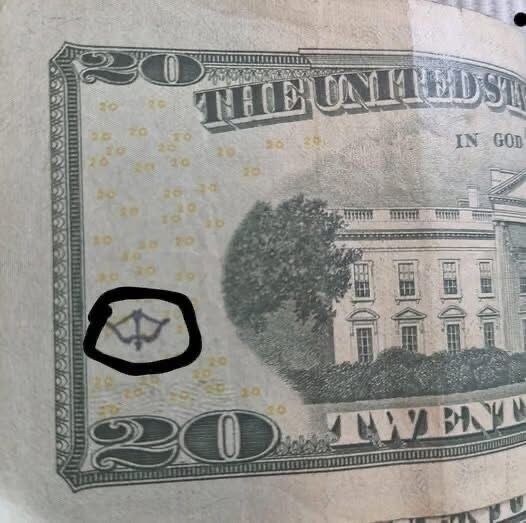
In the sterile, high-precision world of modern finance, most people handle paper currency with a practiced indifference. We glance at the denominations, verify the familiar portraits of long-dead statesmen, and tuck the notes away, rarely pausing to consider the physical history of the paper itself. However, every so often, a twenty-dollar bill or a hundred-dollar note will surface with a peculiar blemish: a tiny, inked emblem of a bow and arrow, a miniature star, or a cryptic geometric shape stamped into the margin. To the uninitiated, these marks might look like graffiti or the work of a bored teller, but they are actually part of a centuries-old, covert verification network known as “chop marking.”
These stamps are not evidence of tampering or counterfeiting; rather, they are the fingerprints of global trade. They represent a decentralized system of trust that predates modern banking and continues to operate in the shadows of the digital age. To understand the bow-and-arrow symbol on your currency is to understand a historical lineage of financial tradition that began in the markets of ancient China and has since traveled across every continent.
The practice of chop marking originated over a millennium ago during an era when currency was valued by its weight in precious metals. In ancient Chinese markets, merchants dealt primarily in silver and gold bullion. Because the purity of these metals could be easily manipulated, a dishonest trade deal could result in financial ruin. To protect themselves, respected merchants and “shroffs”—expert money changers—would meticulously test the weight and purity of the metal. Once satisfied that a coin or bar was genuine, they would strike it with a personal or company stamp, known as a “chop.”
This stamp acted as a signature of authenticity. If a coin circulated back into the market with a recognizable chop, subsequent traders knew it had already been vetted by a trusted peer. Over time, a single coin might accumulate dozens of these marks, becoming a physical record of its own reliability. In the world of precious metals, the more “chops” a coin had, the more trustworthy it became, as it had passed through a succession of skeptical hands and emerged unscathed.
As global economies transitioned from metallic bullion to paper tender, the tradition of chop marking did not vanish; it adapted. Paper currency is inherently more fragile and significantly easier to forge than silver or gold. In the 19th and early 20th centuries, as international trade routes expanded, the U.S. dollar began to emerge as the “lingua franca” of global commerce. However, in regions lacking a centralized banking infrastructure—such as parts of Southeast Asia, Africa, and Latin America—merchants needed a way to verify these foreign bills quickly and accurately.
The solution was the ink chop. Merchants, money changers, and even local casinos began applying small, vibrant stamps to the margins of U.S. banknotes. A bow-and-arrow symbol or a stylized character served the same purpose as the ancient metal punches: they were visual cues that a professional had already inspected the bill’s watermarks, security threads, and paper quality. These marks created an informal, decentralized verification network that allowed trade to move smoothly in environments where the official word of a distant government was not enough to guarantee value.
Today, while the Federal Reserve and the Secret Service use high-tech infrared sensors and magnetic inks to catch counterfeits, the chop mark remains a persistent low-tech reality. If you find a bill with a bow-and-arrow stamp, it has likely traveled through an international trade hub like Hong Kong, Singapore, or Bangkok. It may have been used to settle a wholesale trade in a bustling marketplace or passed through the hands of a currency exchanger in a region where cash remains the primary vehicle for high-value transactions.
From a legal standpoint, the presence of a chop mark does not diminish the value of the bill. Under U.S. law, these markings are generally considered “minor defacement” that does not render the note unfit for circulation. Banks within the United States accept them without hesitation, recognizing that they are simply cultural artifacts of the bill’s journey abroad. However, for numismatists—collectors and scholars of currency—these marks are invaluable. Each stamp is a data point in a hidden narrative of economic migration. A bill with multiple chops from different regions tells a story of global interaction, connecting a bank in Ohio to a street vendor in Thailand and a trading house in Johannesburg.
Beyond the practicalities of verification, chop marks serve as profound cultural artifacts. they demonstrate a fundamental truth about money: it is not just a medium of exchange, but a social contract built on trust. In the absence of a formal institution to provide that trust, human beings have consistently invented their own systems to fill the gap. The tiny bow and arrow is a symbol of human ingenuity, a reminder that before we had digital ledgers and blockchain technology, we had the merchant’s stamp and the promise it represented.
For the curious observer, recognizing these marks requires a keen eye. They are usually found in the “dead space” of the bill, away from the primary portrait of the president and the official security features. They are often applied in bright red, purple, or black ink, and their designs range from simple geometric shapes to intricate logos that function as a merchant’s brand. While they may seem random, their placement is often intentional, designed to be seen at a glance by those “in the know” without obscuring the official print of the Treasury.
In the modern era, as we move toward a cashless society and digital “stablecoins,” the persistence of chop marks is a fascinating anomaly. They represent a tangible, human side of trade that refuses to be fully automated. In certain markets, a merchant’s physical mark still carries more weight than a bank’s digital confirmation. It is a signature of personal accountability in an increasingly anonymous financial world.
The next time you receive a twenty-dollar bill, take a moment to look beyond the face of Andrew Jackson. Search the margins for a tiny, out-of-place symbol. If you find one, you are holding a piece of living history. That tiny stamp is a quiet record of a journey across borders and through the hands of people who relied on their eyes and their reputations to keep the wheels of commerce turning. Far from being a flaw, a chop mark is a badge of honor—a testament to the fact that the bill has earned the confidence of the world’s most skeptical traders.
Leave a Reply