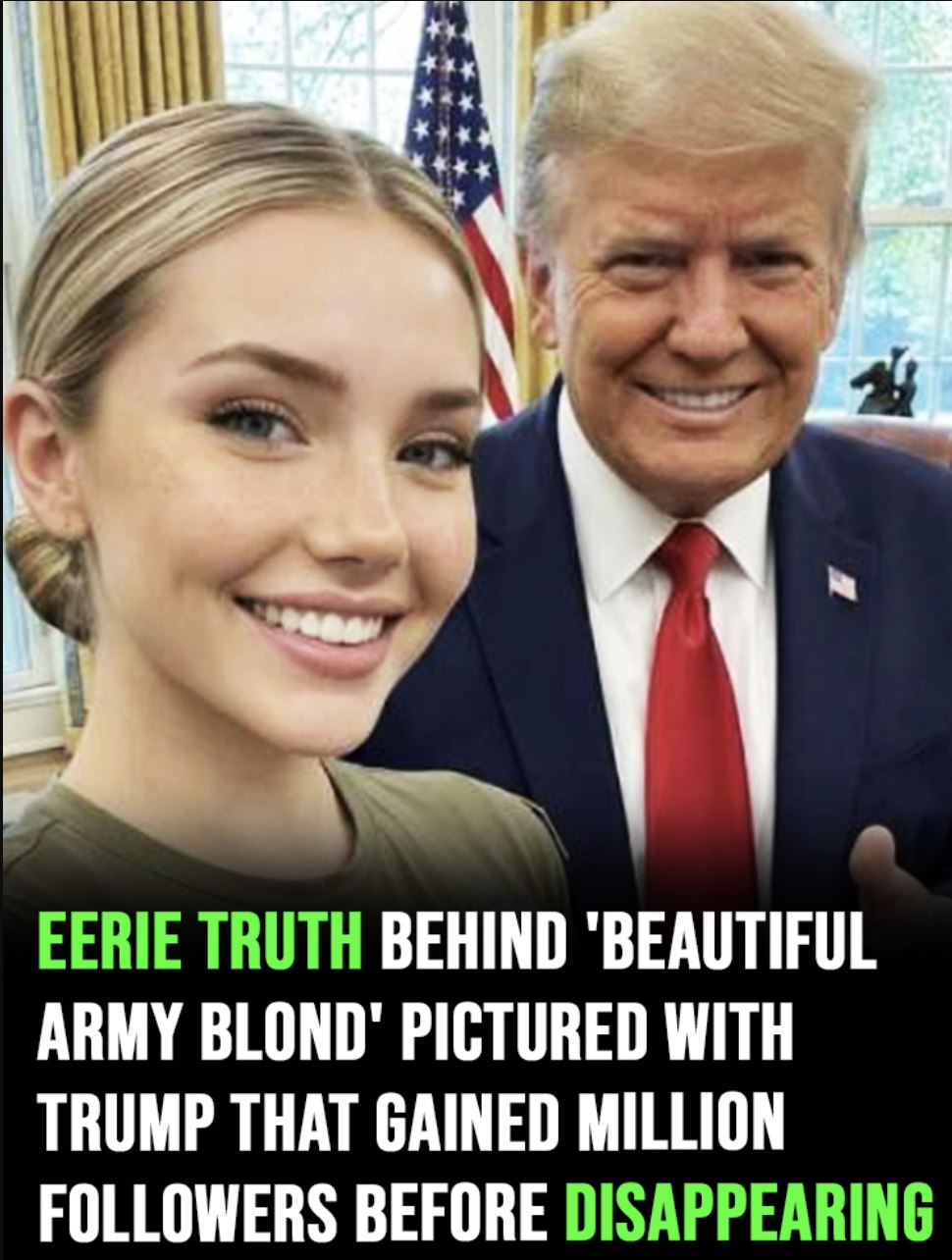
At first glance, she looked like a character straight out of a Hollywood movie.
Blonde, confident, dressed in military gear, and often photographed beside fighter jets or walking across what appeared to be real U.S. military bases. Her social media posts featured patriotic captions, striking imagery, and a strong sense of purpose that quickly captured attention online.
Then one photo pushed her profile into the spotlight — an image showing her seemingly standing next to Donald Trump.
Almost overnight, the account known as Jessica Foster exploded in popularity.
Within a short time, she had gained hundreds of thousands — eventually millions — of followers.
A Rapid Rise to Viral Fame
Jessica Foster’s account grew faster than most influencers could ever hope for. Many followers admired not only her appearance, but the image she projected: discipline, patriotism, and military service.
Comments flooded her posts daily.
Some thanked her for her “service.”
Others praised her lifestyle.
Many described her as the perfect combination of beauty, strength, and patriotism.
To countless viewers, she appeared completely authentic — even inspirational.
But not everyone was convinced.
Small Details That Raised Suspicion
As her audience expanded, some users began examining her photos more closely.
Several subtle details started to stand out:
- Military badges that didn’t match official uniform standards
- Lighting in photos that looked slightly unnatural
- Background settings that seemed almost too perfect to be real
On their own, these inconsistencies were easy to dismiss.
But when people looked at them together, questions started to emerge.
Then an even bigger issue surfaced.
Investigators could find no official record of a soldier named Jessica Foster in the U.S. military.
That discovery quickly shifted curiosity into a deeper investigation.
The Reality Behind the Profile
According to reports, including coverage referenced by The Washington Post, experts eventually confirmed what many had begun to suspect.
Jessica Foster was never a real person.
The images were created using artificial intelligence.
Every detail — the uniforms, the poses, the expressions, and even the environments — had been digitally generated to appear realistic enough to pass as authentic.
And for a while, it worked.
Why Create a Fake Persona?
Experts say situations like this are becoming increasingly common in the digital age.
Creating an idealized online personality — attractive, confident, and tied to themes like patriotism or authority — can quickly attract massive engagement.
And that attention can be turned into profit.
In this case, reports suggest the account directed followers toward paid platforms, a tactic often used to monetize viral traffic.
However, financial gain isn’t always the only motivation.
Fake profiles like this can also be used to influence public opinion, shape narratives, or exploit people’s trust.
A Growing Challenge in the Digital World
What makes the story particularly unsettling isn’t just that the account was fake — it’s how convincing it appeared.
Thousands of people followed her.
They interacted with her posts.
Many genuinely believed she was real.
Modern AI tools now allow creators to generate realistic faces, backgrounds, and entire identities with surprising accuracy. As a result, the line between real and artificial content online is becoming harder to recognize.
The Bigger Lesson
The story of Jessica Foster is about more than just one fabricated account.
It highlights a broader shift in how easily perception can be shaped online — and how quickly people can connect with something that only appears real.
In a digital environment filled with polished images and viral content, a healthy level of skepticism has quietly become essential.
Because sometimes the most convincing stories…
aren’t real at all.
What do you think — would you have spotted the signs, or would you have believed it too?