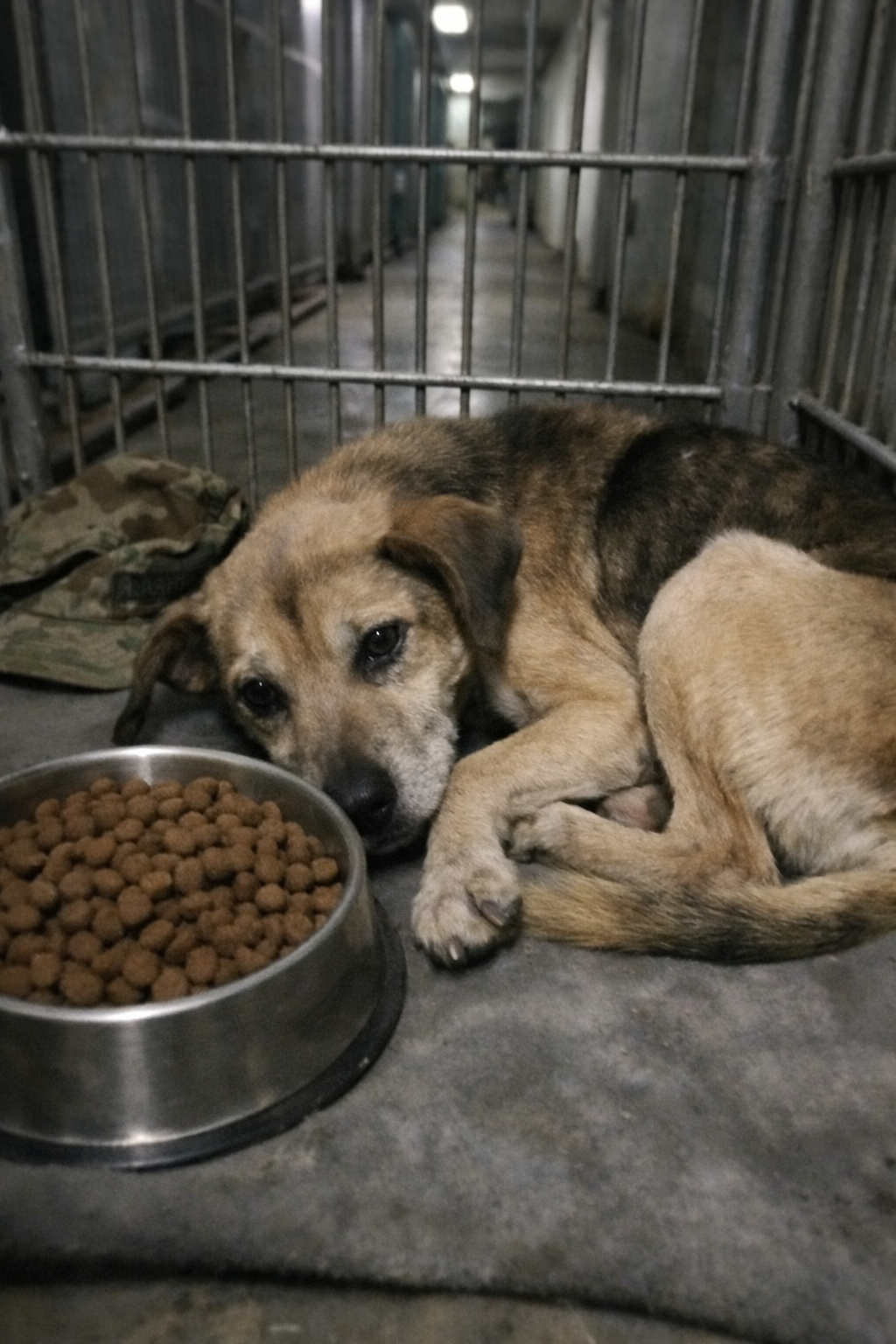
The dog lay curled inside the kennel, inches from a full bowl of food — and didn’t touch it, not once, not for several evenings in a row.
At first, no one thought much of it.
Shelters are quiet in the evenings. The kind of quiet that hums. Fluorescent lights buzz faintly. Metal doors click shut. The smell of disinfectant lingers in the air, sharp and clean, almost cold. Dogs usually eat the moment the bowls are slid in. Hunger always wins.
But not this one.
He was about seven years old. Medium-sized. Mixed breed. His coat was dull but clean, ribs not visible enough to explain the refusal. He lay with his back against the kennel wall, chin resting on his paws, eyes open — always open. Watching.
The bowl sat there. Full. Untouched.
Volunteers paused as they walked past.
Some slowed their steps.
Some frowned.
“Maybe he’s sick,” someone muttered.
“Or depressed,” another said.
On the third night, a staff member crouched in front of the kennel longer than usual.
The dog didn’t move.
His eyes followed her hand as she reached for the bowl. When metal scraped metal, he flinched — just slightly — and his front paw trembled. Not fear exactly. Something tighter. Deeper.
Behind him, in the shadows of the kennel, lay a folded military cap, old and frayed, tucked carefully into the corner like it belonged there.
The room seemed to still.
And for the first time, the question no one had asked yet surfaced quietly, uncomfortably:
Why would a hungry dog refuse to eat… unless he was waiting for something else?
The dog’s intake name was Max.
He’d been picked up by animal control three weeks earlier, found lying beside a park bench after sunset. No leash. No tags. Just that cap beside him. When officers approached, Max hadn’t growled. Hadn’t barked.
He hadn’t followed them either.
He simply stood, picked up the cap gently in his mouth, and walked with his head low.
The shelter paperwork was thin. No owner listed. No emergency contact. Just a note scribbled at the bottom:
Dog calm. Extremely quiet. Does not resist.
At first, Max ate normally.
Then one night — he didn’t.
And then another.
And another.
A volunteer named Sarah noticed something else, too.
Max only refused food after closing time.
During the day, he would take a few bites if someone sat nearby. At night, when the lights dimmed and the hallway emptied, the bowl stayed full.
Sarah began staying later.
She watched him from the end of the corridor, pretending to organize supplies. Max lay still, eyes fixed on the kennel door. Not the bowl. The door.
She crouched one evening and spoke softly.
“Hey, buddy. You don’t like the food?”
Max’s ears flicked at her voice. He didn’t look at her. Didn’t move toward the bowl.
She noticed his breathing then — slow, controlled, but shallow. Like someone holding themselves together by force. His paw twitched again.
Sarah reached carefully into the kennel, her fingers brushing the edge of the cap.
Max’s head lifted instantly.
A low sound escaped his chest — not a growl, not a whine. Something closer to protest.
“Oh,” she whispered. “I’m sorry.”
She left the cap where it was.
Later that night, she searched missing person notices online.
It didn’t take long.
A photo surfaced — grainy, slightly out of focus. A man in his late 50s. Weathered face. Gray stubble. Wearing the same military cap.
Name: Thomas Reed.
Status: Missing.
Last seen near the park.
Sarah’s chest tightened.
The next morning, she showed the photo to the shelter manager.
Max watched from his kennel as they talked. When the photo was held up, his body stiffened. His tail thumped once — weak, hopeful.
And suddenly, his refusal to eat wasn’t stubbornness.
It was loyalty.
The call came from a local hospital two days later.
An older man had been admitted after collapsing near a bus station. Dehydrated. Hypothermic. Confused. No identification — except a dog hair-covered jacket and an empty pocket where a cap should have been.
Sarah didn’t hesitate.
The drive felt endless. Rain streaked across the windshield. Her hands gripped the steering wheel tighter than necessary.
At the hospital, the air was sterile and cold. Machines beeped softly. The hallway lights cast a tired yellow glow. Thomas Reed lay in the bed, pale, eyes closed, IV running into his arm.
“He’s been asking for his dog,” a nurse said quietly. “Over and over. Then he just stopped.”
Sarah swallowed. “Can we bring him?”
They didn’t normally allow animals.
But rules bend when something fragile is at stake.
Max walked into the hospital room slowly, nails clicking against the tile. His body was tense, cautious. Then his nose lifted.
His ears pricked.
And suddenly, he ran.
Not fast — but desperate.
He leapt gently against the bed, placing his front paws on the mattress, sniffing Thomas’s face. His tail wagged hard, then stopped as if unsure.
Thomas’s eyes fluttered open.
“Max?” His voice cracked. “You didn’t eat, did you?”
Max whined softly and pressed his forehead against Thomas’s chest.
The man’s hands shook as they wrapped around the dog’s neck.
“I knew you’d wait,” he whispered. “I tried to come back.”
The room went quiet.
Nurses turned away. Sarah wiped her face with her sleeve.
Thomas explained later, in broken pieces.
He’d been a veteran. Lost his family years ago. Max had been his constant for nearly a decade. When Thomas got sick, he told Max to stay by the bench — just for a moment — while he went to get help.
He never made it back.
“I didn’t want him to see me like that,” Thomas said weakly. “So I told him to wait.”
And Max did.
For nights.
For hunger.
For hope.
Back at the shelter, Max ate that evening.
Every bite.
Thomas recovered slowly.
So did Max.
They moved into assisted housing together, a small place with creaky floors and sunlight that pooled warmly in the afternoons. Max slept near the door now — not because he was afraid, but because old habits die slowly.
He still watched.
But he ate.
Every night.
Some kinds of love don’t announce themselves loudly.
They wait.
If this story stayed with you, if it made you pause even for a moment, share your thoughts in the Facebook comments.
Because sometimes, the quietest loyalty is the one that saves a life.
Leave a Reply