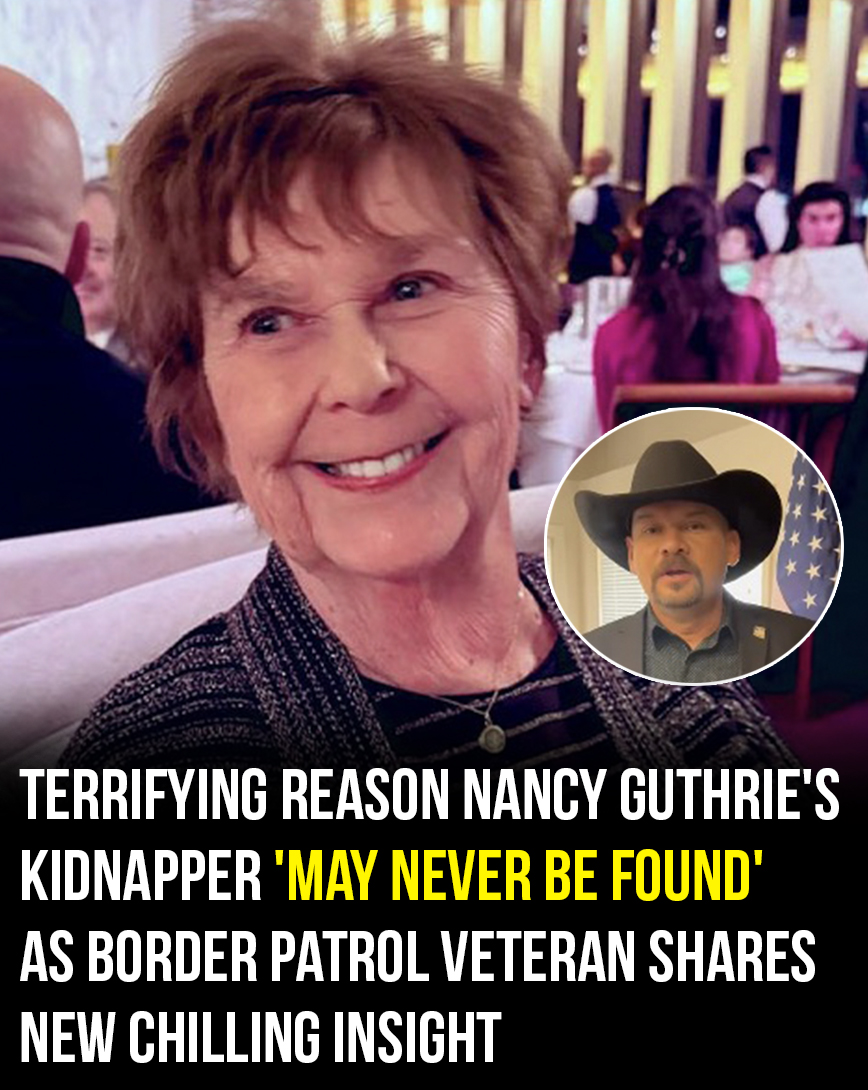
As the search for Nancy Guthrie stretches into another agonizing day, investigators in Tucson are confronting a reality that few families ever want to hear: the person responsible for her disappearance may never be found. That possibility is not rooted in a lack of effort or urgency, but in geography, timing, and a set of conditions that experts say strongly favor someone who planned their escape as carefully as the act itself.
Nancy Guthrie, the eighty-four-year-old mother of Savannah Guthrie, has now been missing for five days. Authorities believe she was taken against her will, yet no suspects have been publicly identified. Each passing hour increases both the stakes and the difficulty of the investigation.
Earlier this week, Savannah and her family released an emotional video appeal, speaking directly to whoever may be responsible. There was no anger in her voice, only resolve and desperation.
“We will not rest,” she said. “Your children will not rest until we are together again.” Addressing reports of a possible ransom note, she added simply, “Please reach out to us.”
But while the family pleads for contact, experts warn that the conditions surrounding Nancy’s disappearance make identification of the abductor extraordinarily difficult.
One of those experts is Art Del Cueto, a longtime U.S. Customs and Border Protection officer who lives just minutes from Nancy’s home. Though he is not involved in the investigation, his career has been spent tracking individuals through the same unforgiving terrain now at the center of this case.
According to Del Cueto, the environment itself may be the abductor’s greatest ally.
The area surrounding Nancy’s home sits at the edge of Tucson’s rugged desert landscape, a region defined by thick cactus, scrubby mesquite trees, rocky ground, and limited visibility. Step just a few feet off the road, Del Cueto explains, and you are effectively swallowed by terrain that offers endless hiding places and almost no clear lines of sight.
“This isn’t an area where you can just scan the horizon and see everything,” he said. “The desert absorbs people. It hides movement. And it does so quickly.”
That concealment is compounded by Tucson’s proximity to the southern border. Del Cueto noted that someone familiar with the area could disappear into Mexico in under ninety minutes, especially if they acted before authorities had a clear understanding of what had occurred.
“We’re on the southern border,” he explained. “You’re dealing with international crime all the time. There are too many variables to rule anything out.”
That reality, he added, may explain why investigators have been so cautious about releasing information. In cases where cross-border movement is possible, revealing too much too soon can compromise strategies that depend on discretion and timing.
Nancy’s neighborhood itself presents additional challenges. It is not gated. There are no natural barriers separating homes from the surrounding desert. A neighbor, Morgan Brown, who lives roughly a quarter mile away, described the area as deceptively open.
“If you step two feet off the road, you’re basically in thick cactus,” Brown said. “It’s desert everywhere—mesquite, rocks, scrub. People wondered if she wandered off, but she walks with a cane. I can’t imagine why she would do that.”
That observation aligns with what authorities have already stated publicly: Nancy did not wander. She does not suffer from dementia or cognitive impairment, and she was known for maintaining consistent routines. Her disappearance does not fit the profile of an elderly person becoming disoriented.
Instead, investigators believe she was taken.
Former FBI special agent Bryanna Cox, now a professor at the University of South Florida, has also weighed in on the case. Based on available details, she believes the abductor is likely a stranger and not someone known to Nancy.
“If it were a family member or someone familiar with the home, there wouldn’t have been forced entry,” she explained. “If she knew the person, they would have likely used a ruse—something to convince her to go willingly and get into a vehicle.”
That distinction matters. Forced entry suggests confrontation. Confrontation suggests urgency. And urgency, combined with advanced age and mobility limitations, raises serious concerns about Nancy’s safety.
Investigators have emphasized that time is critical. The longer a perpetrator remains unidentified, the more opportunities they have to distance themselves from the crime—geographically, digitally, and psychologically. In regions like southern Arizona, those opportunities multiply.
Search teams continue to work methodically, but the environment slows everything. Helicopters scan terrain that looks the same mile after mile. Ground searches are labor-intensive and dangerous. Evidence degrades quickly under desert conditions. Footprints vanish. Traces disappear.
All of this feeds into the expert assessment that the abductor may have planned not just the act, but the aftermath.
That possibility is what makes the case so frightening.
It suggests someone who understood the terrain, the response time, and the vulnerabilities inherent in both. Someone who acted with confidence that even a massive search effort might struggle to close the gap.
For Savannah and her family, those realities exist alongside something far more personal: waiting. Waiting for news. Waiting for contact. Waiting for answers that may or may not come.
Savannah has stepped away from her professional commitments to remain with her family, focusing entirely on the search. Those close to her describe a woman holding herself together through sheer determination, anchored by the belief that public silence cannot mean private surrender.
Authorities have not ruled out any scenario. They continue to evaluate tips, forensic evidence, and possible ransom communications. Federal resources have been brought in. Yet the physical reality of the region remains an obstacle no amount of manpower can fully erase.
Experts agree on one point: the window for easy answers has likely closed.
What remains now is persistence. Careful investigation. And hope—tempered, fragile, but still present.
The idea that Nancy Guthrie’s abductor may never be identified is not something investigators or the family are willing to accept lightly. But acknowledging that risk underscores just how complex and dangerous this case is.
As one grim truth emerges, it is this: sometimes, the most terrifying factor in a disappearance is not human cruelty alone, but the silent, indifferent landscape that allows it to vanish without a trace.
And yet, despite every obstacle, the search continues. Because for the Guthrie family, and for those working to bring Nancy home, resting is not an option.
Leave a Reply