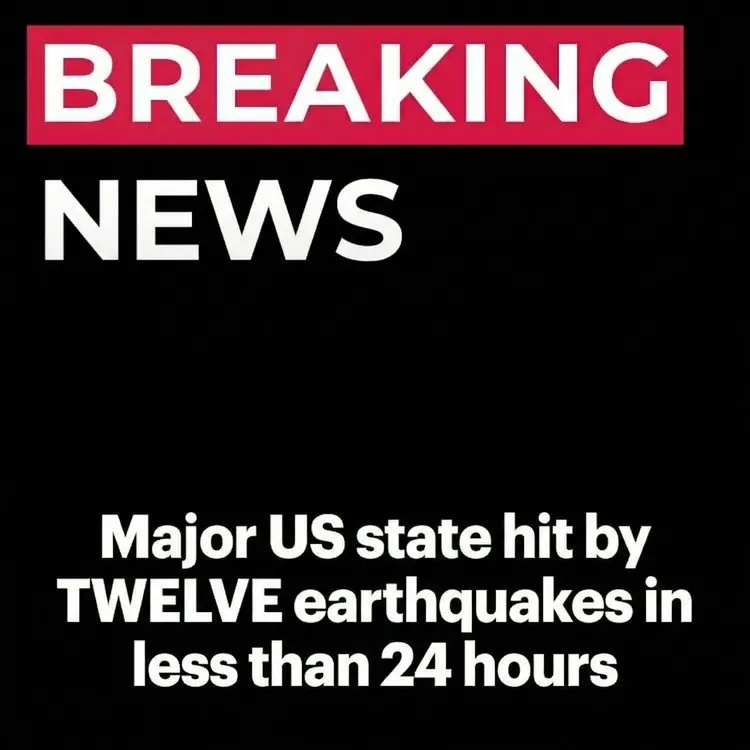
Southern California experienced an unusually active day of seismic movement as a cluster of earthquakes rippled through the region, drawing attention from residents, emergency officials, and geologists. Over the course of roughly 24 hours, more than a dozen noticeable tremors were recorded, with many more smaller quakes detected by instruments. While no serious damage or injuries were reported, the activity served as a sharp reminder of the region’s persistent seismic risk.
The sequence began Monday evening near the city of Indio, located in the Coachella Valley. The initial earthquake, which registered a magnitude 4.9, struck just after sunset and was widely felt across eastern Riverside County. Residents described sharp jolts followed by rolling motion, with some reporting items rattling off shelves and pictures swaying on walls.
In the hours that followed, the area experienced a steady stream of aftershocks. By Tuesday afternoon, seismologists had recorded more than 150 individual seismic events associated with the swarm. Most of these were minor, measuring below magnitude 2.0 and detectable only by sensitive instruments. However, more than a dozen reached magnitudes between 2.5 and 4.9, strong enough to be felt by people near the epicenter.
The most recent notable quake, a magnitude 3.8 event, struck Tuesday afternoon along the Mission Creek strand of the San Andreas Fault. Though relatively modest in size, it was felt across a broad area, including parts of Riverside and San Bernardino counties. Some residents in outlying areas even reported light shaking as far west as Los Angeles and south toward San Diego.
According to the United States Geological Survey, the pattern of activity fits the definition of an earthquake swarm, in which numerous quakes occur in a localized area over a short period without a single dominant mainshock. While the magnitude 4.9 quake was the strongest in this sequence, scientists note that swarms differ from the more familiar mainshock-aftershock pattern and can sometimes persist for days or even weeks.
USGS seismologists emphasized that aftershocks following a moderate earthquake are entirely expected. Forecast models indicate a high probability of continued small tremors in the coming days, with a lower but non-negligible chance of additional earthquakes in the magnitude 4 range. While larger events are always possible in Southern California, experts stressed that the current activity does not necessarily signal an imminent major earthquake.
The location of the swarm has drawn particular attention because of its proximity to the Coachella Valley, an area known not only for its growing population but also for hosting large-scale events such as the annual Coachella music festival. Although the festival is not currently underway, the recent seismic activity has renewed conversations about emergency preparedness for large gatherings in earthquake-prone regions.
Geologists studying the swarm say it offers valuable insight into how stress is transferred along fault systems. The San Andreas Fault, which stretches roughly 800 miles across California, marks the boundary between the Pacific and North American tectonic plates. The Mission Creek strand, where the most recent tremor occurred, is one of several complex fault segments in Southern California that help accommodate plate movement.
Research has long suggested that certain portions of the San Andreas Fault have been accumulating stress for centuries. The southern segment, in particular, has not experienced a major rupture in more than 300 years, making it one of the most closely watched fault zones in the world. While the recent swarm does not release enough energy to significantly reduce the risk of a large earthquake, it provides scientists with real-time data on how the fault behaves under stress.
Previous USGS hazard assessments estimate a strong likelihood that California will experience at least one major earthquake, defined as magnitude 6.7 or greater, within the next few decades. Computer simulations used for emergency planning suggest that such an event could cause widespread damage, particularly to older buildings that were constructed before modern seismic codes were adopted. Transportation networks, utilities, and water systems would also be vulnerable.
Despite the unsettling nature of the recent activity, officials were quick to note that Southern California’s infrastructure performed as designed. No major structural damage was reported, and emergency services did not receive an unusual number of calls related to injuries or collapsed buildings. This resilience, experts say, reflects decades of improvements in building standards and public awareness.
Still, authorities encouraged residents to treat the swarm as a reminder rather than a warning. Earthquake preparedness, they emphasized, is not something to revisit only after shaking occurs. Simple steps such as securing heavy furniture, maintaining emergency supply kits, and practicing drop-cover-hold procedures can significantly reduce injury risk during stronger earthquakes.
Public interest in the swarm also highlighted how closely Californians live with seismic reality. Many residents took to social media to share their experiences, comparing the strength and duration of the shaking and checking in with friends and family. For newer residents, the cluster served as an introduction to the region’s geologic volatility; for longtime locals, it was an all-too-familiar occurrence.
Scientists will continue monitoring the region closely in the days ahead. Each tremor, no matter how small, adds to a growing dataset that helps researchers refine models of earthquake behavior. While the exact timing of future quakes remains impossible to predict, understanding how faults respond to stress improves long-term risk assessments and preparedness strategies.
For now, life across Southern California continues largely unchanged. Roads remain open, businesses operate as usual, and the desert landscape near Indio appears as calm as ever. Beneath the surface, however, the Earth’s slow, relentless movement continues — a reminder that seismic activity is not an anomaly in California, but a defining feature of its natural history.
The recent swarm may fade from public attention in the coming days, but its lesson remains clear. In a region shaped by tectonic forces, preparedness is not optional. It is part of daily life, reinforced each time the ground reminds residents that it is never entirely still.
Leave a Reply