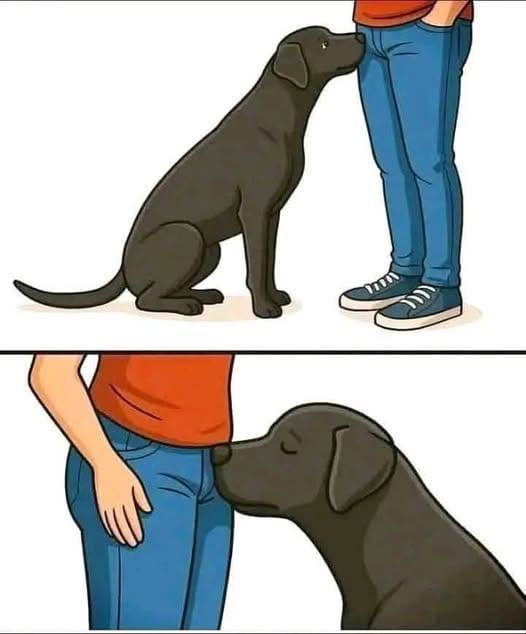
Dogs move through the world with their noses the way we move through it with our eyes and our words. Where we rely on conversation, expression, and observation, they rely on scent—an entire universe of meaning that reaches them before a single thought forms in our minds. One small inhale can tell a dog more about a person than a full day of human interaction, and that difference in perception shapes every moment they share with us.
So when a dog presses its nose toward your crotch, it isn’t trying to embarrass you or invade your privacy. It’s simply gathering information the only way it knows how. The apocrine glands located in the groin and armpits release pheromones rich with chemical signals: hints about your age, sex, hormone levels, stress state, mood, even subtle shifts in health. To a dog, this is the equivalent of catching up—an introduction, a check-in, a way of reading the emotional temperature of someone they care about. It’s not a violation. It’s communication in the language they were born understanding.
But that doesn’t make it any less awkward for us. If you feel uncomfortable when your dog does this, that feeling is completely legitimate. And it doesn’t mean you’re being harsh or cold if you decide to redirect the behavior. Dogs understand boundaries when we teach them gently and clearly. Something as simple as asking your dog to sit, offering a treat, or guiding them into a different greeting ritual can shift their focus without punishing their natural instincts. You’re not scolding them for being a dog—you’re helping them understand how to interact in a way that works for both of you.
Still, it’s important to remember that the same nose that occasionally puts you in an awkward spot is the one that anchors your dog to you in every meaningful moment of your life. That nose is part of what makes them such remarkable companions. It’s the nose that searches for you when you move from room to room. The nose that nudges your hand when you’re crying, sensing the changes in your breathing and heart rate long before you ever speak a word. The nose that rests softly against your shoulder when you’re sick, quietly monitoring your condition, offering comfort in the rhythm of each calm breath.
Dogs don’t read our facial expressions as well as we read theirs. They don’t navigate by tone alone. But they read scent like poetry. Through it, they detect the emotional tremors we try to hide. A shift in our sweat tells them we’re anxious. A slight change in our body chemistry lets them know we’re exhausted. They sense when something is wrong even when our faces stay controlled and our voices steady. Their noses pick up what our words refuse to admit.
So yes, sometimes their instincts put them in socially confusing situations. But that instinct is also the engine of their loyalty. It’s the reason they cling to us during heartbreak. The reason they know when to lean in closer, or when to give us space. The reason they sense danger, stress, joy, illness, and comfort without needing a single explanation.
To a dog, scent is truth. It’s memory, emotion, recognition, and reassurance all at once. It’s how they map the world—and how they find their place in it, especially beside the humans they love. When a dog leans in close, even in a way that makes us blush, it’s offering something deeper than curiosity. It’s making a promise in a language we can’t smell or speak but can absolutely feel.
Every sniff says: I know you. I’m paying attention. I’m here for you, even when you aren’t sure how to be here for yourself.
And that’s the thing worth remembering the next time your dog behaves in a way that feels strange by human standards. Behind that moment is a creature whose entire understanding of the world is tied to the people they love. A creature who uses scent the way we use memory. A creature who never stops learning who we are, day by day, breath by breath.
Through scent, your dog gathers the details of your life. Through love, it chooses to stay.
Leave a Reply