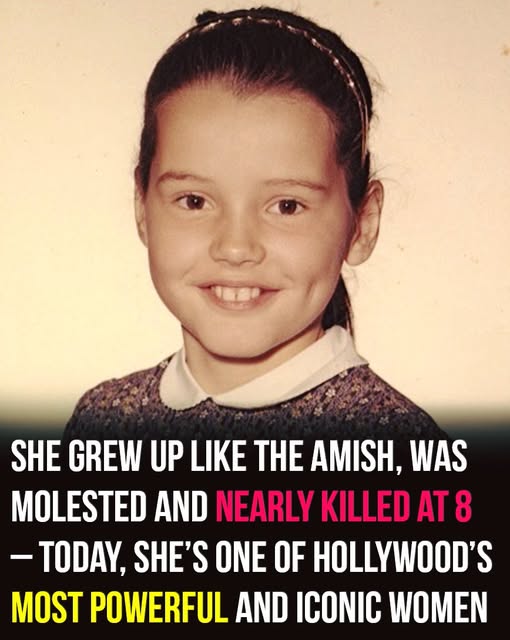
She became one of the most recognizable faces of modern Hollywood, a performer with an easy smile and a presence that could shift a scene without effort. In the 1980s and 1990s, she moved from modeling to major films with the kind of momentum most actors only dream about, eventually earning an Academy Award and helping define an era of women-led cinema. But the story of Geena Davis isn’t just about success. It’s also about a childhood shaped by extreme restraint, fear, silence, and a near-death moment that taught her the wrong lesson far too early: stay polite, no matter what.
Geena Davis was born on January 21, 1958, in Wareham, Massachusetts. Before Hollywood, before red carpets and awards speeches, her world was small and tightly controlled. She has described her upbringing as old-fashioned to the point of being almost Amish in spirit. Her parents, Bill and Lucille, lived simply and kept their children sheltered. The family heated the house with wood her father chopped. Her mother grew much of their food. Entertainment was limited, and exposure to the wider world came slowly. Davis once joked that she knew she wanted to act at three years old, even though she wasn’t sure how she understood it as a job when the only films she was allowed to watch were animated Disney movies.
The rules of her childhood weren’t just about what she watched. They were about how she behaved. Politeness was not optional. Proper conduct mattered. You didn’t complain. You didn’t draw attention to yourself. You didn’t create trouble. Those values followed her into adulthood, and in ways she didn’t fully understand until later, they also made her vulnerable.
When she was eight, she experienced a moment that could have ended her life. She was in a car with her great-uncle Jack, who was ninety-nine years old and driving. As he drifted into oncoming traffic, no one spoke up—not her, not her parents. They watched a vehicle barreling toward them and stayed silent out of deference, fear, and habit. At the last second, Jack corrected the car’s path and avoided a head-on collision. Everyone survived, but the psychological message stuck: even when danger is obvious, don’t be rude. Don’t confront. Don’t interrupt. Stay polite.
That lesson became a theme in her life, and decades later it would become the core of her memoir, Dying of Politeness. In that book, she also revealed something even darker: a traumatic experience from her childhood that she carried like a secret because she didn’t have the language, education, or permission to speak about it. While delivering newspapers, she was molested by a neighbor. She didn’t fully understand what was happening in the moment. The shame came later, especially after seeing her mother’s reaction. Her mother confronted the man and warned him never to touch her again, but no police report was filed, and the incident was never explained to Davis in a way that clarified why it was wrong. Without that clarity, it became something she felt responsible for, something she learned to bury rather than process.
She later described the brutal double bind that many children in similar situations face: knowing something terrible happened, sensing it was serious, but being taught—directly or indirectly—that the safest move is silence. The lesson wasn’t just that abuse was wrong. The lesson she absorbed was that complaining draws attention, and attention is dangerous. She wanted to talk about it, but she didn’t.
School wasn’t an escape either. Another defining feature of her youth was her height. She was tall early and stayed tall, standing out in a way she hated. She didn’t want to be noticed; her body made that impossible. Teachers tried to recruit her for sports. She found her place in track and field, doing high jumps and hurdles, but it didn’t erase the feeling of being different. The teasing didn’t help. Boys mocked her with the nickname Kareem Abdul-Jabbar, turning her height into a punchline. The insecurity wasn’t vanity; it was survival. When you’re shy and self-conscious, being physically unavoidable can feel like a spotlight you can’t turn off.
Despite the discomfort, she kept building skills. She played flute in the marching band. She spent time studying abroad in Sweden during her senior year and became fluent in the language—an unusual accomplishment that hinted at the discipline and intelligence behind her quiet exterior.
After high school, she attended New England College in New Hampshire and later transferred to Boston University to study drama. Her parents didn’t fight the decision. They weren’t stage parents pushing a dream; they simply didn’t fully understand how improbable a successful acting career was. Davis later noted that they accepted her choice partly because the idea of it working seemed so unlikely. She also admitted a strange detail: she never told her parents she didn’t graduate, even though the public narrative often assumed she had. They died without knowing the truth.
In 1977, she moved to New York City and did what nearly every aspiring performer does: whatever work she could find. She was a window mannequin, a sales clerk, a waitress. At the same time, she pursued modeling, believing it could be an entry point into film. Her thinking was blunt and practical: at the time, famous models like Christie Brinkley and Lauren Hutton were getting film offers. She figured modeling might be the quickest route into movies. She wasn’t chasing fashion for fashion’s sake. She was chasing a door.
She signed with the Zoli Agency and landed work, including being featured in the Victoria’s Secret catalog. That catalog appearance proved to be the hinge in her story. Director Sydney Pollack saw her and cast her in Tootsie in 1982, launching her acting career in a way no amount of planning could have engineered. Suddenly, she was on screen alongside Dustin Hoffman, receiving strong reviews and being pulled into a wider circle of opportunity. She moved to Los Angeles, and her name started to carry weight.
She worked steadily through the 1980s, appearing in the TV series Buffalo Bill and later starring in her own show, Sara. When television didn’t sustain her momentum, she pivoted harder into film. A misstep—Transylvania 6-5000—didn’t stop her. Her real breakout arrived with The Fly in 1986, where she starred opposite Jeff Goldblum. The film became iconic, and Davis became impossible to ignore.
Then came a run of projects that cemented her status. Beetlejuice in 1988. The Accidental Tourist in 1989, which earned multiple Academy Award nominations and brought Davis the Oscar for Best Supporting Actress. She wasn’t just a pretty face or a “type.” She was an actor with range, timing, and control.
Her most culturally enduring role came with Thelma & Louise, the feminist landmark directed by Ridley Scott. It wasn’t only a career peak; it was also a personal turning point. Davis has credited her friendship with Susan Sarandon with teaching her something she hadn’t learned as a child: how to speak plainly, how to say what she thinks, how to stop shrinking herself to fit the room. The film became a phenomenon, and the response highlighted something uncomfortable in the industry: stories centered on women were still treated as exceptions, even when audiences clearly wanted them.
She followed it with A League of Their Own, another women-driven hit that reinforced her identity as a major star who could carry films that didn’t revolve around men. At the height of her fame, she enjoyed the glamour, too. She talked openly about the thrill of dressing up for major events, acknowledging how surreal it felt for a woman from a sheltered small-town background to step into the Oscars in a dramatic gown. Her mother, she noted, wore almost no makeup except red lipstick. Davis understood exactly how far she’d traveled from that world.
But as she approached forty, the industry’s familiar pattern emerged. Roles for women narrowed. The offers changed. She described it later as “falling off the cliff,” the moment when even proven actresses discover that Hollywood’s imagination for women has an expiration date.
Her influence, though, didn’t disappear. Neither did her life beyond film. She married four times, including a marriage to Goldblum, and later became a mother for the first time at forty-six. With her fourth husband, surgeon Reza Jarrahy, she had three children: a daughter, Alizeh, and fraternal twin sons, Kaiis and Kian. Becoming a mother later in life came with challenges, but she described the emotional reality with disarming honesty—how she feared she couldn’t love anyone as much as she loved her daughter until her sons arrived and proved that love doesn’t divide, it multiplies.
Motherhood also sharpened her perspective on media. Watching children’s content, she noticed patterns she couldn’t unsee: who got to speak, who got to lead, who got to exist as more than decoration. That observation turned into action. In 2004, she founded the Geena Davis Institute on Gender in Media, pushing for measurable change in representation and calling out the industry’s imbalance, including the dominance of men in directing and decision-making roles. She wasn’t arguing that women lacked talent. She was arguing that the system wasn’t built to let that talent run the show.
Today, Davis remains active, continuing to act and take on new projects. The difference is that her power no longer depends solely on being cast. She built influence beyond roles—through advocacy, through institutions, through shifting conversations that Hollywood once avoided. The girl raised to be quiet became a woman who learned to speak, and then used that voice to change the room.
Her story isn’t just about fame. It’s about what happens when a person survives early lessons in silence, carries them for decades, and finally decides they’re done living that way.
Leave a Reply