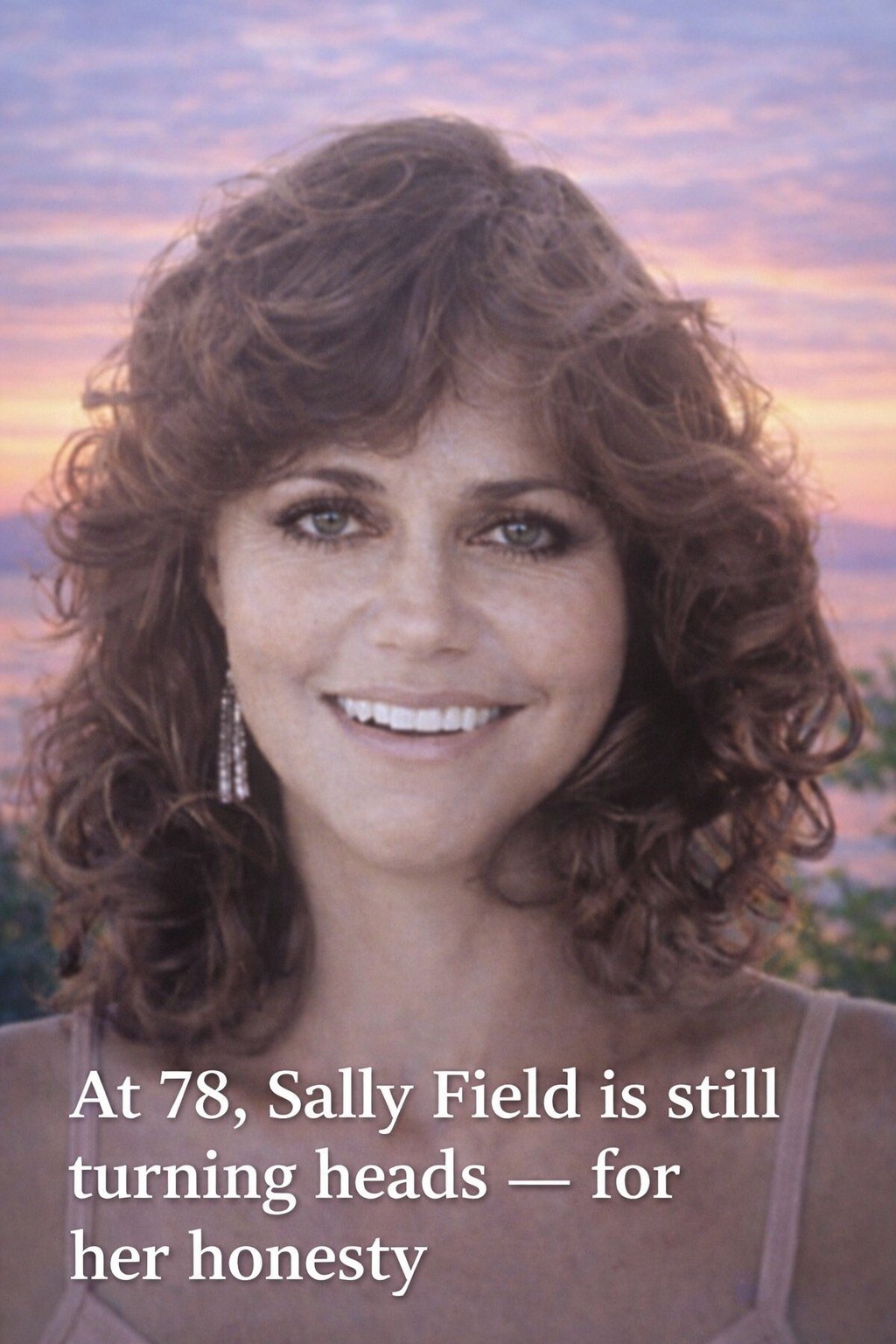
Sally Field has spent more than six decades in the public eye, building a career defined not just by talent, but by an unusual level of candor. At 78, she remains one of Hollywood’s most respected performers, admired as much for her honesty as for the emotional depth she brings to the screen. Long after many of her contemporaries have retreated into carefully managed nostalgia, Field continues to speak plainly about her life, her work, and the complicated relationships that shaped her.
That openness resurfaced in a memorable way during a December 2022 appearance on Watch What Happens Live with host Andy Cohen. What began as a lighthearted segment quickly turned into a viral moment when Field was asked to name the worst on-screen kisser of her long career. The answer she gave wasn’t shocking because it was cruel, but because of who it involved.
Without hesitation, and with a wry smile, Field named Burt Reynolds.
“Okay, this is going to be a shocker,” she said, pausing just long enough to let the audience lean in. “It’s Burt Reynolds.” Laughter filled the studio, but Field didn’t soften or backtrack. She explained that kissing him on camera was awkward, adding with characteristic humor that there was “a lot of drooling involved.” The delivery was playful, but the honesty behind it was unmistakable.
The comment resonated far beyond its comedic value because Reynolds wasn’t just a former co-star. He was one of the most significant figures in Field’s personal life.
Field and Reynolds met in the mid-1970s while filming Smokey and the Bandit, a runaway hit that cemented Reynolds as a box-office phenomenon and helped push Field further into mainstream stardom. Their on-screen chemistry translated into a highly publicized off-screen romance that lasted nearly five years. At the time, they were one of Hollywood’s most photographed couples, emblematic of a glamorous era built on charisma and excess.
Reynolds, already a dominant presence in the industry, played a role in shaping Field’s career during those years. But while the public saw a golden couple, Field’s later reflections revealed a far more complicated reality. The romance, she has said, was not without affection or genuine connection, but it was also emotionally destabilizing and, ultimately, painful.
Her anecdote about the kiss was not an attempt to embarrass Reynolds, who died in 2018 at age 82. Instead, it reflected Field’s long-standing refusal to sanitize the past. She has consistently resisted the urge to romanticize relationships simply because time has passed or because the other person is no longer alive.
That refusal became even clearer in her 2018 memoir, In Pieces, where she wrote candidly about her life, including her relationship with Reynolds. She described it as “confusing and complicated,” acknowledging that while there was love, the dynamic was ultimately not healthy for her. In interviews following the book’s release, she went further, saying plainly that Reynolds was “not good for me in any way.”
Field has linked those patterns to her early life. She has spoken openly about a difficult childhood and a deeply troubling relationship with her stepfather, experiences that shaped how she understood love, approval, and self-worth. Those unresolved dynamics, she has said, followed her into adulthood and influenced her choices, including her relationship with Reynolds.
One of the most striking aspects of Field’s honesty is how she addresses the gap between her own memories and Reynolds’s public statements. After their breakup, Reynolds often referred to Field as “the love of my life” and later expressed regret over their separation. Field did not deny that the relationship mattered, but she rejected the idea that his retrospective narrative matched her lived experience.
She has suggested that Reynolds reimagined the relationship after it ended, elevating its significance in ways that felt disconnected from how it actually functioned. In her view, his regret did not erase the imbalance and emotional strain she experienced at the time. That difference in perspective, she has said, was part of what made the relationship so difficult to process.
In a 2024 interview, Field reflected on how, during that period of her life, she often felt absent from herself. She described adapting, accommodating, and minimizing her own needs in order to maintain harmony. Looking back, she recognized how much of her identity had been shaped by trying to please rather than by expressing her authentic self.
Those reflections lend depth to what might otherwise have been dismissed as a throwaway joke about a bad kiss. For Field, the memory wasn’t isolated. It was connected to a larger story about power, vulnerability, and learning—slowly and painfully—how to claim space in her own life.
Reynolds’s death added another layer to the public’s understanding of their relationship. His affectionate recollections, shared late in life, cast the romance in a nostalgic light that resonated with fans. Field never disputed his feelings, but she remained firm in her own truth. Her honesty was not cruel; it was precise. She acknowledged the “instantaneous connection” they shared while refusing to rewrite history to make it more palatable.
The public response to Field’s 2022 confession was immediate and wide-ranging. Social media lit up with clips and quotes from the interview. Some viewers laughed, enjoying the reminder that even legendary actors have awkward moments. Others appreciated the deeper implication: a woman in her late seventies speaking freely about a powerful man from her past, without fear or deference.
That reaction underscored why Field remains culturally relevant. She doesn’t trade in scandal or bitterness. She trades in clarity.
Her career reflects the same commitment. From her Academy Award-winning performances in Norma Rae and Places in the Heart, to her acclaimed television and stage work, Field has consistently chosen roles that demand emotional truth. She has never relied solely on charm or nostalgia, instead embracing characters that reflect complexity, resilience, and contradiction.
Off screen, she brings that same approach to her own story. By speaking honestly about her relationships, her regrets, and her growth, she invites audiences to see her not just as an icon, but as a person who has done the difficult work of self-examination.
At 78, Sally Field is not interested in preserving illusions. Her reflections—whether about an awkward kiss or a formative romance—are not about settling scores. They are about understanding. They show how memory evolves, how perspective sharpens with time, and how truth, even when uncomfortable, can be liberating.
Her legacy is not diminished by these revelations. It is strengthened by them. In choosing honesty over myth, Field has given audiences something rarer than perfection: a portrait of a life lived fully, thoughtfully, and without apology.
Leave a Reply