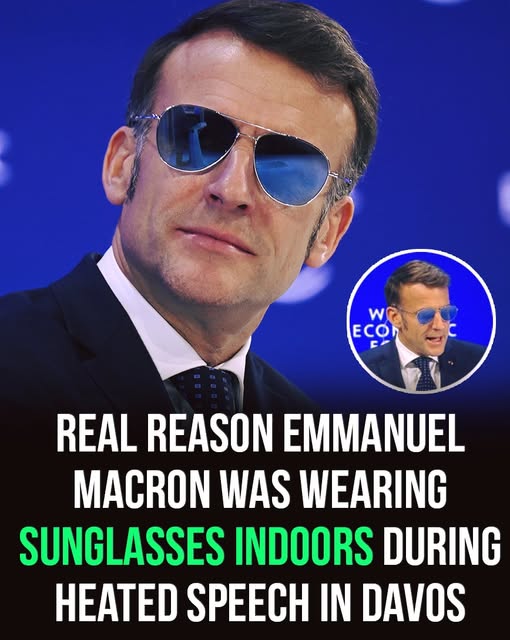
When Emmanuel Macron stepped onto the stage at the World Economic Forum in Davos this week, the reaction was immediate. Not just because of what he said, but because of how he looked. In a room known for dark suits, neutral tones, and restrained optics, the French president appeared wearing blue-tinted aviator sunglasses—indoors. Cameras locked in. Social media lit up. Speculation followed within minutes.
Was it a provocation? A fashion statement? A deliberate signal aimed at rivals?
The answer turned out to be far more human, but no less revealing about how power, perception, and image intersect on the global stage.
The appearance took place at the annual gathering of political and economic elites hosted by the World Economic Forum in Davos, Switzerland. Macron’s speech itself was pointed and unapologetic. He sharply criticized rising geopolitical intimidation, pushed back against unilateral power plays, and took aim—without naming names—at strong-arm tactics involving trade and territorial pressure.
“We believe in growth, yes,” Macron said, “but we prefer respect to bullies. We prefer science to conspiracy. We prefer the rule of law to brutality.”
It was widely understood as a direct rebuke of Donald Trump, whose renewed rhetoric around Greenland, tariffs, and alliance leverage has unsettled European leaders. Macron framed his remarks as a defense of multilateralism and international norms, positioning Europe as a counterweight to raw power politics.
But even as his words landed, many viewers were focused elsewhere: the sunglasses.
In a formal indoor setting, especially one as symbol-heavy as Davos, eyewear like that is unusual. Almost immediately, commentators began dissecting the choice. Some assumed it was calculated theater. Others joked that Macron was channeling a fighter-pilot aesthetic or projecting defiance through style.
The real reason, however, had nothing to do with performance.
Macron has been dealing with a temporary eye condition known as a sub-conjunctival hemorrhage—a broken blood vessel in the eye that causes visible redness and swelling. It looks alarming, but it’s medically harmless and doesn’t affect vision. The condition can be triggered by something as mundane as sneezing, rubbing the eye, or mild strain.
Macron had already addressed it days earlier at a military event in southern France, asking audiences to excuse what he described as the “unsightly appearance” of his eye. With characteristic self-awareness, he even gave it a nickname: l’œil du tigre—the “eye of the tiger”—a tongue-in-cheek reference to resilience and determination.
At Davos, the sunglasses were simply a practical solution. They spared him endless close-up photographs highlighting a medical oddity that could easily be misinterpreted as illness or fatigue. As one physician noted in French media, public figures often choose eyewear in such situations to control optics, not to dramatize them.
Still, the explanation didn’t stop the reactions.
Online, responses ranged from admiration to mockery. Some critics labeled the move arrogant, using French slang like kéké to suggest showmanship. Others leaned into humor, comparing him to movie characters or quipping that Europe’s future must be “too bright to look at.” A surprising number of commenters, however, praised the look, arguing that more world leaders could stand to loosen the rigid visual codes of political performance.
What made the moment resonate wasn’t the eyewear alone, but the fact that with Macron, style is never random.
If the sunglasses were practical, the brand almost certainly wasn’t accidental.
While Macron hasn’t confirmed the manufacturer, observers quickly noted that the frames aligned closely with French design houses. One likely candidate is Vuarnet, a heritage eyewear company based in Meaux, France. Macron has publicly supported the brand before, even gifting a pair of Vuarnet Edge sunglasses to Joe Biden during a diplomatic exchange in 2024.
Another strong possibility is Visages, a French startup specializing in ultralight, 3D-printed frames. Macron received a pair from the company in 2025, and the Davos sunglasses closely matched their minimalist, high-tech aesthetic.
What they clearly were not were Ray-Bans. Despite the brand’s historic association with aviators, Macron’s frames lacked the distinctive markings and industrial styling typical of Ray-Ban designs. The absence was notable, especially given Macron’s consistent pattern of favoring French manufacturers in public appearances.
That pattern is long-standing and deliberate.
Macron routinely wears suits from Paris-based tailors, shoes from Limoges workshops, and watches produced by French brands like Lip, Awake, and Pequignet. It’s not nostalgia—it’s strategy. In a global economy where symbolism matters, Macron treats personal presentation as an extension of industrial policy. French craftsmanship, when worn by the head of state, becomes a quiet assertion of sovereignty.
In that context, the sunglasses did more than cover an irritated eye. They reinforced a message: France does not outsource its identity.
The moment gained further traction when unrelated but explosive political tensions spilled into public view. On the same day as Macron’s Davos appearance, Trump shared what appeared to be a private message from the French president, revealing behind-the-scenes efforts to de-escalate disputes over Greenland and broader geopolitical coordination.
The message proposed diplomatic meetings, multilateral talks, and even a dinner in Paris—an unmistakable attempt to bring dialogue back into structured channels. Its publication stunned European observers, who viewed it as a breach of diplomatic norms.
Relations between Macron and Trump have visibly deteriorated in recent days. Trump has threatened massive tariffs on French wine following France’s refusal to participate in his proposed “board of peace,” a loosely defined initiative that European leaders see as performative rather than substantive.
Macron publicly rejected the tariff threats, stating flatly that such pressure tactics are unacceptable. He later confirmed he had no plans to meet with Trump during the Davos summit.
Against that backdrop, Macron’s sunglasses took on unintended symbolic weight. A president delivering a firm rebuke of coercive power politics, shielding his eyes not from scrutiny, but from spectacle.
In the end, the moment captured something essential about Macron’s leadership style. He is acutely aware that every detail—words, posture, clothing, even eyewear—will be read for meaning. He doesn’t shy away from that reality; he manages it.
The sunglasses weren’t defiance. They weren’t vanity. They were a practical choice that, in the pressure cooker of global politics, became a canvas for interpretation.
That’s how modern leadership works now. Nothing is neutral. Everything communicates.
And sometimes, a pair of sunglasses worn indoors tells the world far more than it seems at first glance.