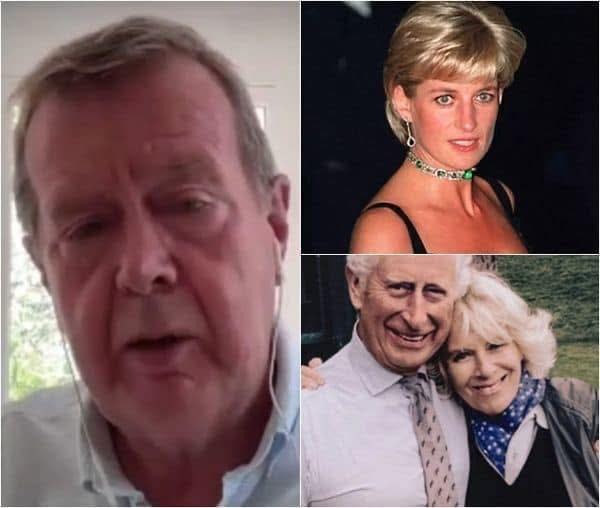
The passage of time has done little to fade the collective memory of August 31, 1997. Nearly three decades have passed since the world was shaken by the news that Diana, Princess of Wales had died in a high-speed car crash inside the Pont de l’Alma Tunnel. For millions around the globe, it meant the loss of the beloved “People’s Princess.” For her sons, Prince William and Prince Harry, it meant the sudden loss of their mother. Even today, people still wonder what Diana might be doing if she were alive—what causes she would support and how her life might have evolved. According to Ken Wharfe, the former protection officer who guarded her for years, the more troubling question is not what she would be doing today, but why she is no longer here to do it.
Ken Wharfe served as Diana’s bodyguard from 1987 to 1993 while working with the Metropolitan Police Service. From his perspective, the security arrangements surrounding the princess in her final weeks were far weaker than the strict protection she once had. Wharfe believes that the events leading to her death were not simply an unavoidable tragedy but the result of several serious security failures.
One of the most immediate issues involved the driver that night, Henri Paul. Diana was traveling with her partner Dodi Fayed and bodyguard Trevor Rees-Jones. Paul, who worked at the Ritz Paris, was not a trained executive protection driver. Reports later showed that he had alcohol and prescription medication in his system. According to Wharfe, a professional Royal Protection officer would never have permitted someone in that condition to drive, particularly while attempting to navigate through heavy traffic and photographers.
A second major issue, Wharfe argues, involved the strategy used to avoid paparazzi. The plan was to travel from the Ritz to Dodi Fayed’s apartment near the Champs-Élysées. Instead of coordinating closely with local authorities such as the French National Police, the security team attempted to mislead photographers by using a decoy vehicle. While one car waited at the front of the hotel, Diana and Dodi quietly exited through the rear entrance in another vehicle.
Wharfe believes this approach turned the situation into a dangerous pursuit. Without direct coordination with French police to manage traffic and media presence, the journey quickly escalated into a high-speed chase. In his view, cooperation with authorities could have allowed a controlled escort through the city rather than a chaotic attempt to outrun photographers.
Yet, in Wharfe’s opinion, the most significant mistake occurred long before that night in Paris. After separating from King Charles III in the early 1990s, Diana decided to give up her official police protection from Scotland Yard. She reportedly feared that members of her security team were reporting details of her private life to the Royal Family. Despite warnings from those who had protected her, she chose to rely instead on private security arrangements.
Wharfe has often argued that the protection offered by the Royalty Protection unit of the Metropolitan Police was uniquely equipped to handle threats against high-profile figures. Officers had access to intelligence networks, diplomatic authority, and extensive training in risk management. In contrast, private security teams—even capable ones—lacked those institutional advantages.
Without that level of protection, Diana’s security depended on decisions made by individuals without the same experience or authority. The tragic crash in Paris remains one of the most widely discussed events in modern royal history. Official investigations concluded that the accident was caused primarily by the driver’s intoxication and the pursuit by paparazzi.
For Wharfe, however, the tragedy represents something more troubling: a sequence of preventable mistakes. He believes that a sober professional driver, coordination with local police, and the continued presence of a Scotland Yard protection team might have changed the outcome entirely.
Today, Diana remains a powerful symbol of compassion and humanitarian work. Her efforts to raise awareness about issues such as landmines, AIDS, and homelessness left a lasting impact. The memory of her life—and the questions surrounding her death—continue to resonate across generations, reminding the world of both her influence and the fragility of the circumstances that ended her life so abruptly.