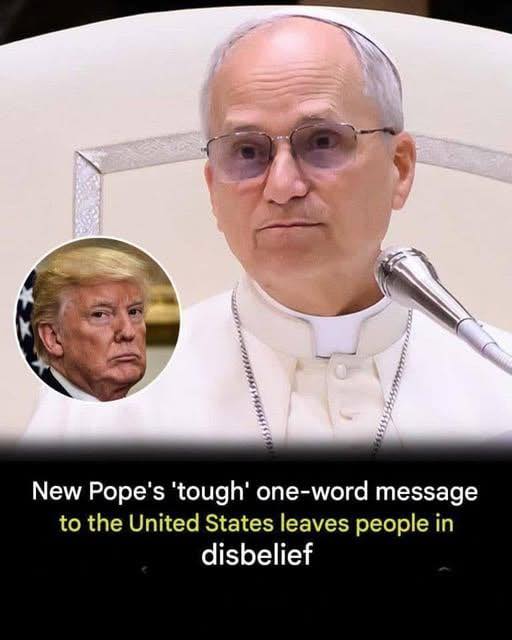
In a moment that has reverberated across the digital and diplomatic landscape of 2026, Pope Leo XIV’s viral, one-word response—“Many”—has sparked an international conversation about the power of brevity in an era of over-explanation. This singular word, delivered with a calm yet pointed intentionality, has been dissected by theologians, political analysts, and social media commentators alike, proving that the weight of a message often lies not in its length, but in its moral clarity. In a world where global leaders often resort to sprawling press releases and complex linguistic maneuvering to avoid direct accountability, Leo XIV’s concise comment has emerged as a carefully crafted provocation, signaling a papacy that is as intellectually rigorous as it is pastorally direct.
The encounter occurred when the pontiff was asked if he had a specific message for the United States, given the mounting internal and external crises facing the superpower. His reply—“Many”—was not a deflection, but an opening. It suggested a profound awareness of the multi-layered challenges confronting America, from the deepening partisan divide and the ethical dilemmas of emerging technologies to the nation’s central role in the current “spiral of violence” in the Middle East. By choosing a word that denotes plurality and complexity, the Pope signaled that he would not be confined by the reductive, partisan expectations that dominate modern political discourse. It was a theological gesture grounded in intentional ambiguity, functioning as both a subtle rebuke of simplistic narratives and an invitation to deeper national reflection.
This bold communicative style is consistent with the background of Pope Leo XIV, formerly Cardinal Robert Francis Prevost. As the first American to lead the Roman Catholic Church, Leo XIV brings a unique perspective to the Vatican, shaped by his years as an Augustinian missionary in Peru and his administrative experience in Rome. His election on May 8, 2025, was seen by many as a historic shift, moving the papacy from a European and Latin American focus to include the complexities of a global superpower. His choice of the name “Leo” was itself a deliberate signal; he intended to channel the spirit of Pope Leo XIII, the 19th-century pontiff who authored Rerum Novarum and established the foundation of modern Catholic social teaching during the Second Industrial Revolution. Just as his predecessor addressed the plight of the working class during a time of radical economic change, Leo XIV has positioned himself as a moral compass for the “new industrial revolution” of artificial intelligence and digital disruption.
Throughout his first year in office, Leo XIV has demonstrated a willingness to confront political power directly. He has been a vocal advocate for migrant rights, drawing on his own multi-ethnic heritage and his missionary work to defend the dignity of those at the margins. His previous criticisms of isolationist policies and his defense of social justice reflect a leader who views the Gospel as a mandate for active engagement in the world’s most pressing problems. Importantly, he resists simple ideological labels. While he has challenged right-wing rhetoric on immigration and nationalism, he has been equally critical of secular liberal stances on issues such as economic justice and the sanctity of life. Like Leo XIII, who balanced the rights of labor with the principle of personal ownership, Leo XIV represents a nuanced, deeply Catholic approach to social ethics—one that prioritize human dignity over political expediency.
The word “Many” also resonates with the Pope’s specific concerns regarding the current escalation in the Persian Gulf. As the world watches the “chilling” exchange of missiles between the U.S., Israel, and Iran, the Pope has used his platform to call for a “disarming peace.” In his recent Angelus prayers and diplomatic addresses, he has warned that the world faces a tragedy of “enormous proportions” and has urged leaders to assume the moral responsibility of halting the descent into an “irreparable abyss.” In this context, his one-word message to America takes on a more urgent tone. It serves as a reminder that the consequences of conflict are numerous and far-reaching, affecting not just the combatants but the “many” innocents who pay the price for the failure of diplomacy.
Furthermore, Leo XIV has turned a critical eye toward the digital ecosystem that carried his message around the globe. He has chosen “Preserving Human Voices and Faces” as the theme for the 2026 World Day of Social Communications, highlighting the risks posed by deepfakes and AI-generated disinformation. His insistence that public communication requires “human judgment, not just data patterns” explains his preference for organic, human-centric moments like the one that produced the “Many” response. He is a pontiff who understands the “immense potential” of technology but fears its power to erode the authentic human voice. By delivering a message that was impossible for an algorithm to predict or a deepfake to replicate with the same soul, he has reclaimed the narrative of moral leadership in the digital age.
The reaction to the Pope’s brevity highlights a thirst for authenticity in the public square. When political figures over-explain, they often obscure the truth; when Leo XIV offers a single word, he invites the listener to fill in the blanks with their own conscience. The word has functioned as a mirror, allowing Americans to see the “many” issues—from the #SendBarron debate to the closure of international airspaces—that are currently testing the fabric of their society. It was a “whisper with weight,” a signal that this papacy will be pastoral in its care for the weak, provocative in its challenge to the strong, and impossible to ignore in its quest for global peace.
As he prepares for his historic address to the Spanish Parliament in June 2026 and continues to navigate the “Year of St. Francis,” Leo XIV is proving to be a leader of unexpected maneuvers. He is a “dignified middle-of-the-road” candidate who has found a way to bridge the gap between tradition and the future. Whether he is grading papers remotely or praying for a halt to the “spiral of violence,” his actions are defined by a sense of “compassionate realism.” In just one word, he has announced himself as a force to be reckoned with—a Pope who knows that in a world of noise, the most powerful thing one can say is the truth, even if it only takes five letters.
Leave a Reply