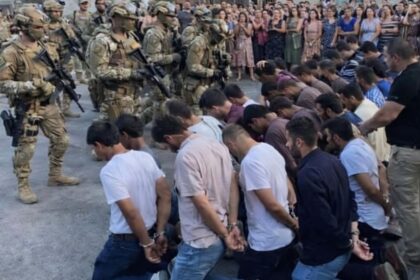
On January 3, 2026, U.S. military forces executed a bold nighttime strike deep in Caracas, Venezuela, seizing the nation’s president, Nicolás Maduro, and his wife, Cilia Flores, and flying them to New York to face federal charges. The operation, codenamed Operation Absolute Resolve, involved coordinated action by elite units from the Army, Delta Force, Marines, Air Force, Navy and intelligence elements, which overwhelmed Venezuelan defenses, killed dozens of combatants, and injured several U.S. soldiers. Maduro and Flores were indicted on charges including narcoterrorism and cocaine trafficking in Manhattan federal court and pleaded not guilty. The United States justified the mission as part of its broader 2025–26 campaign against drug smuggling and terrorism, but the extraordinary use of force reignited a fierce constitutional and political battle at home over war powers and the proper role of Congress in authorizing military actions. (Wikipedia)
Within hours of the announcement, the Capitol was engulfed in debate. Lawmakers, diplomats and legal scholars immediately raised questions about whether the president’s actions exceeded constitutional limits and bypassed congressional authority. Under the 1973 War Powers Resolution, presidents must notify Congress within 48 hours of deploying forces into hostilities and must end those hostilities within 60 days absent express congressional approval—requirements rooted in the Constitution’s division of war powers between the executive and legislative branches. But successive administrations have stretched those limits, and the Trump administration argued this seizure was a lawful “law enforcement” action that did not require advance approval. (Close Up Foundation)
Democratic leaders in both chambers were quick to condemn the operation as unconstitutional. Senate Minority Leader Chuck Schumer said that acting without congressional authorization was reckless and illegal, arguing that the mission was more akin to war than a targeted strike on criminal syndicates. Progressive members went further, with some calling the decision an “impeachable offense”—asserting that removing a foreign head of state by military force was beyond the scope of inherent presidential powers. Others warned that the United States may have set a dangerous precedent both domestically and internationally. (The Guardian)
Republicans were divided. A faction of GOP senators applauded what they saw as decisive action against Venezuela’s corrupt government and drug networks, arguing it served U.S. interests in security and regional stability. Others—most notably Sen. Rand Paul—broke with the White House stance and called the operation a war that required congressional debate, stressing that once the military commits forces in such a manner, it’s Congress’s constitutional job to authorize or restrict further action. (Fox News)
The White House and administration officials aggressively defended their position. They framed the raid as a necessary and lawful enforcement measure against international crime, not a declaration of war or occupation. President Trump claimed the United States would “run” Venezuela in the interim, overseeing the transition to a “safe and proper” government—a statement that fueled further controversy about U.S. intentions and the legal footing of the operation. U.S. officials also seized Venezuela-linked oil tankers in international waters, a move that underscored broader economic and strategic interests at play. (CBS News)
International reaction was immediate and sharply critical. United Nations Secretary-General António Guterres expressed deep concern about regional stability and the legality of the U.S. action under international law, warning that the precedent could undermine sovereign norms. Countries including Russia, China, and Cuba condemned the strike as an illegal act of aggression, while some Latin American nations called for Maduro’s release and restoration of Venezuela’s political process. (Reuters)
Back in Washington, the constitutional storm centered on Congress’s authority under Article I of the Constitution to declare war and oversee the use of U.S. forces. Tim Kaine, a Democratic senator, became a prominent voice in the pushback, sponsoring a War Powers Resolution that would prohibit any further military actions against Venezuela without explicit congressional authorization. Joining him was Rand Paul, making the effort bipartisan, though Republicans still held a narrow Senate majority. (Close Up Foundation)
The Senate scheduled a pivotal procedural vote aimed at curbing further military operations in Venezuela. If passed, the resolution would require the president to terminate the use of U.S. forces against Venezuela unless Congress authorized such actions—reviving a statute often ignored or sidestepped but never fully repealed. Supporters of the measure argued that meaningful debate and consent are not burdensome hurdles but essential checks against unchecked executive authority. (CBS News)
Opponents countered that requiring upfront congressional approval would hobble the president’s ability to respond swiftly to security threats abroad, citing decades of precedent where commanders-in-chief acted first and informed Congress later. They argued that rapid, decisive action is necessary to counter transnational drug networks and terrorist activities that endanger U.S. interests. (ABC News)
Even if the Senate passed the resolution, its fate remained uncertain. Republicans controlled both chambers, and a presidential veto was highly likely. Overriding such a veto would require a two-thirds majority in both the House and Senate—an uphill battle in a closely divided Congress. (Reuters)
Domestic public opinion mirrored the political fracture. Polls showed Americans sharply divided over the Maduro capture and broader military engagement, with many opposing the action and criticizing a lack of clarity about U.S. goals, while others supported decisive moves against international crime and authoritarian leaders. (Congressman Kevin Mullin)
The legal debates reverberated beyond Capitol Hill. Constitutional scholars noted that the War Powers Resolution itself has long been contentious, with presidents from both parties challenging its constraints by invoking inherent commander-in-chief powers or broad authorizations like the post-9/11 AUMF. Courts have rarely intervened in these disputes, leaving war powers largely a political rather than judicial question. (Brookings)
As the Senate prepared to vote, lawmakers acknowledged that the issue struck at the heart of American governance: who decides when and how the nation goes to war or uses military force abroad. For some, the Venezuelan operation was a stunning example of unchecked executive action; for others, it was necessary enforcement against criminal networks and a destabilizing regime.
What happened in Caracas has already reshaped the dialogue on war powers, executive authority, and congressional oversight. In the weeks and months ahead, the outcome of the Senate vote and subsequent political battles may define the balance of military decision-making and constitutional governance in an era of global uncertainty. (Reuters)