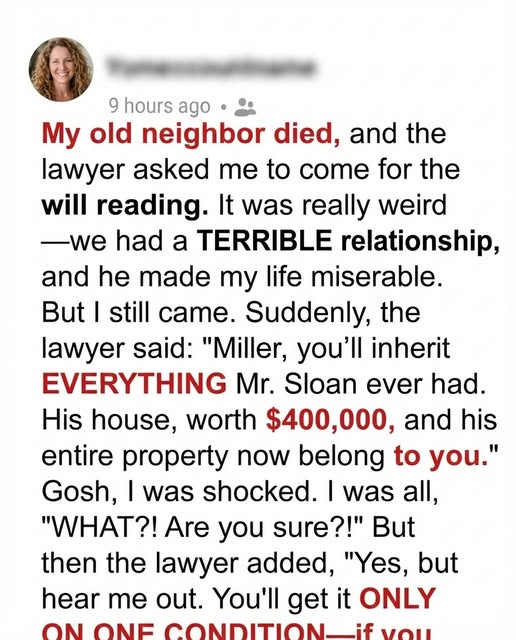
I spent years believing my neighbor existed for one purpose only: to make my life miserable.
The man next door was sharp-eyed, perpetually scowling, and seemingly allergic to kindness. He mastered a particular brand of quiet hostility—never loud enough to invite witnesses, always subtle enough to feel intentional. He complained about my fence line, glared at my garden, and once “accidentally” sprayed weed killer just far enough to damage my plants while pretending it was a mistake. I told myself to ignore him. I told myself he was lonely, bitter, bored. But the morning he dumped an entire mound of dirt onto my rose bed, crushing months of careful work, something inside me snapped.
What I didn’t know was that he had already set something in motion that would unravel everything I thought I understood about resentment, family, and belonging.
I loved my mornings. Suburban mornings had a stillness to them, like the world was holding its breath. I’d sit on my porch with coffee warming my hands, a notebook balanced on my knee, sketching bouquet ideas and tracking flower orders. I was a florist, mostly online, busiest during summer wedding season. Brides loved my roses because they were grown by hand—uneven, fragrant, real.
My garden was my pride. Rows of pale pinks, deep reds, and creamy whites curved toward the fence line. Or at least they had.
That morning, I took one sip of coffee and looked up. Where my roses should have been was a brutal heap of dark soil, dumped without care. Crushed stems jutted through it like broken bones. The smell of fresh earth mixed with the sharp green scent of torn leaves.
I stood there shaking.
I knew exactly who had done it.
I stormed across the yard, sandals scraping against gravel, fury boiling over. I stopped at the edge of his property—and froze. The driveway was full of unfamiliar cars. Dark, quiet, solemn.
A woman from the next street stood near the gate, her hands clasped.
“What happened?” I asked, my voice already unsteady.
She looked at me gently. “Oh… you didn’t hear? Harold passed away last night. Heart attack.”
The anger drained out of me all at once, replaced by a hollow shock. The man I had been ready to confront was simply gone.
Before I could process that, someone cleared his throat behind me. A man in a dark suit introduced himself as Harold’s attorney. He told me I was required to attend the reading of the will.
Me.
I laughed, assuming it was a mistake. He assured me it wasn’t.
At the funeral the next day, I sat in the back pew, hands clenched, staring at the closed coffin. I replayed every argument, every glare, every petty act. What kind of final insult dragged me into this room?
Afterward, the lawyer led me into a small office. An elderly woman sat by the window, delicate and composed, staring outside. We exchanged polite nods.
The lawyer opened a folder.
“Miss Miller, you inherit Mr. Sloan’s house and surrounding property.”
I actually laughed. Out loud.
Then he continued.
“There is one condition. You must provide a home for Mrs. Rose Dalton. She will live with you for as long as she wishes. You will be responsible for her care.”
I stared at the woman. She smiled kindly and said she wouldn’t be any trouble.
If I refused, the inheritance was void.
I thought about my rent. My ruined roses. The neighboring land overflowing with the same varieties brides begged me for. That house could save my business. Change my life.
I accepted.
At first, I told myself it would be manageable. She was gentle, polite. I could help her, rebuild my garden, move on.
That illusion shattered quickly.
Her needs were precise. Food prepared exactly right. Lights adjusted just so. Pillows fluffed. Windows checked for drafts she alone could feel. Nights were worse. A bell rang at midnight for tea. At two, she couldn’t find her glasses—already on her nose. At dawn, she worried her medication had expired and needed replacing immediately.
One morning, after biking through fog to a pharmacy only to find her asleep, something inside me cracked.
Later that day, searching the garage, I found an old box. Inside were photographs. Black and white. Faded.
One stopped me cold.
A young woman holding a baby. The woman’s face mirrored my own.
On the back: “Rose and my girl, August 1985.”
My breath caught.
She appeared behind me quietly.
“You found them,” she said.
“That’s you,” I whispered.
She nodded. “You look just like I did.”
The truth came out that night.
I had grown up in foster care. No photos. No names. Just the knowledge that I’d been left.
She told me about poverty, fear, impossible choices. About a man who watched me grow from across a fence, too ashamed to speak. Harold hadn’t hated me. He’d hated himself.
She gave me a letter.
“I was never brave enough to be your father when it mattered,” it read. “But watching you grow into who you are gave me peace.”
I cried until I couldn’t breathe.
All that anger had been grief in disguise.
Spring came quietly. Rose and I rebuilt the garden together. She told stories while I planted new roses beside the old ones.
Forgiveness didn’t arrive all at once. Healing never does.
But the roses grew.
And for the first time in my life, I understood what it meant to belong.
We didn’t break.
We grew.