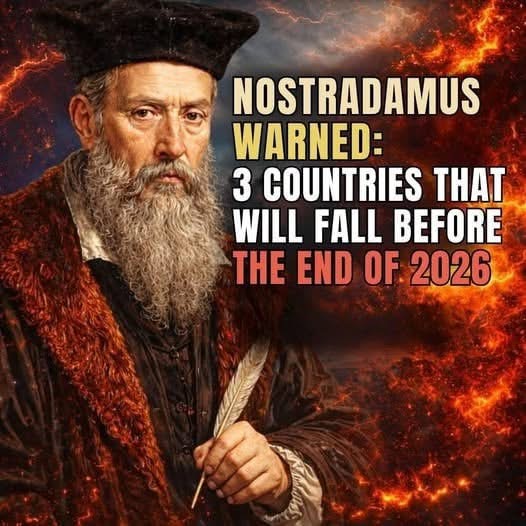
The writings of Nostradamus have fascinated readers for centuries. His famous collection Les Prophéties contains hundreds of short four-line poems known as quatrains. Written in symbolic and often deliberately obscure language, these verses have been interpreted repeatedly over the past five hundred years as predictions of wars, disasters, and political upheavals. Because the wording is so ambiguous, each generation tends to reinterpret the texts through the lens of its own fears and uncertainties.
One interpretation frequently discussed today revolves around the symbol of a “wounded eagle.” In political symbolism, the eagle is widely associated with United States, whose national emblem features the bird prominently. Some modern readers suggest the image could metaphorically represent internal division or political strain within a powerful nation. Rather than describing a literal attack, the “wound” is sometimes interpreted as social or economic conflict that weakens a country’s global influence.
Another symbol often linked to Nostradamus interpretations is the “trapped bear.” Historically, the bear has been associated with Russia in political cartoons and international commentary. Interpreters who focus on this imagery suggest it might represent a powerful nation feeling cornered or pressured in a geopolitical conflict. The idea of a trapped animal reacting aggressively is sometimes used as a metaphor for escalation when a country believes it has few options left.
A third commonly discussed symbol is the “aging lion,” which some commentators associate with United Kingdom or the broader historical influence of Europe. In symbolic readings, the lion can represent an older power whose influence is gradually declining as global leadership shifts to new regions of the world.
However, historians and scholars caution that Nostradamus’s writings were intentionally vague and poetic. Because the quatrains rarely mention specific places, dates, or names, they can be interpreted in many different ways. This flexibility explains why people from different eras—from the French Revolution to modern geopolitics—have believed his verses predicted events happening in their own time.
Ultimately, the enduring fascination with Nostradamus reveals more about human psychology than about actual predictions. When the world feels unstable, people often look for patterns or ancient warnings that might explain current events. His mysterious verses provide a kind of canvas onto which each generation projects its own anxieties and expectations.
Whether seen as prophecy, poetry, or historical curiosity, the writings of Nostradamus continue to spark debate centuries after they were written. What remains clear is that the uncertainty of global events often encourages people to search the past for clues about the future—even when those clues are open to countless interpretations.