My father has always treated family like a contract. He believed in rules, bloodlines, and the kind of loyalty that looks good from the outside but turns cold the moment you don’t follow the script. For most of my life, I tried to earn his approval the way you earn a grade: do the right thing, say the right thing, make choices that fit his idea of “respectable.”
Then I met Thomas, and everything I thought I knew about love—and family—changed.
The first time I brought Thomas to dinner, my father sat at the head of the table like he was interviewing a candidate for a job. Back straight. Hands folded. Eyes sharp. He asked Thomas what he did for work, and Thomas answered calmly, like he didn’t notice the tension building in the room.
“I manage a logistics team,” Thomas said.
My father gave a slow, measured nod, the kind that meant he was filing the information away for future judgment. I sat there trying not to fidget, trying not to look as nervous as I felt. I was in my mid-thirties, old enough to stop caring what my father thought. But old habits don’t die cleanly.
What made the dinner different wasn’t Thomas. It was Caleb.
Caleb was six at the time. Thomas’s son. A quiet kid with alert eyes, the type who listened more than he spoke. He sat beside Thomas, legs swinging under the chair, watching the adults the way a child watches a storm through a window.
My father didn’t like him. He didn’t even try to hide it.
“So,” he said eventually, glancing at Caleb like he was an unfamiliar object. “He’s very quiet.”
“He’s observant,” I replied. “He’s just taking everything in.”
My father hummed as if he didn’t believe me.
I carried dishes into the kitchen to escape the air at the table, but my father followed like he’d been waiting for a moment alone. He leaned against the counter, arms crossed.
“So this boy,” he said, “where is his mother?”
“She left when he was little,” I answered.
My father’s eyebrows lifted. “Left?”
“She walked out when he was a toddler. He barely remembers her. She just stopped coming back.”
My father shook his head slowly, like he was watching something unnatural unfold. “That’s not normal.”
I kept my voice steady. “It happens.”
He pressed again, still unsatisfied. “Where is she now?”
“She died,” I said. “A car accident. Years ago.”
That seemed to settle something in him—not sympathy, but certainty. Like he’d just found the missing piece of a judgment he’d already made.
“So,” he said, his voice sharpening, “you’re playing house with a widower’s child.”
I turned fully toward him. “I’m building a life with a man I love.”
“And inheriting someone else’s mess.”
“He’s not a mess,” I said. “He’s a child.”
My father gave that familiar, rehearsed shake of disappointment.
“You could do better, Julie. You should be having your own children,” he said. “Not taking in strays.”
For a second I couldn’t speak. The cruelty wasn’t even loud. It was casual, like a belief he’d carried his whole life. Like he thought he was offering practical advice.
I didn’t argue. I didn’t beg. I just went back to the table and finished dinner with my throat tight and my jaw clenched, already realizing the truth: my father wasn’t going to meet me where I was. He expected me to return to where he wanted me.
Thomas proposed soon after that. We didn’t do a grand wedding because we didn’t need one. We got married with close friends and simple vows in my best friend’s backyard. It was warm. It was honest. It was ours.
My father criticized that too.
“It’s your wedding,” he said. “Where’s the spectacle? You’re not even wearing a proper dress. Just because he’s been married before doesn’t mean you should accept less.”
“I’m not accepting less,” I told him. “I’m choosing what matters.”
He made a face like that answer offended him.
After the wedding, we settled into real life. No drama. No fairy tale. Just days that built into something steady. I packed Caleb’s lunches. I sat with him at the kitchen table while he practiced spelling words. When he woke from nightmares, I’d sit on the edge of his bed and rub circles on his back until his breathing slowed.
I never tried to replace his mother. I never tried to rewrite his past. I simply showed up, over and over, until he stopped waiting for me to disappear.
One night after I tucked him in, he looked up at me with a seriousness that didn’t belong on a child’s face.
“Can I call you Mom?” he asked.
My eyes burned instantly. “If you want to,” I whispered. “I’d be honored.”
A year later, we made it official. Adoption papers. Courthouse. Thomas holding my hand. Caleb standing between us wearing his favorite superhero shirt. When the judge smiled at us and declared it done, something in me settled. Not because a piece of paper created the bond, but because it protected it. It acknowledged what we already knew.
I called my father afterward. I told him. I didn’t do it to provoke him. I did it because I was done hiding the best parts of my life.
He exploded anyway.
“What are you thinking?” he snapped. “That child isn’t yours.”
“He is mine in every way that matters,” I said, holding my voice steady with both hands.
He laughed, short and sharp. “You’re tying yourself to someone else’s responsibility. You’re throwing your life away.”
“That’s not how love works,” I said. “Thomas and Caleb are my family.”
My father went quiet, the dangerous kind of quiet.
“There are limits,” he said finally. “Blood is one of them. You’re making a choice you can’t undo.”
Then he delivered the final cut, clean and deliberate.
“Don’t call me again. Not until you come to your senses.”
I waited for him to soften. He didn’t. The line went dead.
He didn’t just reject my decision. He rejected my family. He rejected my son.
So I stopped calling.
Four years passed. Caleb grew taller. His voice changed. He started reading thick books and leaving them open on the couch like he owned the world. Thomas got promoted. We bought a house with a yard big enough for a swing set. We built a life that didn’t include my father, and eventually the empty space stopped aching.
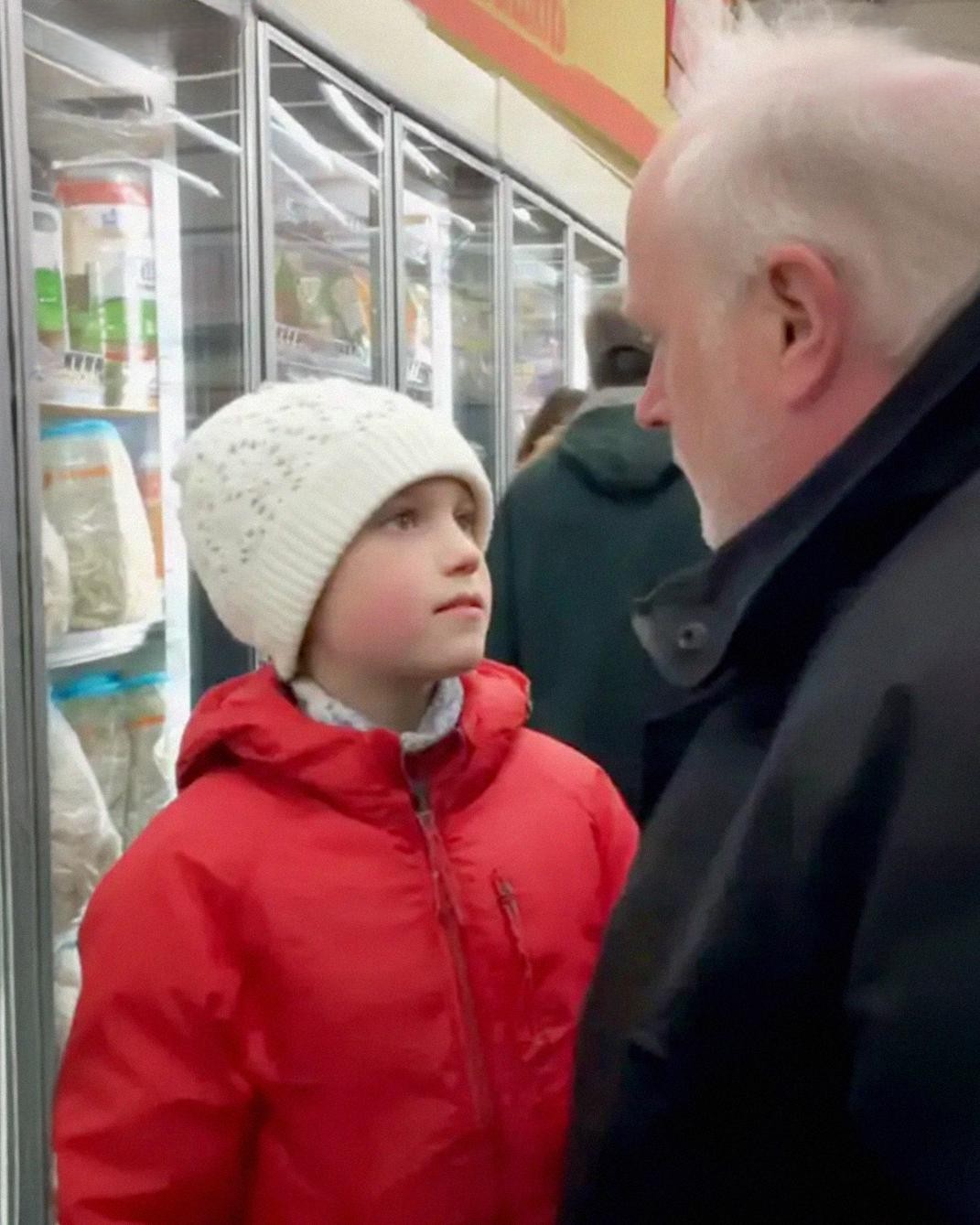
Then one afternoon, after school, Caleb and I stopped at the grocery store. He pushed the cart carefully, steering around other shoppers, while I checked a list.
And I looked up and saw my father.
He looked smaller than I remembered. Thinner. Hair completely white. The sharpness in his eyes was still there, but the years had taken something from him. I froze in the produce aisle, every old emotion rising like a reflex.
“Mom?” Caleb said, noticing my stillness.
I couldn’t speak right away.
Caleb followed my gaze and then looked back at me. “That’s your dad, right? You still don’t talk?”
“No,” I managed.
“Why not?”
I didn’t want to drop my father’s ugliness into my son’s hands. He didn’t deserve that. So I gave him the truth in a simpler shape.
“He didn’t accept our family,” I said.
Caleb stared at my father for a long moment, then nodded once, as if something clicked into place.
“Then I think I should tell him something,” he said.
Before I could stop him, he walked away from the cart and headed straight for my father.
My heart dropped so hard it felt physical.
My father turned, confused as this boy approached him with calm confidence. When he saw me following behind, his face tightened.
“What is this?” he demanded. “What are you doing here?”
Caleb didn’t answer that.
Instead, he looked up at him and said, clear and steady, “Julia is my family. She’s my mom.”
My father scoffed. “No, she isn’t. Blood matters. You’ll never be her child.”
I stepped forward, ready to pull Caleb away, ready to end it before my father could poison another moment of our lives.
Caleb lifted a hand slightly, not to stop me, but to signal he wasn’t finished.
“She’s my mom because she chose me,” he said. “My real mom left when I was little. I don’t really remember her. But Julia packs my lunches. She stays with me when I’m scared. She never leaves.”
My father’s jaw clenched. “That doesn’t make her your mother.”
Caleb’s eyes didn’t flinch.
“You’re her dad, right?” he asked.
My father nodded stiffly. “Of course.”
Caleb took a breath, then said the words that seemed to slice straight through my father’s armor.
“Then you’re supposed to choose her too,” he said. “But you didn’t. I don’t understand how someone who stopped choosing their own kid gets to decide who is a real parent.”
For a second my father looked like he’d been hit. His mouth opened, ready to argue, ready to defend himself with all the familiar logic.
But nothing came out.
His shoulders sagged. The fight drained out of him like a leak.
“I… I didn’t think of it that way,” he said, and his voice broke.
That was when I stepped forward and put my hand on Caleb’s shoulder.
“You don’t get to judge my motherhood,” I told my father. “We may not look like the family you wanted, but we are a family.”
His eyes were wet now, and the sight of it stunned me more than I expected.
“If you want to know your grandson someday,” I continued, “you’re going to have to learn what choosing someone actually means.”
I didn’t wait for promises or apologies. I didn’t chase closure. I turned the cart around. Caleb took the handle like he always did, as if the world hadn’t just shifted under our feet.
Behind us, my father called my name. Soft. Uncertain.
I kept walking.
Caleb looked up at me. “Are you okay?”
I squeezed his shoulder. “Yeah,” I said, and I meant it.
Because the truth is simple: being chosen is powerful. And choosing someone—fully, deliberately, without conditions—is what makes a family real.