A fatal shooting in Minneapolis has ignited nationwide outrage after video footage appeared to contradict the federal government’s account of events.
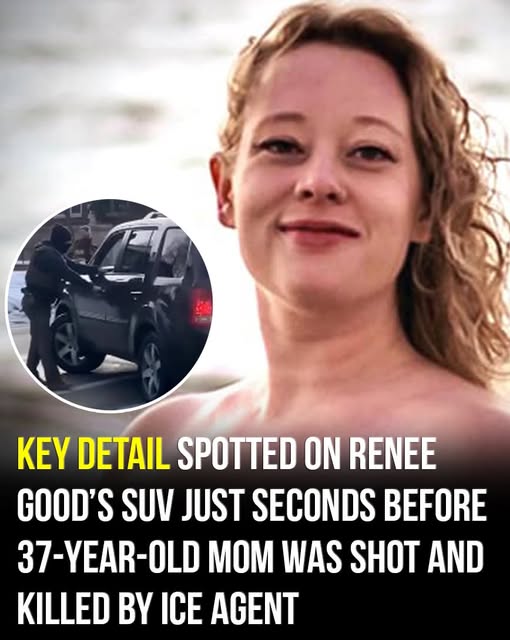
On Wednesday, 37-year-old Renee Nicole Good was shot and killed during a confrontation with federal immigration officers. The incident involved agents from U.S. Immigration and Customs Enforcement, commonly known as ICE, and unfolded in a matter of seconds. Since then, conflicting narratives have emerged, with a single detail in the video drawing intense scrutiny: the position of the wheels on Good’s vehicle at the moment shots were fired.
According to the Department of Homeland Security, Good “weaponized her vehicle” during the encounter. Federal officials went further, labeling the incident an “act of domestic terrorism,” a description later echoed publicly by Donald Trump. That framing immediately raised alarms among civil rights advocates and local officials, who said it bore little resemblance to what the video appeared to show.
Footage circulating widely on social media captures the confrontation from close range. An ICE agent is seen attempting to open the driver’s side door of Good’s SUV while other officers surround the vehicle. Seconds later, Good reverses abruptly. The SUV’s front wheels are clearly angled away from an officer standing near the front of the vehicle, not toward him.
As Good attempts to flee, the SUV clips the officer, but he is not knocked to the ground. Almost instantly, the officer fires a shot through the windshield. At least two more shots follow through the driver’s side window as the vehicle continues moving. The SUV then travels roughly 100 feet before crashing into a parked white car. The entire sequence lasts less than ten seconds.
For many viewers, that brief moment—the direction of the wheels—has become central to the debate. Critics argue it suggests panic and escape, not an intentional attempt to strike an officer. Online, frame-by-frame analyses flooded platforms within hours.
One widely shared comment read, “The wheels are fully turned away from the officer. Watch it in slow motion. No intention to hit anyone. She was trying to leave.” Others were blunter, calling the shooting “murder” and accusing agents of firing out of anger as Good tried to get away.
The backlash wasn’t confined to social media. Prominent lawmakers publicly rejected the federal narrative. Alexandria Ocasio-Cortez described the killing as a “public murder,” saying the video showed a woman being shot while trying to flee for her life. She called the incident “the manifestation of every American’s worst nightmare,” arguing that accountability was being deliberately avoided.
Minneapolis Mayor Jacob Frey delivered one of the most forceful responses. Speaking to reporters after viewing the footage, Frey flatly rejected claims of self-defense.
“To ICE, get the f*** out of Minneapolis,” he said. “They are not here to make this city safer. They’re ripping families apart, sowing chaos, and in this case, literally killing people.”
Addressing the justification offered by federal authorities, Frey added, “They’re already trying to spin this as self-defense. Having seen the video myself, that is bullsh*t.”
As officials argued, Good’s family was left mourning a woman they say has been completely misrepresented.
Her mother, Donna Ganger, described her daughter as deeply compassionate and gentle. “She was extremely caring. She took care of people her whole life,” Ganger said. “She was loving, forgiving, affectionate. She was probably terrified.”
Good was a poet, a writer, and a mother of three. Just hours before her death, she dropped off her youngest child at an elementary school in Minneapolis. The family had only recently moved to the city from Kansas City, Missouri, hoping for a fresh start.
Contrary to rhetoric portraying her as dangerous, Good was a U.S. citizen born in Colorado. She had no criminal history beyond a single traffic violation. Friends and former teachers recalled her as creative, soft-spoken, and deeply empathetic.
“She was incredibly caring of her peers,” said Kent Wascom, a former writing instructor. “Her presence made the classroom feel safe. She was someone who looked out for others.”
In the immediate aftermath, neighbors created a small memorial near the crash site, leaving flowers and handwritten signs. One note taped to a nearby door read, “NO MEDIA INQUIRES” and “JUSTICE FOR RENEE.” A video recorded moments after the shooting shows a distraught woman crying near the wrecked SUV, screaming, “That’s my wife. I don’t know what to do.”
Despite public outrage, federal leadership quickly closed ranks. JD Vance stated that the ICE agent involved would not face charges, asserting that the agent has “absolute immunity.”
Speaking to reporters, Vance said the officer was “doing his job” and dismissed criticism from Minnesota officials as politically motivated. When questioned about the state’s investigative agency being denied access to the case by federal prosecutors, Vance was blunt.
“The precedent is very simple,” he said. “You have a federal law enforcement official engaging in federal law enforcement action. That’s a federal issue. That guy is protected by absolute immunity.”
He added that any attempt to prosecute the agent would “get tossed out by a judge,” effectively shutting the door on criminal accountability before an independent investigation could fully unfold.
That response only intensified anger in Minneapolis and beyond. Civil rights groups argue that labeling a civilian’s attempt to flee as “domestic terrorism” sets a dangerous precedent, especially when video evidence appears to undermine that claim. Legal experts have also questioned the sweeping use of immunity before all facts are examined.
At the center of it all remains the video—and the wheels.
To critics, they tell a simple story: a woman boxed in by armed agents, panicking, trying to escape, not attack. To federal authorities, the interpretation is very different, and final judgment appears to have already been made.
As protests continue and demands for transparency grow louder, Good’s family is left with grief and unanswered questions. For them, this is not a political debate or a legal abstraction. It is the violent loss of a daughter, a mother, a human being.
The investigation remains officially “ongoing,” but with federal immunity asserted and state authorities sidelined, many fear accountability will never come. What remains undeniable is that a life ended in seconds, captured on video, with one small detail—the angle of a steering wheel—now standing at the center of a national reckoning over power, force, and the meaning of justice.