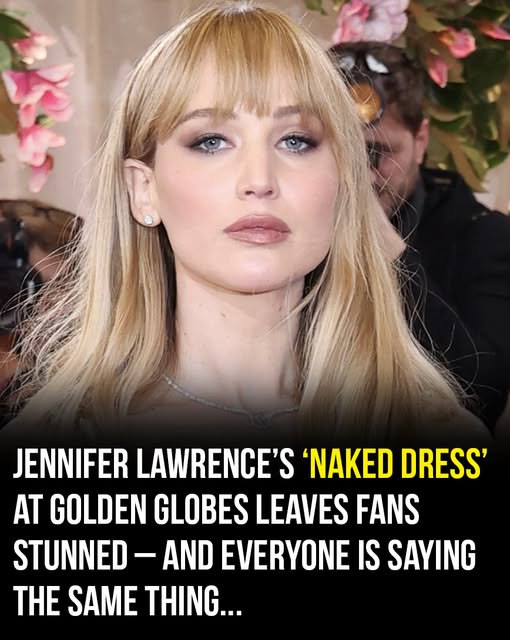
When Jennifer Lawrence stepped onto the red carpet at the Golden Globes in 2026, she didn’t just show up for the cameras. She detonated a full-blown cultural argument in real time.
Award shows are technically about trophies, speeches, and prestige, but everyone knows the real spectacle happens before anyone steps inside. The red carpet is where reputations are tested, where fashion turns into commentary, and where one outfit can hijack the entire night. This year, that outfit belonged to Lawrence.
She arrived wearing a sheer, floral-embroidered gown that was immediately labeled a modern “naked dress.” The look was daring without being crude, delicate without being timid. Still, it didn’t take long for the internet to do what it does best: split cleanly down the middle.
This wasn’t the first time a red carpet look sparked outrage masquerading as concern. Just a year earlier at the Grammys, Kanye West stood stiffly beside his then-girlfriend Bianca Censori as she dropped a fur coat to reveal a nearly transparent outfit. That moment ignited debates about control, consent, and spectacle. This time, the conversation landed squarely on Lawrence’s shoulders.
What made the reaction louder was the context. Lawrence wasn’t there just to be seen. She was nominated for Best Performance by a Female Actor for her role in Die My Love, a brutal, unflinching portrayal of a young mother in rural Montana unraveling under postpartum depression and psychosis. The performance was raw, exhausting, and deeply personal. Yet the headlines fixated on fabric, not craft.
The gown itself came from Givenchy, designed by creative director Sarah Burton. Soft pinks, ivories, and muted greens were embroidered across the sheer base, giving the dress a romantic, almost antique quality. It wasn’t aggressive. It wasn’t shocking for the sake of shock. It was intentional.
That didn’t stop the backlash.
“Maybe they should have a dress code,” one critic wrote. “Or put these shows on after kids are in bed.” The implication was familiar: women should carry the burden of other people’s discomfort, even at events built on excess and display.
Fans weren’t having it.
“The only acceptable return of the naked dress. Classy and elegant,” one supporter posted. Another cut straight to the point: “She looks great. End of discussion.”
Some responses were longer, more philosophical. One fan noted that everyone is naked under their clothes and accused critics of obsessing over trivialities instead of enjoying life. Another called it the most beautiful naked dress they’d ever seen, pointing out that Lawrence wore it with confidence rather than apology.
One particularly detailed comment framed it as the rare version of a sheer gown that actually works: socially acceptable, visually balanced, and designed to provoke imagination rather than outrage. The fan even compared it to Halle Berry’s legendary Elie Saab Oscar dress from 2002, a comparison that placed Lawrence squarely in red carpet history.
Lawrence herself seemed thoroughly unbothered.
When asked by Entertainment Tonight whether she planned to attend after-parties, she laughed and shrugged it off. “I’m going to hang,” she said. “I’m naked, I might as well.” Then she added, without missing a beat, that her kids would strongly prefer she not be there at all.
That mix of humor and blunt honesty has always been part of her appeal. She’s never tried to polish herself into something untouchable, and that carries over into how she talks about her work.
Ahead of the Globes, Lawrence also spoke openly about filming intimate scenes in Die My Love, including those opposite Robert Pattinson. In an interview with People, she admitted that not knowing her co-star well actually made those scenes easier.
“It’s kind of better that way,” she said. “Doing it with a stranger is preferable.”
She also described how things escalated immediately on set. According to Lawrence, director Lynne Ramsay wasted no time pushing boundaries. On the very first day, the actors were thrown into intense, physical scenes and then casually asked if they could do them naked. No buildup. No easing in. Just straight into the fire.
That intensity wasn’t accidental. The role hit close to home.
Lawrence has spoken candidly about experiencing postpartum depression herself after the birth of her second child. In an interview with Vogue, she explained that while she doesn’t usually carry characters home with her, this one demanded something different.
“It’s hormonal, yes,” she said, “but it’s also an identity crisis. Who am I as a mother? As a wife? As a sexual person?” She described the character as haunted by the feeling of disappearing, and admitted the only way to access that level of emotion was to draw directly from her own experience.
That context reframed the dress for many fans. What looked like provocation to critics read as ownership to others. A woman who had bared her psyche on screen had no interest in hiding her body to make strangers comfortable.
At 35, Lawrence is clearly in a transition phase, and she’s not easing into it quietly. She’s set to return as Katniss Everdeen in The Hunger Games: Sunrise on the Reaping, revisiting the role that defined her early career. At the same time, she’s stepping into darker territory with What Happens at Night, a new horror project directed by Martin Scorsese, starring opposite Leonardo DiCaprio.
The contrast is telling. Franchise icon on one hand. Prestige horror on the other. Safe nostalgia paired with creative risk.
The dress controversy will fade, like all red carpet storms do. What won’t fade is the pattern. Lawrence is no longer interested in playing agreeable, digestible, or quiet. She shows up, does the work, wears what she wants, and lets the noise burn itself out.
If the Golden Globes were meant to signal where Hollywood is headed in 2026, her appearance made one thing clear. Jennifer Lawrence isn’t dressing for approval anymore. She’s dressing like someone who knows exactly who she is and doesn’t need permission to take up space.
Leave a Reply