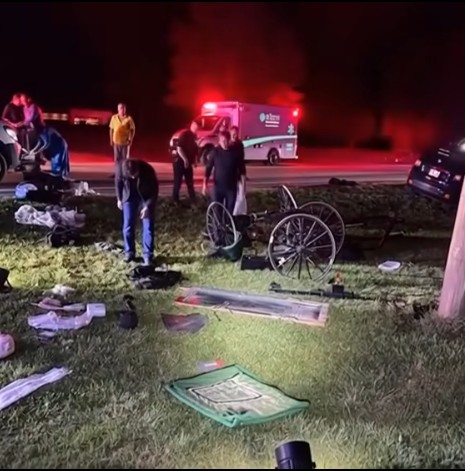
A quiet October night in rural Indiana turned violent in seconds when a Jeep slammed into a horse-drawn Amish buggy on State Road 218 near Berne. What should have been a peaceful ride home for one family became a chaotic emergency scene stretching across the dark highway. First responders were called out just after 11:20 p.m. on October 7, and what they found was grim: a shattered buggy torn apart across the pavement, debris scattered in every direction, and a Jeep crumpled in a ditch.
The buggy had been carrying nine people — a heavy load even on a good day, and a deadly vulnerability on a rural highway at night. Seven of the occupants were injured badly enough to require medical care. Six of them were juveniles, though specific ages varied depending on the early reports. The driver of the buggy, 32-year-old Ruben L. M. Schwartz of Berne, suffered the most severe injuries. He was airlifted to Lutheran Hospital, a sign of how urgent his condition was. Joseph L. M. Schwartz, age 20, and five children were taken by ambulance to Parkview Hospital. Two other passengers — 32-year-old Saraetta L. Schwartz and a 2-year-old child — declined medical treatment at the scene, shaken but physically stable.
According to Adams County Sheriff Dan Mawhorr, the Jeep was driven by 33-year-old Bradley J. Ocilka of Burlington, Kentucky. He had been traveling eastbound when he struck the buggy from behind. Buggies move slowly, especially at night, and without the bright lights modern vehicles rely on, they can be difficult to spot. Ocilka was taken to the hospital to undergo a legal blood draw but refused any further medical treatment. As of the initial reports, no charges had been filed, though investigators emphasized that their work was far from finished.
Within minutes of the crash, the scene was crowded with flashing lights from multiple agencies. Adams County EMS, Berne and Geneva police departments, the Berne Fire Department, Wells and Jay County EMS, Indiana State Police, and the Lutheran Hospital Flight Team all responded. The rural road became a temporary command center as crews worked with speed and focus, assessing injuries, stabilizing patients, and clearing the roadway. First responders described the scene as chaotic — a mix of twisted metal, splintered wood, a frightened horse, crying children, and panicked adults trying to understand what had just happened.
Photos released later paint a stark picture: the buggy splintered and broken, wheels twisted, pieces of wood and personal items littering the asphalt. Emergency vehicles lined the road, their lights casting harsh red and blue flashes across the dark farmland. These roads are familiar to the large Swiss-Amish community in Adams County — routes used daily for school, work, worship, and family visits. A crash like this ripples through the entire settlement, touching not just a single household but an extended network of relatives and neighbors who share responsibilities, traditions, and support systems.
Anyone who has spent time in Amish country knows that late-night travel by buggy is always a risk. Modern vehicles often underestimate how slow a buggy moves or how little margin for error exists on narrow rural highways. Safety experts repeat the same warnings year after year: slow down, increase following distance, and expect sudden changes in speed when approaching a buggy. At night, reflective markers, lanterns, and small battery lights help, but they are no match for distracted or fast-moving drivers.
This accident serves as another grim reminder of the vulnerability of horse-drawn vehicles in a world built for speed. One driver misjudges a distance, becomes inattentive, or simply fails to see the buggy in time — and suddenly a family’s entire world collapses in seconds. The Amish themselves accept the risks as part of their way of life, but every crash cuts deep, especially in a community where family bonds run strong and children outnumber adults.
In the immediate aftermath, neighbors began to gather information and offer support. In Amish communities, help arrives quickly — meals prepared, chores taken over, children watched, and emotional support offered with quiet steadiness. The Schwartzes, like many Amish families struck by tragedy, won’t face recovery alone. The network around them will tighten, and while the pain is heavy, no one will carry it without hands reaching out to help.
Authorities are still piecing together what happened. Crash reconstruction, witness interviews, vehicle analysis, and blood test results all take time. Early reports noted that no charges had been filed yet, but that is common in the first phase of an investigation. Officials stressed that they would release updates as more information becomes available.
For people living in the area, the message from law enforcement and community leaders is simple: slow down. Buggies will always be on these roads. They will always move at a pace that frustrates impatient drivers. But frustration is not a justification for risk. A moment of caution can prevent a lifetime of consequences. For residents who want to help the affected family, local churches and community organizations may coordinate support or establish recovery funds. Whatever you choose to give — meals, money, or prayers — respect the family’s need for privacy as they navigate grief, fear, and uncertainty.
The Schwartzes face a long road ahead. Physical injuries will take time to heal. Emotional wounds may last longer. Children thrown from a buggy in the dead of night don’t forget the terror easily. Adults carrying the responsibility of keeping those children safe bear their own heavy weight of guilt, even when they did nothing wrong.
But if there is one thing rural Indiana knows well, it’s how to rally when tragedy hits close to home. The Amish community will handle the internal emotional load; the English community around them has already begun offering support in the ways they can. Crashes like this pull people together — not out of curiosity, but out of recognition that on roads like these, anyone can become a victim in an instant.
The investigation continues. Charges may follow, or they may not. But whatever the outcome, the message remains unchanged: when you share the road with buggies, slow down, pay attention, and give more space than you think you need.
Lives depend on it — as this family learned in the hardest possible way.
Leave a Reply