The prom dress arrived the day after Gwen’s funeral.
I stood on the porch holding a cardboard box that felt much heavier than it should have. The shipping label blurred as tears filled my eyes again. We had buried my granddaughter just the day before, and I had convinced myself the hardest part was already behind me.
I carried the box inside and placed it gently on the kitchen table, as if it might break. For a long time I couldn’t open it. I simply sat there staring at it, thinking about how quickly a home can change—from full of laughter to painfully quiet.
Gwen had been my whole world for years.
When she was eight, her parents—my son David and his wife Carla—were killed in a car accident. One moment Gwen had a family of three. The next, it was just the two of us trying to understand a life that suddenly made no sense.
For months she cried herself to sleep. I would sit beside her bed, holding her hand until her breathing finally slowed. My knees protested every trip up the stairs, but I never let her see that. If she needed something steady, I was determined to be that for her.
About six weeks after the accident, she walked into the kitchen while I was making toast. Her hair was messy and her eyes were swollen from crying.
“Don’t worry, Grandma,” she said quietly. “We’ll figure it out together.”
And somehow, we did.
Over the next nine years we built a life from simple routines—Friday movie nights, Sunday grocery trips, and long dinners where she told me about school, friends, and her plans for the future. I believed I understood everything happening in her heart.
I didn’t realize how much she had kept to herself.
The doctor later told me her heart had simply stopped.
“She was only seventeen,” I kept repeating, as if saying it enough times might somehow change the truth.
He explained that some young people live with hidden heart rhythm disorders that show very few warning signs. Stress or fatigue can trigger a serious event without anyone realizing the danger beforehand.
After that conversation, my mind replayed every memory. Had she seemed tired? Had I missed something important?
Those thoughts stayed with me when I finally opened the box.
Inside was the most beautiful prom dress I had ever seen.
The fabric was deep blue, shimmering like water under moonlight. The skirt flowed softly, and every seam looked carefully stitched. It was the kind of dress you buy when you believe the night will matter.
And Gwen believed it would.
In the months before she died, prom was one of her favorite topics. During dinner she would scroll through pictures on her phone, comparing dresses and colors like an expert.
“Grandma,” she said once, “it’s the one night everyone remembers.”
I asked her why it mattered so much.
She shrugged and tried to sound casual.
“Even if the rest of high school is terrible, at least you get one perfect night.”
Two days after the dress arrived, I sat staring at it in the living room when a strange thought came to me.
I couldn’t give Gwen her prom night.
That was impossible.
But maybe I could make sure she wasn’t completely absent from it.
Standing in front of the mirror wearing a teenager’s prom dress at my age felt ridiculous at first. My hair was gray and my shoulders softer than they once were.
But when I turned and watched the skirt move, something unexpected happened.
For a moment it felt like Gwen was standing beside me.
In my imagination I heard her voice:
“Grandma, you look better in it than I would.”
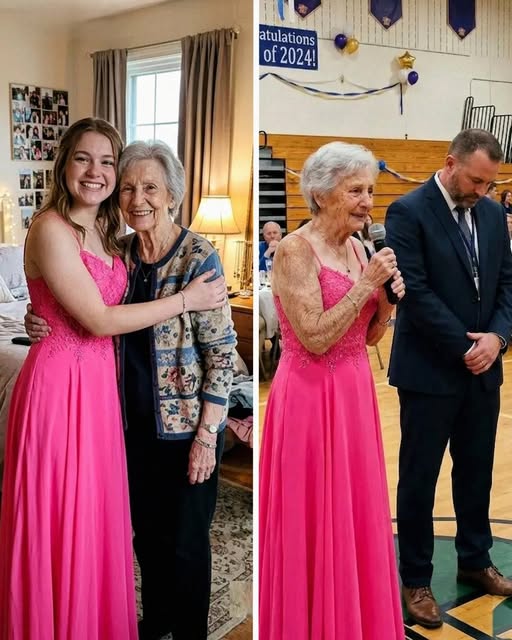
On prom night, I drove to her high school wearing the blue dress.
The gymnasium glowed with string lights and silver decorations. Students in tuxedos and glittering gowns filled the dance floor while parents stood along the walls with phones raised.
When I walked in, the room slowly quieted. Some students stared, unsure what to make of it.
I heard someone whisper, “Is that someone’s grandma?”
I swallowed and reminded myself: She deserves to be here.
I stood near the wall watching the dance floor when I felt something pressing against my side.
At first I thought the lining had caught on something. But when I shifted, I felt the sharp edge again—like cardboard hidden inside the dress.
I stepped into the hallway and felt along the seam near my ribs. There was something tucked inside.
Carefully, I opened a small gap in the lining and pulled out a folded piece of paper.
I recognized the handwriting immediately.
The first line nearly made my knees buckle.
“Dear Grandma, if you’re reading this, I’m already gone.”
Leaning against the wall, I continued reading with trembling hands.
Weeks earlier, Gwen wrote, she had fainted at school. A doctor suspected a heart rhythm condition and wanted more tests.
But she never told me.
She wrote that she remembered how hard life had been after we lost her parents. She didn’t want our final weeks together filled with fear, hospital visits, or worry.
So she carried the fear alone.
And she hid the letter in her prom dress because she believed that one day, somehow, I might wear it.
When I finished reading, I folded the note and walked back into the gym.
The principal was speaking on stage, but I barely heard him. I walked forward, climbed the steps, and quietly asked for the microphone.
The room fell silent.
“My granddaughter Gwen should be here tonight,” I said.
I told them about her excitement for prom. I told them about the letter she left and how she hoped that if she couldn’t attend, the person who loved her most might wear the dress for her.
By the time I finished, tears filled the room. Students wiped their faces. Parents lowered their phones.
For a moment, the night wasn’t about dancing anymore.
It was about love.
The next morning my phone rang.
A woman introduced herself as the seamstress who had made the dress. Gwen had visited her shop shortly before she died and asked her to sew the letter into the lining.
“She told me her grandmother would understand,” the woman said softly.
I looked at the dress draped over a chair in my living room, its blue fabric glowing in the morning light.
Gwen had trusted me with her heart for years.
Even in the end, she believed I would know what to do with what she left behind.
And somehow, through all the grief, she was right.