At sixty-two, Anne believed the narrative of her life had long since moved into its final, predictable chapters. As a high school literature teacher for nearly forty years, her world was defined by the comforting, if exhausting, cadence of the academic calendar: hall duty, the analysis of Shakespearean tragedies, and the endless sea of essays that seemed to multiply on her desk overnight. December was her favorite month, not for the promise of miracles, but for the subtle softening of her teenage students. Every year, she assigned a holiday interview project, asking students to engage with an older adult about a meaningful memory. She never expected that this year, the assignment would turn its inquisitive lens back toward her own buried past.
The catalyst for this shift was Emily, a quiet but perceptive student who insisted on interviewing Anne. Despite Anne’s protests that her memories were mundane, Emily’s steady gaze and her comment that Anne “made stories feel real” won her over. The interview began with safe, nostalgic anecdotes about leaning Christmas trees and burnt fruitcakes, but Emily soon ventured into deeper waters. She asked if Anne had ever experienced a holiday love story. The question struck a dormant nerve, unearthing the memory of Daniel—the boy Anne had loved with the fierce, stupid bravery of a seventeen-year-old.
Daniel had been her inseparable half in a world of domestic instability. They had shared dreams of California sunrises and new beginnings, promises made with no money but infinite hope. Then, overnight, he was gone. A financial scandal involving his family had forced them to vanish under the cover of darkness, leaving Anne with no goodbye and a silence that lasted four decades. She told Emily the “cleaned-up” version of the story, insisting that she had moved on. But as Emily left, Anne felt a long-sealed door beginning to creak open. The past was no longer a closed book; it was a living, breathing ache that the cold December air seemed to sharpen.
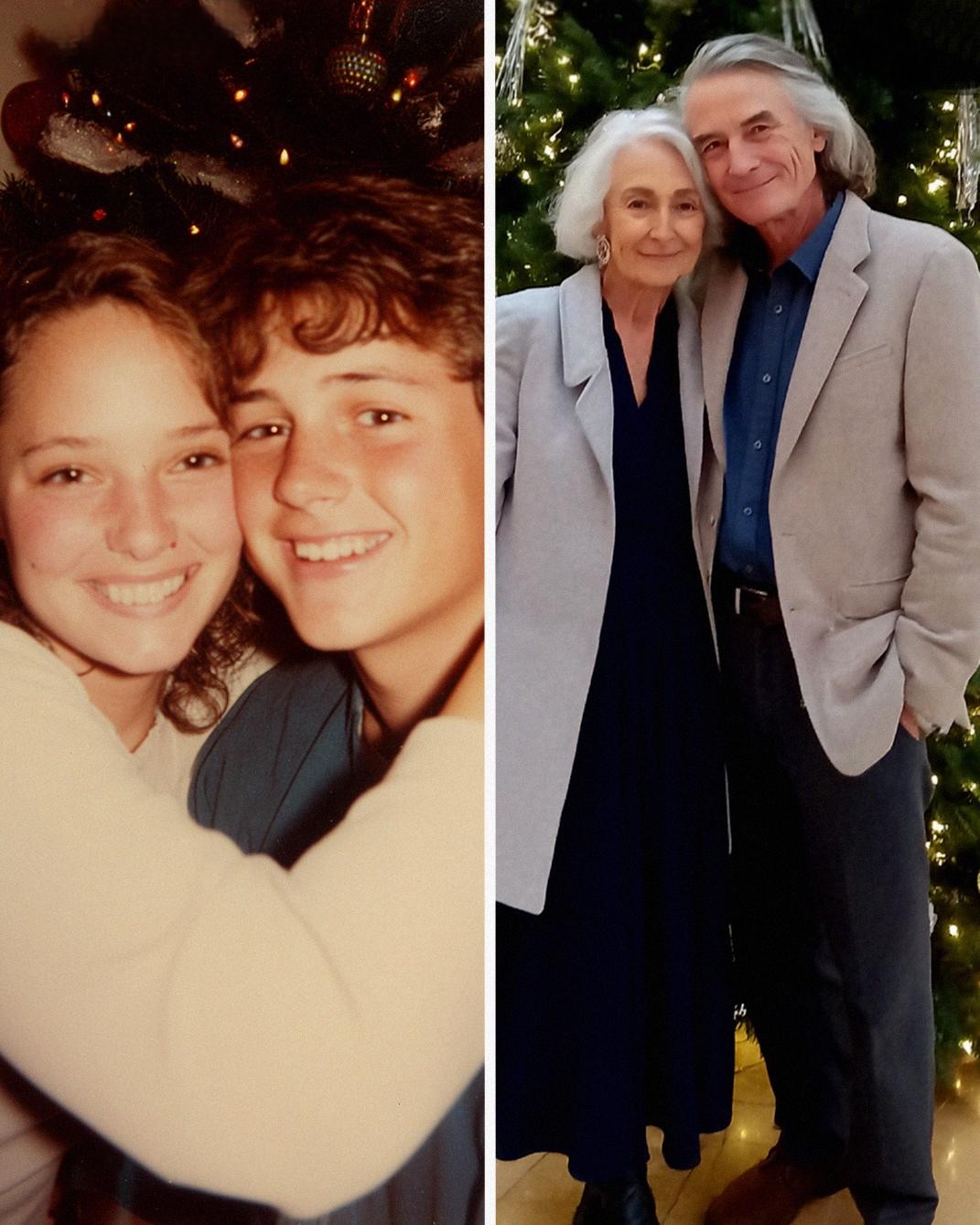
A week later, the academic routine was shattered when Emily burst into the classroom, breathless and clutching her phone. She had found a post on a local community forum titled, “Searching for the girl I loved 40 years ago.” The post described a seventeen-year-old girl with a blue coat and a chipped front tooth—a girl who wanted to be a teacher. Attached was a photograph of a young Anne, laughing in that very coat, with Daniel’s arm draped protectively around her shoulders. The realization hit Anne with the force of a physical blow. Daniel hadn’t just been reminiscing; he had been searching for her with a persistence that spanned forty years.
With Emily’s tech-savvy assistance, a meeting was brokered. Anne found herself navigating a whirlwind of teenage-like anxiety, rejection-checking her wardrobe and even visiting a hairdresser. The meeting was set for a Saturday at two o’clock in a small café near the park. As Anne drove there, she was haunted by the fear that time had been too cruel, or that the past was a prettier fiction than the present truth. However, when she stepped into the café, she saw him immediately. Though his hair was now silver and his face bore the intricate lines of a life lived, his eyes remained unchanged—warm, attentive, and slightly mischievous.
The conversation that followed was a delicate bridge between two lifetimes. Daniel explained the shame that had kept him away; his father’s crimes had made him feel “dirty” by association, and he had vowed to build a life of his own merit before seeking her out. He had spent decades following dead ends, frustrated by Anne’s name changes following her marriage to Mark—a marriage that had ended when her husband left her for another woman after twenty years. They sat as two people with “ordinary damage,” acknowledging the separate lives they had built and the scars they carried.
Then came the moment that transcended mere conversation. Daniel reached into his coat and produced a locket—the very one Anne had lost forty years ago, containing the only photographs of her deceased parents. It had been packed in his family’s hurried exit, and he had guarded it for four decades as a physical promise to find her. Opening the locket and seeing her parents’ smiles, untouched by the passage of time, Anne felt a weight lift that she hadn’t realized she was carrying. Daniel wasn’t asking to redo their youth; he was asking for a chance to see what remained for them in the autumn of their lives.
On the following Monday, the secret was shared with Emily at her locker. The student’s joy was a bright spot in the crowded hallway, a reminder that stories do, occasionally, have the grace to come full circle. Anne stood in the hallway, no longer just a teacher of literature, but the protagonist of a story she hadn’t dared to write. At sixty-two, she realized that hope is not the exclusive province of the young. With her parents’ locket in her pocket and the memory of Daniel’s smile in her mind, she understood that she wasn’t stepping back into the past. She was stepping through a door that she thought had been boarded up forever, ready to discover whatever lay ahead in the twilight of the year.
This reunion served as a profound reminder of the “Quiet Reset” that life can offer when least expected. It proved that the foundations of the heart are often more resilient than the circumstances that try to bury them. Anne’s journey from a lukewarm tea-drinking teacher to a woman rediscovered by her first love highlighted a beautiful, human truth: that it is never too late for a “Polar Star” to guide one back to a sense of belonging. The locket was home, and so, it seemed, was Daniel.
As the winter break approached, the school hallways felt different to Anne. The stories she taught no longer felt like distant fictions, but like echoes of the very reality she was living. She had spent her career helping teenagers find the “realness” in stories, only to find that her own life possessed a narrative arc more poignant than any she had assigned. The connection she forged with Emily, and the subsequent restoration of her past with Daniel, created a legacy of kindness and persistence that would linger in the halls of the school long after the final bell of the year had rung. Anne was 62, and for the first time in forty years, she was exactly where she was meant to be.