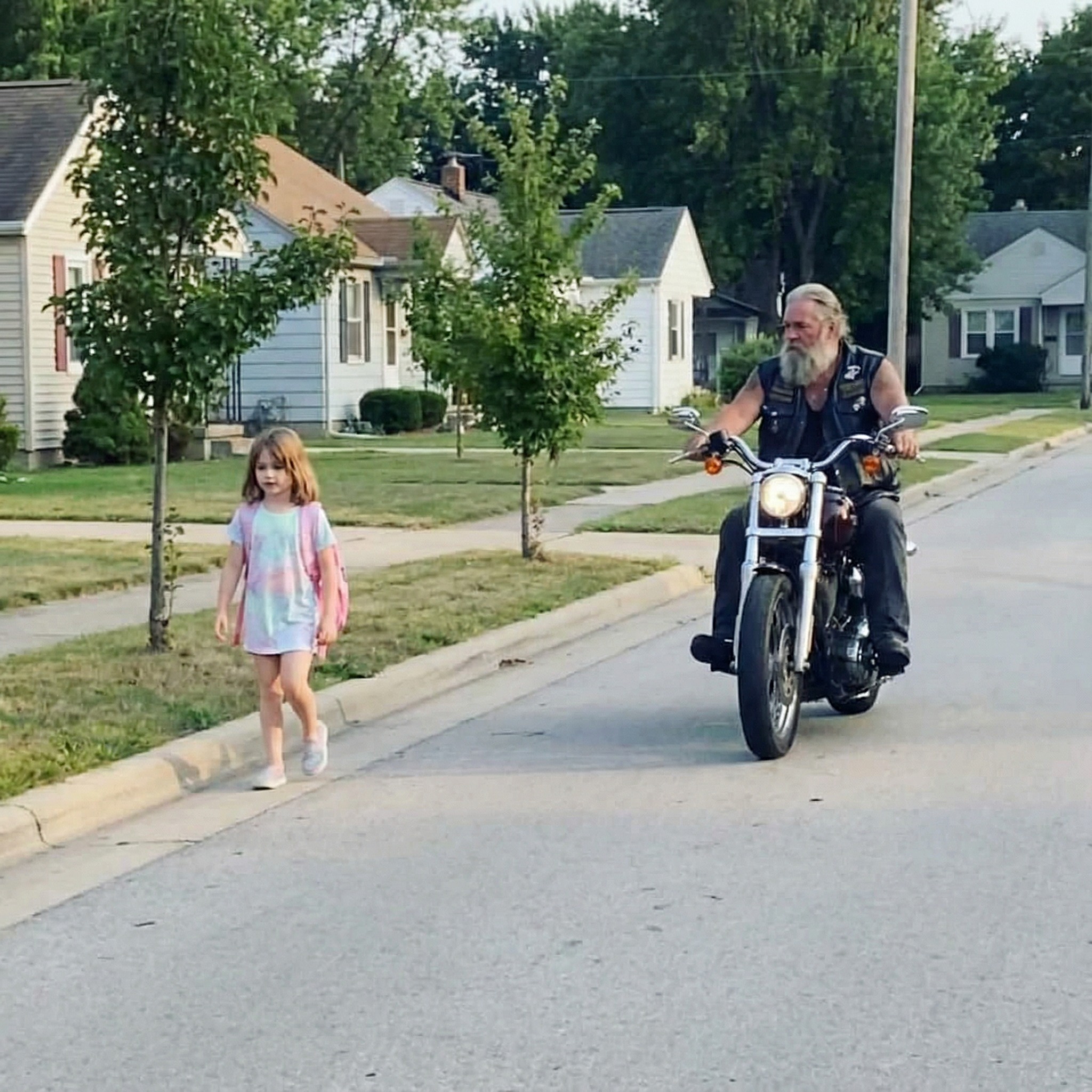
For three long weeks, a heavy sense of unease had settled over my neighborhood in the quiet suburbs of Riverside. It started with a low, rhythmic thrum—the unmistakable vibration of a heavy motorcycle engine idling just out of sight. I began to notice him every afternoon: a massive figure on a black Harley-Davidson, trailing my eight-year-old daughter, Lily, as she walked the four short blocks from her elementary school to our front door. He was always there, maintaining a disciplined fifty-foot gap. When Lily stopped to adjust her shoelace or look at a flower, the bike would slow to a crawl or pull to the curb. He never approached her, but he never left her side until she was safely behind our locked door.
My neighbor Karen, a woman who made it her business to know everyone’s business, confirmed my fears. She stood on her porch one Tuesday, clutching her sweater tight against her chest. “Sarah, that man in the leather vest is back,” she hissed. “He looks like he’s part of some dangerous gang. He’s been stalking Lily every single day. You need to call the police before something unthinkable happens.” As a single mother who had raised Lily alone since her father walked out six years ago, my protective instincts were already tuned to a high frequency. I didn’t want to wait for a 911 dispatcher to prioritize my call. I wanted to confront the threat myself. I wanted this man to look into the eyes of a mother who had everything to lose and realize he had chosen the wrong family to target.
That Thursday, I took half a day off work, parking my car in a strategic position where I could watch the school gates. At 3:00 PM sharp, the bell rang, and Lily emerged, her bright pink backpack bobbing with every step. My heart hammered against my ribs when, thirty seconds later, the black Harley rumbled to life across the street. The rider was imposing—easily six-foot-three and broad-shouldered, wearing a weathered leather vest adorned with patches. A thick, salt-and-pepper beard flowed down his chest. He looked like every cinematic villain I had ever been taught to fear.
I followed them in my car, creeping along at a distance. I watched him pull over and pull out a phone when Lily stopped to pet a neighbor’s cat. This was the moment. I accelerated, swerved my car in front of his motorcycle, and jumped out before the engine had even fully cut out. “Hey! You!” I screamed, my voice cracking with a mixture of adrenaline and terror. “What the hell do you think you’re doing following my daughter?”
The biker looked up, and for a split second, I expected a snarl or a threat. Instead, I saw eyes that were deeply weary, etched with a profound, lingering sadness. He didn’t reach for a weapon or rev his engine to escape. He simply sighed, a sound that seemed to carry the weight of a hundred tragedies. “Ma’am, I can explain,” he said, his voice a gravelly baritone. I wasn’t having it. I pulled out my phone, my thumb hovering over the emergency dial. “Explain what? That you’ve been stalking an eight-year-old? I’ve seen you every day. I’m calling the cops right now.”
“Please,” he said, holding up a steady hand. “Give me two minutes. If you still want to call them after that, I’ll sit right here on this curb and wait for them to handcuff me. But your daughter is in grave danger, and it isn’t coming from me.” His sincerity was disarming. I lowered the phone slightly, but kept my finger on the screen. “What are you talking about?”
He reached slowly into his vest and pulled out a smartphone, swiping through a gallery until he found a specific photo. He held it out to me. It was a professional headshot of a clean-cut man in a suit, smiling warmly. “Do you recognize him?” My blood turned to ice. It was David Chen, the popular new teacher’s aide who had started at Riverside Elementary three weeks ago. “How do you know Mr. Chen?” I whispered.
“His name isn’t Chen,” the biker said, his jaw tightening. “It’s David Carpenter. He’s a high-level registered sex offender from Minnesota who served four years for an attempted abduction. He changed his identity, forged his teaching credentials, and moved here to start over. The school’s background check only looked for ‘David Chen,’ and that man has a clean record because he doesn’t exist.” He swiped to the next photo: a grainy mugshot of the same man, younger but unmistakably the same person.
I felt the world tilting. My legs felt like they were made of water. “How do you know this? Who are you?”
“My name is Marcus Thompson,” he replied. “I’m part of BACA—Bikers Against Child Abuse. We received a tip from an old contact in Minnesota who recognized Carpenter at a grocery store here. We alerted the local authorities three weeks ago, but because of the name change and the jurisdictional red tape, the police said their hands were tied until they could prove his identity. We couldn’t just sit back and wait for him to snatch a child while the paperwork processed.” He explained that he and five other members of his chapter had been taking shifts, guarding the three girls Carpenter seemed most interested in. Lily was at the top of that list.
Marcus swiped to one final photo, and this one made me physically ill. It was a long-lens shot of my own house. My daughter’s bedroom window was circled in red digital ink. “We found this on a device in his car this morning while he was inside the school,” Marcus said. “He’s been documenting your work schedule. He knows you’re a single mom. He was planning to move on Monday, during the early release for the teacher’s meeting.”
With trembling hands, I dialed 911. This time, Marcus stayed by my side, providing the dispatchers with the precise evidence his group had gathered. Within an hour, the quiet street was a sea of blue and red lights. The police arrested “Mr. Chen” on the school grounds. A subsequent search of his apartment revealed a “predator’s kit”—zip ties, sedatives, and a notebook detailing Lily’s every move. The detective told me later that without Marcus and his brothers, Lily would have been gone by Monday evening.
As I stood in the police station later that night, I saw Marcus sitting on a bench in the lobby, his large frame hunched over, his head in his hands. I approached him, overcome with a debt I could never repay. “You saved her,” I said softly. He looked up, and I saw tears in the eyes of the man I had labeled a monster. He told me about his own daughter, Emma, who had been taken years ago. Though they found her, the trauma had been a poison she couldn’t outrun, and she had taken her own life at fourteen. “I couldn’t save my Emma,” he choked out. “I spent the rest of my life promising I’d save someone else’s.”
I realized then how profoundly wrong I had been. I had judged a man by his leather vest and his scars, while the true monster was wearing a tie and a smile in a classroom. A few days later, Marcus and his fellow bikers came over for a “thank you” lunch. My living room was filled with massive, tattooed men who looked like they belonged in an action movie, but they sat on my floor playing board games with Lily and drinking apple juice. Lily gave them a drawing of a motorcycle with wings.
The experience changed our lives and our community. The school now partners with BACA for safety workshops, and Marcus is a regular fixture at our local park, no longer a shadow in the distance but a recognized guardian. I learned that day that protection doesn’t always look like a badge or a uniform. Sometimes, it looks like a black Harley-Davidson and a man who refuses to let another child face the darkness alone. Every night, when I tuck Lily in, I think of the biker who followed her home, and I thank God for the angel who wore leather instead of wings.