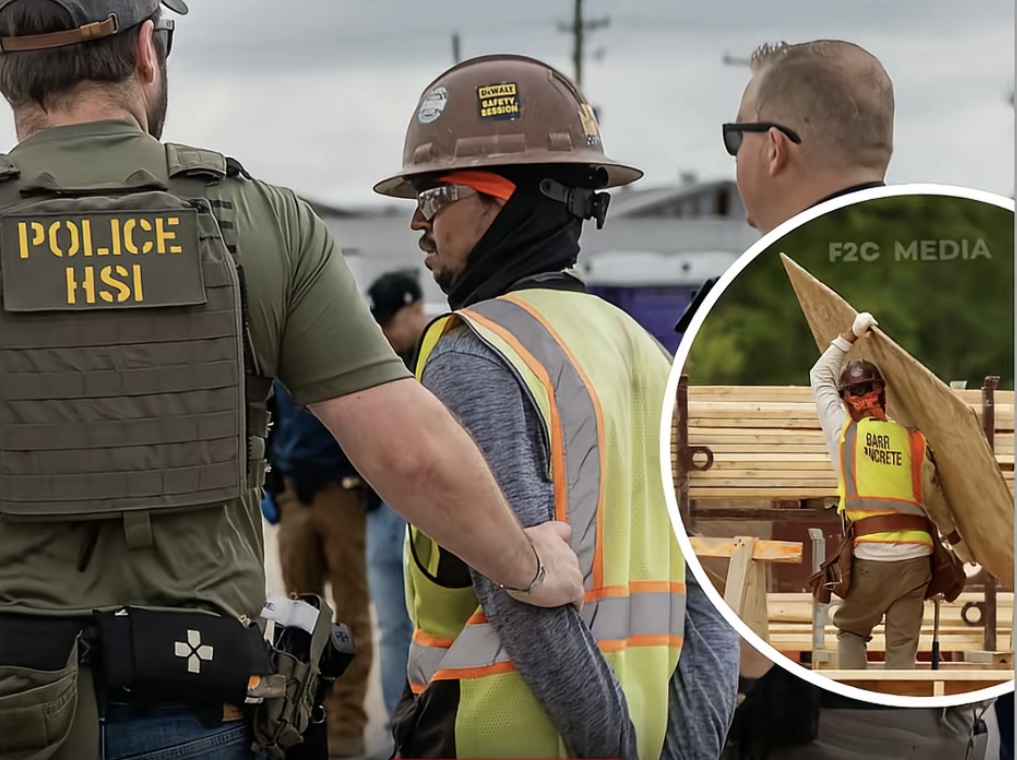
A construction job that was supposed to last just a few days has now turned into one of the most talked-about controversies online, after a group of immigrant workers were suddenly detained by federal immigration agents at the very site where they had been hired to work.
According to reports circulating widely across social media, a homeowner identified as Karen Treviño allegedly hired six undocumented workers to complete renovation work estimated to be worth around $10,000. The men reportedly spent several days working on the property, carrying materials, installing structures, and performing demanding construction tasks under the assumption they would be paid once the project was completed.
But what happened next shocked many people following the story.
On what was reportedly the final day of the project, immigration enforcement officers from ICE (U.S. Immigration and Customs Enforcement) arrived at the location and detained the workers. Witnesses say the agents approached the job site while the men were still working, leading to their immediate arrest.
The incident quickly spread across social media after photos and videos from the scene began circulating online. In several posts, users claimed the homeowner herself had contacted authorities after the work was finished, effectively reporting the very workers she had hired.
The story sparked a massive wave of outrage online, with many commenters accusing the homeowner of exploiting vulnerable workers and then using immigration enforcement to avoid paying them.
Supporters of the workers argued that the situation highlights a broader issue that undocumented laborers often face in the construction industry — performing physically demanding jobs with little protection if disputes arise.
However, the situation is not entirely clear.
Some reports indicate that the homeowner has denied making the call to ICE, and immigration officials have not publicly confirmed who alerted authorities to the workers’ presence. ICE operations sometimes occur as part of broader enforcement actions in specific areas, which means the arrests may not necessarily have been triggered by a single complaint.
Despite the uncertainty surrounding the exact details, the story has reignited debate across the United States about immigration enforcement, labor rights, and the vulnerability of undocumented workers who often take on jobs that others are unwilling to do.
For many observers, the incident raises a troubling question: if workers can be detained at the very job sites where they were hired, who is responsible for protecting them from exploitation?
As the story continues to circulate online, it remains unclear whether any legal consequences will follow or whether the workers involved will ever receive compensation for the labor they performed.
What is clear, however, is that the incident has struck a nerve — sparking a national conversation about fairness, responsibility, and the human cost behind America’s construction workforce.